Monday, 18 March 2019


Hello all,

You may have noticed that this post is one week early. There's a good reason for that. I will be so busy next week that I will not have time for the blog. Some of you will already know that The Melbourne International Flower and Garden Show (MIFGS) will be on from Wednesday 27th March until Sunday 31st March.  As with previous years, I will be taking part in the Baptcare Shop Window Competition. We have three days for setting up before the opening. On Sunday, the last day, at 11.30 there will be Ikebana demonstrations on the main stage by members of Ikebana International. I will be the Sogetsu demonstrator.

Ikebana will be very well represented in the Great Hall this year because the Iemoto (Head of School) of the Ichio School, Naohiro Kasuya, will be here to produce a very large display, with the assistance of II members.

Last week the Ikebana International Melbourne Chapter celebrated its 60th Anniversary. The meeting was well attended and the delicious fruit cake made by Marj Campkin-Smith was enjoyed by all, especially me!

I was particularly happy and grateful at that meeting because I was the first winner of the raffle making me the owner of the beautiful vase, above. It was a very generous donation by Joshua Longmore from Made In Japan.

Like a child with a new toy, I couldn't wait to come home and 'play' with it. The curved agapanthus stems suited the shape of the container and the yellowing seed head picked up the colour of the rim of the container. The unobstructed, clear view of the water was particularly pleasing to me.


For the meeting, my arrangement, above, began with the crucifix orchids, which were the only undamaged flowers in my garden. Their very thin stems meant that I could use them in this vase, which has a very small opening. I then looked around for accompanying material, settling on the spent sunflowers and taro leaves. For more photographs of the members' arrangements, click on II Melbourne.

At our last class I had set the theme 'Composition Expressing a Movement'.

Lucy's arrangement viewed from above - 'Swirling'. She used weeping willow
Nicole went with 'Leaning'. She used agapanthus and Belladonna lilies
Unfortunately, the photo doesn't show how far the agapanthus are leaning forward
Vicky depicted 'Wrestling'. She used red geraniums to represent blood on the
very aggressive looking agave
I, also, used agave but in a very different way with one garlic flower.
My movement is 'Poking' 

Shaneen's arrangement addresses the theme "Curved and
Straight Lines.She used umbrella grass stems, flax and sedum
As I was looking through the agapanthus bed for materials, I came across two interestingly bent stems. Now, I often create the curves myself but in this case nature gets all the credit. As I held them and looked at them, the arrangement came to life. So, when putting them in this self-made container, I took some pains to make sure that the stems rose from the middle of the vase and did not lean against the edge. I was happy with the result. Later, as I walked passed it a few times, it seemed a tad too simple. I looked around for something suitable to add and found this old wisteria vine that was sprayed black. Personally, I still prefer the first version. You can decide which you like better.


Bye for now and, maybe, I'll see you at the Show,
Emily


Sunday, 10 March 2019


Hello all,
Last week I had the pleasure of introducing ikebana to the U3A Mornington Group as part of their "That was Then" 2019 history program.

I had been contacted by Gus van der Heyde late last year and was asked to do this presentation. Of course I agreed and, when the time came, I 'dragged' the ever accommodating Lucy along as my assistant.

We had a very pleasant morning demonstrating to a group that was appreciative, interested and engaged. It's quite different demonstrating to a group that knows nothing about ikebana or floral art. I needed to select appropriate arrangements that are varied in style, size, materials and containers. The difficulty that I faced was the scarcity of materials that had not been destroyed by the extremely hot weather we had experienced. It just meant that I had to be more creative with the materials I had.

Below are photographs of the eight arrangements I did that morning. I had to dismantle the arrangements to bring them home and then re-arrange them in order to photograph them. My apologies to the attendees if there are slight differences from the original. It is almost impossible to recreate an arrangement exactly.

I used squiggly grass and small roses. The theme is 'Paying
Attention to the shape of the Container'
A single philodendron leaf in a tall glass
container

Contorted Hazel (Corylus avellana 'Contorta', hydrangeas and
Kniphofia uvaria


Japanese Maple and Altissimo roses In a ceramic 'basket'


The stripped umbrella is the unconventional material in this
arrangement. Crab apples, iceberg roses and amaranthus
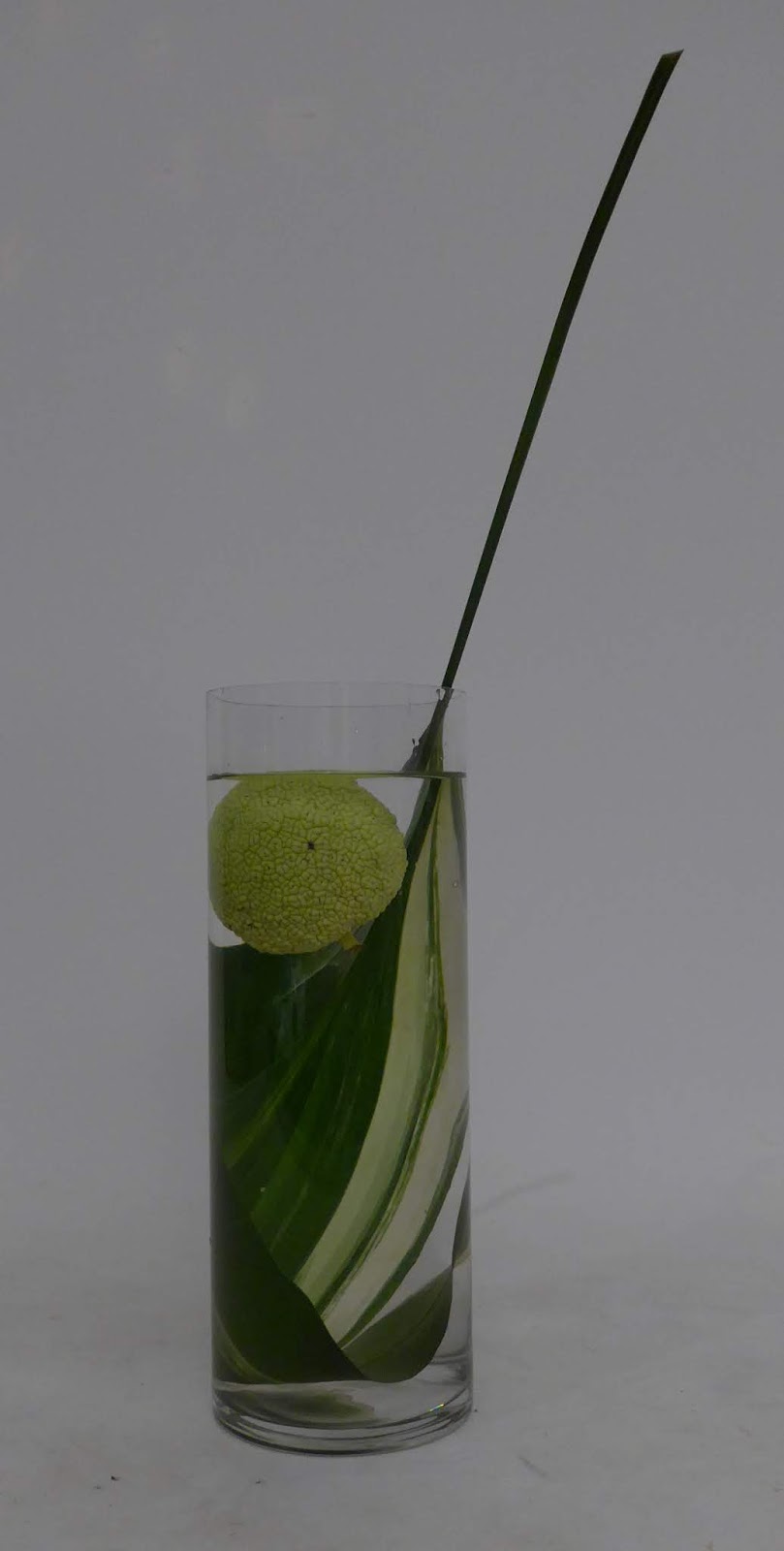
Variegated aspidistra and an osage orange
(Maclura pomifera)
Agapanthus seed heads in stainless steel containers


Part of a philodendron leaf and a belladonna
flower


Bye for now,
Emily

Monday, 25 February 2019

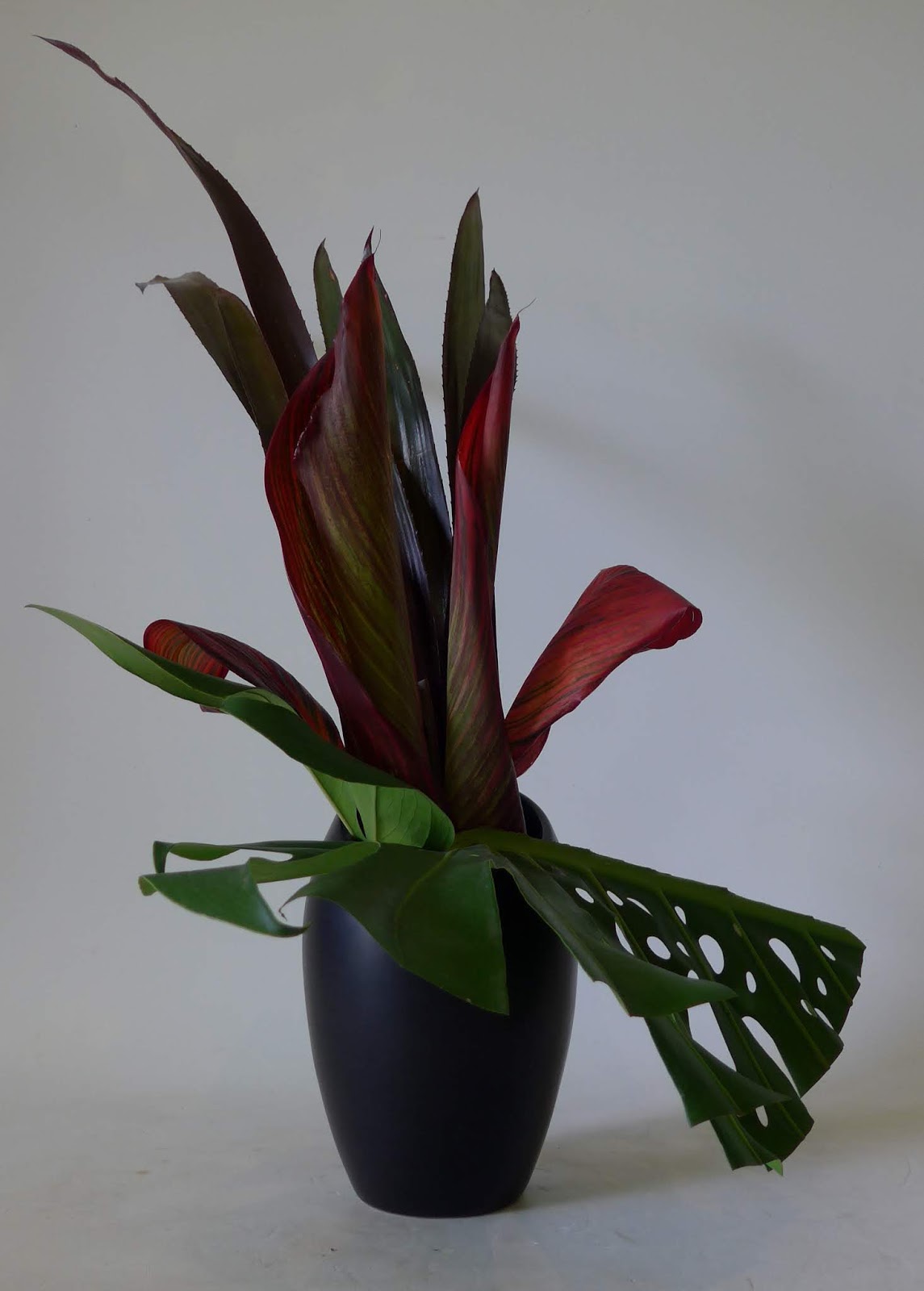
Bromeliad flowers courtesy of my generous neighbour, Thomas
Hello all,
It's been a busy time ikebana wise lately. We had our first Ikebana International meeting for the year and a week later, we had our Sogetsu Annual General Meeting and workshop.

At the II meeting we enjoyed a talk on Sumi-e (ink brush painting) by Emi Kamataki, who is a very experienced practitioner of this ancient art form.

Before Ms Katamaki's very informative talk, the members were asked to make an arrangement using the theme Japanese Art Work/Sumi-e.

The first Japanese art work that came to mind for me was the giant yellow pumpkin on Naoshima island by Yoyoi Kusama. This is because I had recently seen the documentary about her life, 'Infinity'. Also I had visited Naoshima with Sam in 2014 and was quite impressed by this sculpture sitting on a jetty and greeting visitors as they approach the island. There was, also, an exhibit of hers at the NGV in 2017 called 'Flower Obsession'. I had taken the two older grandchildren to that, something we all enjoyed.


I used fishbone fern and hydrangeas to reference the giant pumpkin
For more photographs of the members' arrangements, please go to II Melbourne.

After the Sogetsu Annual General meeting a workshop was conducted by Angeline Lo on the theme from book 4 and book 5 of an 'Arrangement without a kenzan'. This means that branches and other materials are to be arranged in a suiban (shallow dish) without the use of a kenzan. There's quite a degree of difficulty in balancing the materials whilst creating a pleasing arrangement. I used some large branches of viburnum opulus and agapanthus intending to make the 'legs' of the arrangement vertical but the side branches were too weak to hold the weight, so I ended up with this 'tee-pee' style instead. Not my favourite look.
For more photographs please go to Sogetsu Ikebana Victoria

As this is a large arrangement, I used two suibans to
accommodate it.


Lucy used Hawthorn berries and New Zealand flax


Nicole used dried Manchurian Pear brunches and kangaroo paw
For class last week I set the theme from Book 4 - With Leaves Only because there are few flowers left in our gardens after the extreme temperatures that we have been experiencing. Coincidently, my colleague, Christopher, also set the same theme for his class. To get to Christopher's blog click on 'Roadside Ikebana' on the side of this page.

Leaves can vary greatly in colour, texture, shape and size, so that it is not difficult to create a pleasing arrangement without adding flowers. For this exercise we use only individual leaves not leaves on a branch. Two or more different types of leaves should be used and thin leaves, such as dietes or spear grass are to be avoided as they are considered 'lines' in this context.

Lucy used a strelitzia nicolai, a strelitzia regianae
and New Zealand flax leaves
Bredenia used bird's nest fern, philodendron and some small
curly leaves, whose name is unknown to me

Nicole used canna lily leaves, monstera deliciosa and
cordylines


Vicky used a canna lily leaf and two
clivia leaves in her minimalist arrangement
I used calla lily leaves, aspidistra and mother-in-law
tongues (sanseveria trifasciata)
My student Shaneen, who is working her way through Book 3, made this next arrangement - Composition of Curved Lines.

Shaneen used New Zealand flax and leucadendrons

I've really enjoyed using these garlic flowers, which, apart from being large and beautiful, they are very long lasting because they dry without changing appearance. In the arrangement, below, I have used the flowers from a previous arrangement I did in late December. They still look great two and a half months later.

I used dietes leaves with the garlic flowers
Bye for now,
Emily


Monday, 11 February 2019

Wisteria (leaves stripped) and hydrangeas
Hello all,

I've had my wisteria for more than twenty years, growing vigorously over the fence but frustrating me immensely by not producing many flowers. I've threatened it many times with removal but to no avail. Recently I discovered that I have not been pruning it at the right time. I was told at the nursery that I should prune after flowering, which I did. Then, more recently, The Gardening Australia Show, which I watch religiously, advised that wisterias should be pruned now. So I went and removed all the long thin vines and am keeping my fingers crossed that I might enjoy some more flowers in spring.

There is always inspiration for ikebana when pruning and this was no exception. I made the arrangement, above, with the very long vines in this large container. I had enough length to thread the vines through the holes a couple of times.


This delicate new growth looks
beautiful but, sadly, wilted by
the next day

I particularly like the russet colouring of the new growth, which
is picked up by the hydrangea and the vase by Paul Davis


I've spoken before about our local fauna - possums, rats, birds and bats, all of whom are very well fed thanks to our fruit trees. We've not been able to eat even one pear from our very old tree because the bats have been feasting on it whilst the fruit are still quite green. So, I was delighted when I found not one but two pears, still intact that I could use in my arrangement, below. I made a wall arrangement because I wanted to use the whole length of the branch. These sunflowers I grew for the first time. It was a wise decision to plant the smaller ones as they are much more manageable than the large. And, I was surprised that they lasted well over a week.

When the flowers and most of the leaves on the branches died, I reused the pear branches, cutting them shorter and adding the hydrangeas in the tall glass vase.


Classes started last week, and, as is often the case on the first lesson, a number of students were absent. For the advanced students I provided Japanese maple branches from my tree that needed pruning. It was a good opportunity to workshop this material, which has a number of characteristics we need to bear in mind when working with it.

Firstly, the branches are almost always slanting or horizontal and often hanging. Very rarely can I find an upright branch. Secondly, the foliage is very dense and needs to be thinned out to reveal the character of the stems. And thirdly, the soft young growth has some give but the woody stems do not bend but snap.

I used these two, self made vases with two different dahlias. The branches are in
the slanting position
,
Nicole, also used slanting branches with belladonna lilies and hawthorn berries


Vicky used oriental lilies with her sweeping branch

I leave you with this next arrangement for Valentine's day. Yes, I know it's kitsch and a cliche but, come on, cut me some slack. I'm having a bit of fun.


Happy Valentine's day!
Bye for now,
Emily


Sunday, 27 January 2019

Hello all and a very happy Australia Day weekend.

I arrived in Australia when I was eleven years old together with my parents and two younger sisters. We came from a very poor village in Northern Greece, in fact we were subsistence farmers. My parents' very meagre income was supplemented by my father's fishing. We just made do.

My parents were further burdened by the knowledge that they would have to, somehow, find dowries for three daughters, if they were to marry.

Coming to Australia was, literally, life saving for us. My parents, like most migrants and without a word of English, worked extremely hard to establish themselves and to raise and educate us. It was, also, extremely difficult for us, the children. In particular for me, the eldest. I was responsible for my sisters, one seven and the other two.

Despite extreme hardships initially, we are eternally grateful to this country for accepting us and for allowing us to become its very proud citizens. This is an amazing country, deserving of the description 'The Lucky Country'. Certainly, I and my family will always feel lucky to be calling Australia home.

In honour of Australia day, I wanted to make an arrangement using only Australian natives. I headed straight to my go-to casuarina tree that grows by the side of the road. This little tree has some very interestingly curving branches and I found one that I liked. I brought it home and, after struggling with the mechanics for over an hour, I broke the branch, cut my thumb and gave up, in disgust, on the 'interestingly curved' branch and settled for one that was more cooperative. Then I had to find native flowers to put with it and that was an impossibility. So I settled for the blue and white hydrangeas.


This morning, however, I was not satisfied with this compromise and set myself the challenge to make another arrangement, this time using the two native materials that grow in my garden - gymea lily leaves and acacia aphyla.


I felt that the arrangement was complete (and all native) without the addition of flowers but, after photographing it, I thought I'd try placing flowers. As I said before, I have no native flowers, so, again, I compromised and used non-native flowers. This time the red crucifix orchids.


I recently came across a beautiful, small tree that I had not seen before. The owner has no idea what it is but allowed me to take a cutting. I'm hoping someone will recognize it and be able to tell me what it is. The yellow flowers are quite sparse and have a strong perfume. There is, also, on the same stem a cluster of what appear to be seed pods.


We've had some record breaking temperatures recently (mid 40s C in our area) but we managed to protect most of our precious, vulnerable plants. Sam and I used seven old sheets to cover hydrangeas as well as a number of other plants and kept up the watering. However, sadly, we used up all the water in our rain water tanks in the process. From here on, we will have to rely on mains water, albeit sparingly.

The crocosmia, in the arrangement, below, was not affected by the heat but the hydrangeas only survived because they were covered.


Glass arrangements are ideal for summer because the water through the glass gives a feeling of coolness but, also, they require fewer materials. The kniphoffia is one of those plants, whose flowers appear quite suddenly, often catching me by surprise. The curves on these stems occurred naturally and are quite lovely, however, the heads are heavy making them difficult for the stems to hold up their weight, nor can a kenzan hold them. By using the two glass vases the heads could rest on the edge of the tall one.


My daughter and her family moved in with us two weeks ago, whilst their house is undergoing renovations. It was little Aria's birthday the other day and we celebrated it here this  morning. Yesterday my daughter, Madeline, Aria and I worked on her birthday cake - a Dolly Varden, chosen by the little miss from the old Women's Weekly Cake book. This was a very pleasant experience, especially when it occurred to me that we were three generations of females working together.

It's a simple cake but it made Aria very happy
I couldn't resist including a photo of our little precious.

Oh, and just one more thing. In my last post I wrote about gloriosa lilies. I have since spoken to Jan from the Gloriosa Farm here in Victoria, from whom I bought my first rhizomes. She corrected me on the scientific name of the ones I grow. They are not gloriosa superba, as I thought but, rather, gloriosa rothchildiana.

Bye for now,
Emily


Sunday, 13 January 2019


Gloriosa superba 

Hello all,

I've been growing gloriosa superba lilies for many years now. I bought my first 2 rhizomes at the Melbourne International Flower and Garden show and they have been multiplying ever since. I grow them against a North facing wall, where they are well protected as they don't like frosts. I gave away dozens of rhizomes to students and friends, all of whom have been delighted with this exotic flower. My friend, Bo, who lives in NSW has just sent me a photo of her plant thanking me for it. However, she pointed out that in NSW it is considered a noxious weed. This is very concerning and I will have to be extra careful not to allow any parts of it to leave my property.

I have a pot of horse tail (Equisetum Hyemale), which is, also considered an aggressively spreading weed. I've had no trouble with it spreading so far because I'm very careful with how I dispose of any cuttings. I have an old casserole in the storeroom into which I put my cuttings and pour boiling water to kill them before putting them in the compost. I will be doing the same with the gloriosas.

As I have them in abundance at the moment, I've made several arrangements with them. The only down side is that the stem of each individual flower is quite short (12 - 18 cm). If I were to cut a long stem, I'd have to sacrifice many buds and I'm loathe to do that.

Gloriosas submerged in glass vases plus kiwi vine
Small arrangement in glass vase with squiggly grass

With garlic flower


With umbrella grass stems
The garden has been quite prolific this year. We enjoyed the loquats first, then came the strawberries and raspberries. (I have to say here, that there's nothing more pleasing for a gardener than to see the grandchildren run to the back of the garden to pick raspberries and eat them directly from the canes.) Now the nectarines are almost ready to pick, their red colours looking very enticing on the tree. The birds and possums have not been too much of a problem so far. However, our persimmon tree has not fared as well. A little before Christmas it was laden with fruit, still very small. One morning I discovered a great many leaves fallen on the ground, a sure sign that something had been in the tree and, upon inspection, I noticed that most of the fruit was gone. I had to do something to protect what was left because I would hate to disappoint my grandson, who is constantly asking when will the persimmons be ready. So, I covered them with plastic bags, as per the photo below, and am keeping fingers crossed that some will survive.


In my previous post I wrote about my summer calla lilies, which produce, apart from the normal flowers and leaves, some distortions. The photograph, below, is of an arrangement that I made using distorted leaves and a flower. Next to it I put a normal leaf for comparison and the photo after that is of a close up of the distorted flower.


I leave you with this next arrangement of one of my favourite materials (agapanthus) in one of my favourite containers.


Bye for now,
Emily
Enjoyed this post? Never miss out on future posts by following us