Monday, 22 February 2021

First Masterclass


Hello all,

Last Saturday we had our first Masterclass. It was a week later than originally planned due to a snap lockdown and had to be capped at 5 participants to comply with the restrictions. Despite all that, we had a very productive and, from my point of view, successful workshop.

The participants arrived with their cutters only. I provided containers, materials and tools because I wanted them to be completely unprepared. At this particular workshop I provided heavy, fruit bearing branches, which require strong mechanics to support them. Also, the containers I provided were tall ones because heavy fruit have the tendency to droop down, thus requiring height. Kenzans are not a good option for heavy branches.

I made the above arrangement on this theme after the class because I did not want to have an example for the participants, however, I did want to put myself through the exercise. It is important to note that, with heavy branches, the further away from the container the branch extends, the heavier it appears to become and is more likely to topple the container. In my arrangement, using the tall curved vase was very helpful in this regard because, by curving backwards, it brought the centre of gravity closer to the heaviest part of the branch. 

I got the pomegranates from an uncle and aunty, whom I visited once the restriction was eased and visits were allowed. As I entered their driveway I noticed their pomegranate tree full of fruit, unlike my baren one, and decided that was what I would use for my exercise. On closer inspection, however, I was crestfallen when  I noticed how many had actually been eaten and only the husk left.


And now for the work of the participants in the masterclass. I did not choose who would get which combination of container and materials. It was all random. And the challenge was to work out the mechanics necessary to support very heavy branches. I'm happy to say that they all did very well.

Nicole had a large branch of keffir lime with fruit on it and had to use quite a big container, something she would not normally do. She also used oriental lilies and amaranthus.


Akemi used her branch veritally. This might seem easier than horizontally but it's not. The stem with the heavy fruit can twist and must be secured. She also used Asiatic lilies and iris japonica leaves.


Christine's branches of persimmons were particularly heavy, so she kept them fairly close to the container. The blush on the fruit was picked up by the hydrangeas as well as some of the pink laurel berries.


Jenny had quite a challenge with the pear branches that had some quite large fruit on them. She also used oriental lilies and elm branches.


Lucy had a very heavy branch of crabapples and used with them oriental lilies and amaranthus.


Today was the first for the year of our Sogetsu meeting and workshop. Shoso Shimbo was the presenter of the workshop with the theme Mass and Line in a nageire container. I'm sure Christopher will post the members' photos on our blog when he's had some time. Sugetsu Ikebana Melbourne.

My arrangement is below. I apologise if it does not look identical to the one that will appear on our Sogetsu website but I had the devil of a time trying to recreate it. Especially after a piece of one of my sticks broke off in the car. I used chestnuts, procured from aunty's neighbour, who, when I asked if I could have some, said 'Take as much as you like'. I also used three brightly coloured nerines at the back and two coloured pieces of contorted hazel (Corylus avellana 'Contorta') for the lines.


My private student, Mary Southerland, is finishing Book 2 and made a couple of pleasing arrangements, which I wanted to include here. They are both Variation No. 7 - A floating arrangement, in which she used a flax leaf, dietes leaves and Japanese anemones. 


- A morimono, in which she used a small purple cabbage, pears and chillies and connected the two groups with a mahonia leaf


Bye for now,
Emily

Monday, 15 February 2021

15th February, 2021


Hello all,

The photograph, above, is of my new shishi odoshi (deer scarer). I had one in that position in front of the house for many years but time took its toll and the bamboo rotted and split, requiring replacement. Unfortunately, the retailer, from whom I bought the original, no longer sells them so, I was left with the only option of making it myself.

The recent lockdown meant I had time I would otherwise not have had, so, I took out my tools and got started. Fortunately, because I am an irredeemable horder, I had plenty of bamboo in different sizes to choose from. The only other tool I needed, according to Peter, our family tool man, was a 'fret saw'. A trip to Bunnings took care of that.  I struggled a little because bamboo is a very hard material to cut through and I didn't have the correct size hole saw. Also, the new bamboo is much thicker and, therefore, heavier, which affected the tipping of the water. I kept cutting slices off the bottom of it until I got the right balance. And now it works beautifully. The proof is that we have absolutely no deer in our front garden.

Last Saturday was to have been the first of my Masterclasses but the lockdown put paid to that. Yes, I'm disappointed but, compared to other people, whose lives and livelihoods are strongly impacted, I see the effect on me as just an inconvenience. I've postponed the class to the following Saturday but I'm prepared to do so again if we are not out of lockdown by then.

In preparation for the class I cut some materials for the participants to use. Fortunately, I had not, as yet, bought flowers. The material that was sitting in buckets could not be wasted, so I set out to make some arrangements myself.

I had cut some large pieces of golden elm, which I trimmed back heavily to create interesting shapes. I adore the lime green colour of this material. I, also, used the first belladonna lily and two agapanthus flowers in a stainless steel container.


Golden elm, hydrangea and equisetum
in ceramic container


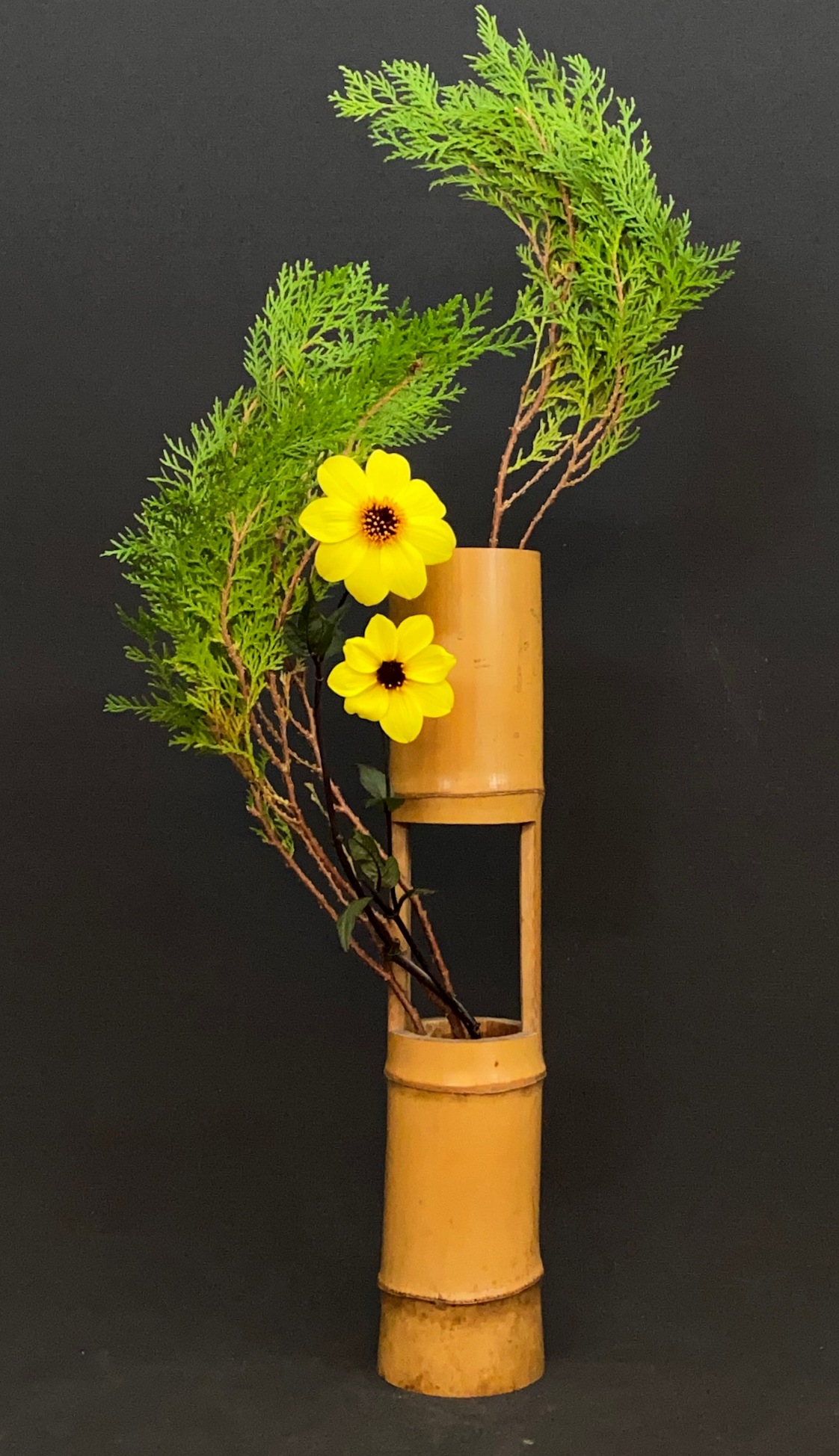
Book leaf pine (thuja orientalis) and dahlias
in bamboo container

Aspidistra leaves, hawthorn berries and echinops in ceramic container

In the next arrangement, I used umbrella grass with the flower heads inside the lopsided glass containers. Unfortunately, it's hard to see the swirling pattern inside the vases. I used the stems to create the sharp lines and softened the arrangement with the use of the crucifix orchids.


With the lockdown, I had to look after two granddaughters today and the arrangement which impressed them the most was this next one, in which I used five different materials. I must admit, the more arrangements of this style that I make, the more I like them

Hawthorn berries, crocosmia, cosmos, agapanthus and murraya paniculata
in ceramic container.

I hope that we all stay safe and well and that we are out of this lockdown very soon.

Bye for now,
Emily


Monday, 8 February 2021

8th February, 2021


With leaves only

Hello all,

Most of my ikebana is opportunistic, that is, I arrange materials that become available at the time and, often, I make more than one arrangement, more or less, workshopping the material. However, as a teacher, I need to go back to basics and practice some of the themes that I don't instinctively gravitate towards. Case in point is the above arrangement - 'With leaves only'. I used 6 different types of leaves - hostas, cana lilies, calla lilies, curculigo, bromeliad and fish bone fern (nephrolepis).

I also made the arrangement, below, for the same reason. The theme is 'Using a variety of materials'. The inspiration came from my vegetable garden, where some of my herbs are going to seed and had to be cut back. I used oregano, mint, amaranthus, oleander, alstroemeria psittacina, fish bone fern, cosmos and night blooming jasmine (Cestrum).


I used a tsubo vase in which I wedged a cross fixture and used only one of the 'wedges' created by the fixture. It's not visible in the photograph but, by using the back, right hand wedge, the material stay upright and there is space around the lip of the container. In this arrangement lightness is very important.


Classes resumed last week and I was delighted to see my students after such a long time. We all appreciate what we have, much more, now and take things less for granted than before the pandemic.

The theme I set for the advanced students was 'Mass, line and colour in two containers'. I specified that I did not want them to use either agapanthus or hydrangeas because it would be too easy to get a mass with those flowers. I wanted them to create their own mass. Below is my arrangement in which I used alstroemeria psittacina seed heads and crucifix orchids in matching ceramic containers.

Jenny did the next one. She used two different coloured chrysanthemums, nandina domestica nana and umbrella grass stems in ceramic containers.


Next is Nicole's arrangement and she used crepe myrtle flowers, nandina domestica nana and painted willow stems for the lines in two, very interesting, ceramic containers.


And Vicky did the next one in two large, boat shaped suibans, using marigolds and umbrella grass stems.


Lucy's arrangement was very difficult to photograph successfully. I have a white and a black background for photos. When using the black background, the kiwi vine was lost and when using the white, the containers are less visible. Also, I could not capture the shadow of the stem over the water, which was Lucy's specific intention.


Bredenia came to class with the same containers as me and was concerned that some might think she was copying me. Absolutely not! She had no way of knowing what I used before she came to class. 

While I'm on the subject of Bredenia, I'd like to mention that she works for 'Breastscreen Victoria'. She makes ikebana arrangements for the room at work, where she speaks to clients and, often, has to impart unpleasant news. She has just the right temperament for such an important and difficult job. The arrangements are very helpful as people are interested and ask questions, which help to break the ice. The other staff are also very appreciative of Bredenia's work.

In her arrangement, Bredenia used cathedral begonia leaves and bamboo.


Maren is close to finishing Book 5. Her theme was 'Preparing for a future Exhibition'. We concentrated on secure mechanics, so that the arrangement could withstand any accidental knock by the public. She used a lichen covered, dry branch and alstroemerias in a ceramic container that she used for the first time.


Lei's curriculum lesson was 'Emphasising Lines at the Base'. She used palm leaves, which she trimmed, asparagus fern and belladonna lilies in a ceramic container


Wendy's curriculum lesson was 'Freestyle arrangement using two containers'. She used rose hip stems and two different coloured roses in matching, ceramic containers.


I don't, normally, include basic arrangements in this blog but I was very pleased with Dianne's 'Variation No.6 Horizontal' and felt it deserved a place.


Bye for now,
Emily


Monday, 1 February 2021

1st February, 2021


An arrangement using 5 different materials - persimmons, cumquats, hydrangeas, crocosmias, and bamboo
in ceramic container

Hello all,

Well, it's February already and we've had some unpredictable weather - from extreme heat to quite cool and very wet. Sam and I had worked very hard to protect our plants from the heat by covering as many as possible with old sheets, moving pots into shade and watering until the water tanks were empty. So, it was with great relief that we welcomed the rain. And boy did it rain! The water tanks are full again, which, for me, is like having the pantry full.

When I delivered some food to my elderly uncle and aunty the other day, I discovered that they had growing on their nature strip three book leaf pines (Thuja Orientalis). These must have been planted by them years ago, as there are no others in the street. I can't believe I hadn't noticed them before. So, of course, I helped myself to some 'leaves'.

In the arrangement, below I wanted to emphasise the lines at the base. I trimmed all side shoots leaving the lines clean.

Thuja Orientalis and tiger lily (Lilium Lancifolium)
in ceramic container

The calla lilies are well past their best and the flower heads had to be removed, otherwise, left to drop, they will self seed and I didn't want any more plants. It's quite interesting that the stems of the flowers become very weak and bendy as they age and I wanted to take advantage of this by creating beautiful curves.

Using only one kind of material
Calla lilies in ceramic container. 

Calla lily stems and agapanthus in ceramic container

Still on the subject of calla lilies, one clump has distinctively long and narrow leaves, which, together with the speckled effect are quit beautiful and I use them in their natural state. However, I also like to change their appearance by twisting and pinning into place, creating a more modern look. The photographs, below, show the leaf before and after twisting and then two arrangements using the leaves, whose appearance I have changed.


My crucifix orchids have had a bumper season. I had to wait a few years to get flowers but, now that they have started, they are quite prolific and very useful in ikebana. Their thin, long stems are perfect for creating line in an arrangement and they are quite long lasting. They also add vibrant colour.


Crucifix orchid and squiggly grass in stainless steel container.

Bye for now,
Emily

Monday, 25 January 2021

24th January, 2021


Queen's Tears bromeliad flowers and Pinellia tripartita leaves in 
ceramic container

Hello all,

I'd like to start with an announcement that I will be running an Ikebana workshop at the Bulleen Art and Garden Centre on 28th February. For more information please click on the link and then on 'Classes and Workshops' http://www.baag.com.au/

This workshop is one of three that I was booked to conduct last year but were cancelled. I'm happy that things have improved sufficiently to allow for such events to go ahead.

I'm also going to try something I've been wanting to do for some years. I'm going to run an Ikebana Masterclass once a month, beginning in February, for the more advanced students of ikebana. I'm quite excited about this and am really looking forward to it.

After the Zoom demonstration over a week ago, all the surfaces in the house still have arrangements on them. There is nowhere to display any new ones. But I have left over material from the demo as well as new material in the garden that must be used.

In this first one, Vicky gave me three pieces of the fan-aloe (Kumara plicatilis) for the demo. Having used only one, I wanted to play around with another. I love it when I have the opportunity of workshopping some material because I learn about its properties, difficulties etc. In this case, the aloe is soft to the touch but can snap quite easily but, most importantly, it is very heavy. Here's what I did with it.

Fan Aloe with dahlia in ceramic container

I tried to pull out a leaf from my Bromeliad Neoregelia but was not careful enough and pulled out the centre of the plant. I couldn't think of any way to use it other than the way it grows naturally. I merely had to find a suitable container. It looked quite good on its own but I felt I needed to add something more. Hence the wisteria vine.

Bromeliad Neoregelia and wisteria vine in ceramic container

My clump of umbrella grass (cyperus alternifolius), has spread so much that it is encroaching on the grass path. I finally cut it back very hard, digging up all the self seeded plants along the way. This provided me with an abundance of the lovely, long stems. These, too, had to be used and I found a couple of different ways to do so.

Umbrella grass stems and hydrangeas in ceramic container

The container in this next arrangement was brought to me by my good friend, Olga when she dropped in recently. She said that she and her daughter came across it and bought it for me. How lucky am I? And this is not the first time Olga did this. I have another container from her from some years ago, which I have used extensively.


Umbrella grass stems and and leek
flowers in ceramic container

I finally dismantled the large arrangement with the pear branches. As I was about to cut them up and put them in the garden waste bin, an idea emerged and I brought them back inside and started anew.

I trimmed, then balanced the branches downwards on this pedestal with an opening on one side. I placed a small branch inside the cavity, giving the impression that the branches are growing through the wall. I decided on the leek and garlic flowers to complete the arrangement, thinking that the monochrome effect would be smart. Hmmm, maybe.

When I photographed it I found it less impressive than I expected. The skeletal look of the branches was somewhat lost against the dark background and the flowers looked dull.

So, I went out into the garden looking for brighter coloured flowers and there were the dahlias, as bright as bright can be. I also changed the background by placing the arrangement against this chartreuse coloured wall. Two quite different looks. I'm not sure which I like best.

Before

After

,


I leave you with this simple, little, wall arrangement using aeoniums in a metal container.


Bye for now,
Emily

Sunday, 17 January 2021

Zoom Demonstration January, 2021


Glass arrangement - gloriosa lily in two glass containers
Hello all,

Well, the zoom demonstration, for which I've been preparing for some time, is over and, judging by the comments on Facebook and messages to me personally, it was well received. I want to thank all of you, who have taken the time to give me such positive feedback. It means a great deal and I will endeavour to answer all your messages. Unfortunately, as I'm not on Facebook, I can't reply to those comments. But I do thank you, most sincerely. By the way, for those who have missed it but would like to see it, it can be seen on YouTube 

https://youtu.be/ZRaB-3wEpi8

Or Facebook

 https://www.facebook.com/ikebanainternationalmumbaichapter

Following are photographs of all the arrangements of the demo in the order they were made.

Fan Aloe in glass container
Agapanthus and nandina domestica nana in ceramic container

Wooden structure made from dried flower stem of New Zealand Flax
Hydrangeas and crucifix orchids in ceramic container

Dried and sprayed agapanthus, mahonia and alstroemeria psittacina
in ceramic container


Garlic flowers and bromeliad leaves in
self made ceramic container


For the next arrangement using strelitzia nicolai and a gymea leaf I'm including two different views because one can't do it justice. I'm very grateful to my sister-in-law, Betty for providing me with the flower because mine are past their best.
Front view


Side view

Valentine's Day Arrangement

Hearts made of agapanthus stems, roses, gypsophila and
chocolates

The container in this next arrangement is an up-side-down fruit bowl with a small tsubo vase on top. Because of all the drama in the container, I used only one flower, a Crucifix orchid, to complete the arrangement.


Manipulated alium flowers in a kintsugi-repaired ceramic vase

For my finale I made a large arrangement using Australian natives on a very strong, black, perforated metal structure. I had used this structure at our last Ikebana International exhibition in a very modern way, using just gymea leaves bent through it. This time I used it very differently. I wanted to contrast the strength of the structure with the softness of floral material.

I'm embarrassed to admit that I was not sure of the names of some of the native material because I don't grow them myself. Still, that's not a good excuse - I should have looked them up. I'm grateful to one participant who wrote and gave me the names, making it much easier for me to check them out.

The materials were - Cootamundra wattle, Corimbia ficifolia, Banksia baxteri, Kangaroo paw and dietes leaves.


I must say, one more time, how grateful I am to Mrs Taruna Agarwal of Mumbai Chapter for inviting me to do this demo and for organising everything so well. It was a new experience from which I learnt quite a lot.

The greatest challenge for me in this demonstration was trying to visualise an audience when all I could see was the laptop screen with me in it. I've done many demonstrations and feel comfortable doing them but I've always had feedback from the audience. Without that, it was quite surreal. 

Bye for now,
Emily


Enjoyed this post? Never miss out on future posts by following us