Monday, 27 February 2023

27th February, 2023


Hello all,

I have a number of bromeliads growing at the bottom of the garden, basically, thriving on neglect. It was when I was watering my dogwoods down there that I noticed two flowers on the Queen's tears bromeliad (Billbergia nutans). In such situations my first instinct is to cut the flowers and worry about what to do with them later.

For the above arrangement, I used the lower part of this, unidentified palm frond where the leves grow at a much sharper angle. I felt it worked well with the modern, stainless steel container. The softness of the flower contrasted well with the sharpness of the palm frond and container.

But, as I mentioned, I had two flowers. For the next piece I used a large, rectangular, glass container. I cut the middle section of the palm frond and inserted it diagonally in the vase. The bromeliad flower has its stem in the vase but hangs at the back of the container, outside of it.

Initially, I had used the flower as it was, without trimming....

 I was not happy with that because, even though the flower was outside the container, it, nevertheless, filled in the space that was created by putting the palm frond to the left. So I trimmed the flower and was better pleased.


There is a particular weed growing in a large mass by the side of the road that look quite beautiful with their russet-red inflorescences. When I last drove past I actually had time to stop and pick some. Once I removed their leaves, which were not attractive, I arranged them in this horizontal arrangement with Portugal laurel berries and hydrangeas that are just starting to change colour. The vase is metal.


My cousin, Nick, gave me a umber of cycad fronts a month ago. I used a couple of them previously but I still had some in the bucket in good condition, which I could not allow to go to waste.

I played with bending them but they snap. However, they still remained attached to the stem. By intertwining the tips, I was able to make them support each other and created an interesting space between them. I've been watching how this particular crucifix orchid was growing for some time and thought it would be perfect for this application. It curves to the back, then curves forward. Most accommodating of it. The narrow, ceramic container is quite deceptive because it can hold a lot of water, making it heavy enough  to hold the stems, which are extended sideways.


Again, at the bottom of the garden, I was surprised and delighted to see a fully open Belladonna lily. The first in my garden.  And, as is my wont, I cut it first and then walked around the garden, with the lily in one hand, looking for appropriate materials to go with it. Usually, ideas come to me rather quickly but I struggled with this one. The flower head, which is made up of a number of individual flowers is so big and rigid in its habit that I spent some time before settling on a beautifully curved stem of the Siberian dogwood (Cornus Siberica alba). The flower tends to fall forward, so I added nandina domestica inflorescences and some leaves to the back. I'm sorry you can't see the proper curve of the stem as it sweeps forward.


I gave the arrangement, below, to someone as a 'thank you' for some work he did for us. He was absolutely delighted with it but thought it was a potted plant that would keep on growing. Sadly, I had to disabuse him of the notion. Those of you who have seen the street sculpture 'Love Flower' will notice the resemblance with the agapanthus. I used umbrella grass (Cyperus alternifolius) stems and a hydrangea to cover the florists' foam.


Mary's curriculum lesson was 'In a suiban without a kenzan'. She used Siberian dogwood and snapdragons in a ceramic suiban, keeping the stems of both trimmed neatly, so that their lines are emphasised and a canopy is created.


Bye for now,

Emily

Monday, 20 February 2023

20th February, 2023


Hello all,

My arrangement, above, began with my newly acquired, ceramic container with a metallic patina. I had the piece of dried agave for, literally, years and the one that is partially dry for about one year. I thought the colour of the agaves toned in well with the colour of the container and I liked the contrast of the dry, shrivelled material against the shiny surface of the container. 

Initially, I did not want to add any other material. However, I wanted to see what it would look like with a flower and I tried a number of positions. When I placed it high, in front of the agaves, it interfered with the design, so I moved it into the cavity created by the green agave. This way it is partially concealed and does not dominate. Still, personally, I prefer the arrangement without the flower.


The class theme this week was from Book 4 - 'Paying attention to the container and to the place where the arrangement will be put'. This is, actually, a very important lesson, the principles of which apply to every single arrangement we make.

I had designated a place in my home for each student so they had to prepare for an arrangement that would fit the space allocated.

I had to photograph Jenny's arrangement first n its own as it did not photograph well in situ and then placed it on the glass, coffee table in the family room. She chose colours carefully wanting to tone in with the wall hangings and the timber floor boards, which are clearly visible through the glass. She used hydrangeas and willow in a deep, ceramic suiban.


I had to do the same with Vicky's arrangement. Her spot was particularly difficult because it has a window with reflections on one side and a silk screen on the other. She used a large piece of painted wisteria, pineapple lilies and arum italicum pictum berries.


Nicole and Bredenia were allocated the same spot - a plinth under the curve of the staircase. This was not a problem because they come to class at different times.

Nicole used tortuous willow branches sweeping upwards, following the line of the staircase. The colour of the willow in the photograph is deceptive as it reflects the light. It is, actually, the natural, olive green colour of willow. The fennel, however, picks up the colour of the staircase, as does the ceramic container.


Bredenia used a ceramic vase that sweeps upwards following the curve of the stair. She used fountain grass,  Pennisetum setaceum 'Rubrum' and greeny/yellow kangaroo paws, Anigozanthos (possibly) Yellow Jem.


Lucy was allocated the large dining table which measures 3 metres in length. This was not to be a table arrangement where there would guests sitting around the table, so she could go to town with it. She used two ceramic containers of different sizes and the largest gymea leaves she could get from my garden. She secured the leaves horizontally along he length of the table and dded 5 blue agapanthus flowers. Photographing it was a challenge!


By coincidence, Lei's curriculum lesson was the same as the advanced students. Her allocated spot was the meals area table, which is a type of frosted glass. The colour of the wall along the staircase leading to the laundry is a type of chartreuse, which Lei's materials picked up very well. She used agapanthus flower stems with the seeds removed and variegated New Zealand flax leaf. Her yellow, modern container fitted in nicely.


Shaneen's curriculum lesson was 'Jumonji-dome' (cross bar fixture). She created a horizontal arrangement using coprosma branches and roses in a dark brown, ceramic vase. Shaneen was aware that she needed to thin out the leaves of the coprosma but time was limited.


Dianne's lesson was 'Composition of Straight lines'. She used leek flowers with long stems, creating the straight lines. Th flower heads toned in well with her soft pink coloured roses.


Mary's lesson was 'Arrangement with plants on a wall'. She used aspidistra leaves, as they can survive well without water, as do the crocosmia inflorescences. The hydrangea stems were in water vials, which were well hidden.


Bye for now,
Emily


Monday, 13 February 2023

Gloriosa lilies


Hello all,

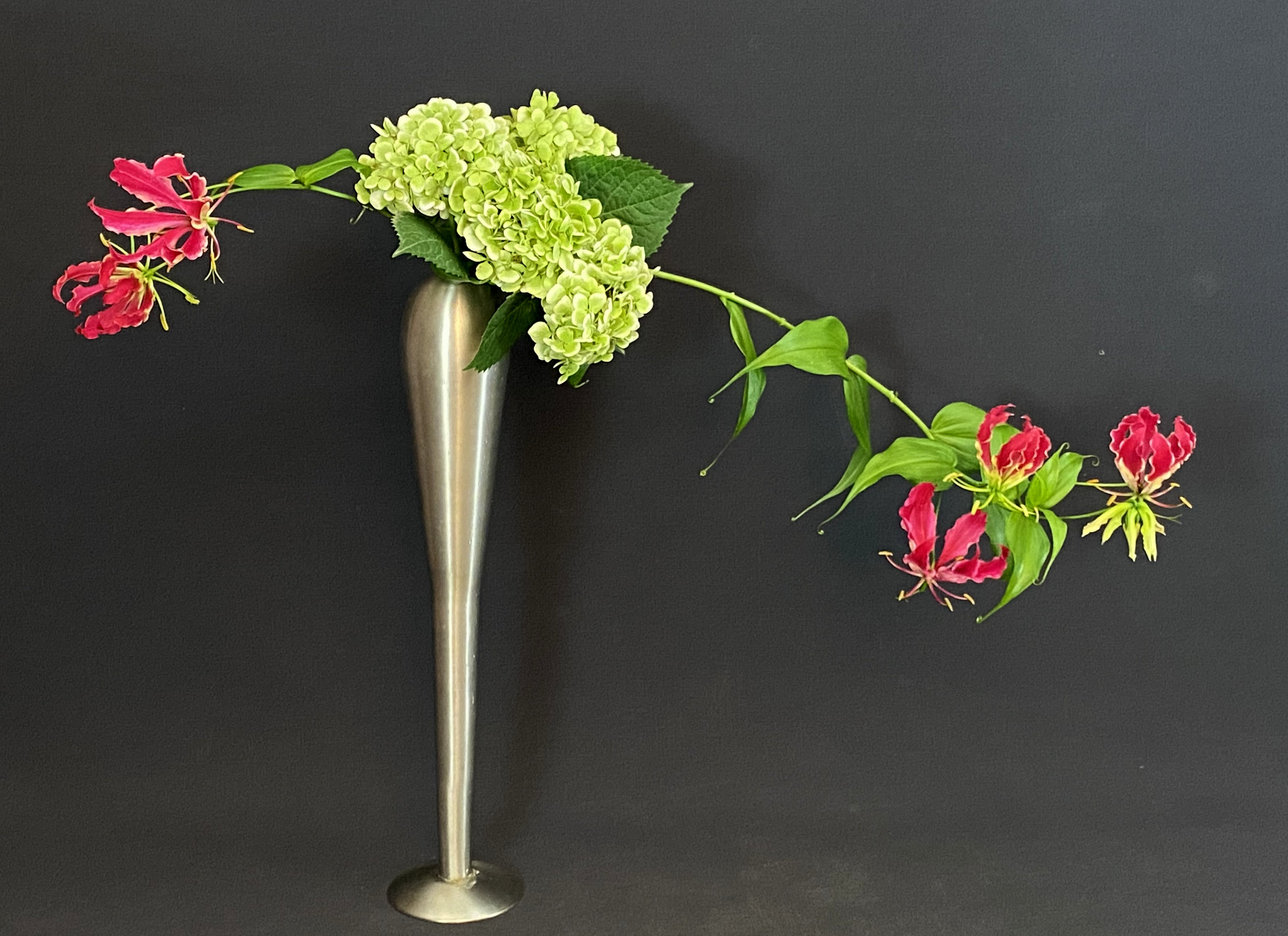
Is it possible to have too much of a good thing? When it comes to an overabundance of gorgeous flowers like the gloriosa lilies, I say 'no'! The photograph, below, is of some of my pots growing against a northerly facing, brick wall, which seems to be ideal for these tropical plants. I keep trying to come up with different ways to use them, which is a challenge but challenges are good and keep our work fresh.


In the arrangement at the top of this page I used stems that grew sweeping downwards and slightly forward. With their strong colour, I wanted the lilies to be the focal point so I picked these pale green hydrangeas with their more neutral colour as accompanying material.

The photograph, below, is of a wall arrangement in a metal container. I used gloriosas again but this time with branches of Portugal laurel, from which I removed the leaves and left only the berries. I love the way the colour of these berries ranges from pale green to yellow, red and almost black. Eventually they will all be almost black.

Two weeks ago I posted the photograph on the left of my arrangement using cycad fronds and Arum Italicum Pictum berries. While the berries have died, the cycads are still as fresh as when I first arranged them. So, I just replaced the berries with, yes, you guessed it, gloriosa lilies.

I feel it's necessary to include a side view of the arrangement to get an idea of the depth.


Last Monday the first meeting of our Sogetsu group was held. The workshop was run by Aileen Duke and the theme she selected was a 'Double Shin Arrangement'. I have seen photographs of this arrangement my Norman Sparnon but, as it is not in the Sogetsu curriculum, I have not had the chance to do it. 

Our director, Christopher James has posted a detailed explanation of the theme and of our workshop together with photographs. Therefore, to save me writing it all again, I refer you to his blog RoadsideIkebana

Very briefly, the double shin arrangement, as I now understand it, is to be made using one kenzan in a suiban with two shins and a narrow space between them.

 It was decided that my arrangement at the workshop was not quite correct and that it was closer to  a ka-bu-wa-ke than a Double Shin.


I took the correction on board and, when I came home, I removed some of the materials, brought the kenzans closer together (with the containers I had selected, I could not use one kenzan) and generally simplified the arrangement. I concede, this is a better attempt at the theme.


Mary's curriculum theme was 'Paying attention to the container and the place where the arrangement is to be put'. I had selected this pedestal in a corner with a silk fabric screen to one side. Mary used a  rhododendron stem with strong, green leaves that contrasted with the dark colour of the screen. The mauve dahlias were subordinate to the rhododendron leaves. The stripes on her ceramic container picked up the colour of the pedestal.


Bye for now,
Emily


Monday, 6 February 2023

COOL ARRANGEMENTS


Hello all,

Last Wednesday was the first class for the year and it was with great delight I welcomed back most of my regular students and one new one.

For the advanced students I had set the theme of 'A Cool Arrangement'. As this is not in the curriculum, there are no rules, as such, to be adhered to, so I allowed students their own interpretation.

For my arrangement, above, I chose cool colours in my materials as well as my self made container. The hydrangeas are in pale blues and mauves and the green stems are the inflorescences of a particular green vegetable, similar to spinach, which I grew in winter and which we enjoyed eating. However, I neglected to dig them up when they started to go to seed and this was the result. I don't know the name of the plant because it came in an Italian seed packet which I lost. Anyway, I loved the shapes that were created and the delicate, mauve flowers scattered sparsely through the stems. Sadly, the flowers died within a day. But I did collect some seeds.

The similarity between mine and Nicole's arrangements is purely coincidental. She, too used cool coloured hydrangeas. She also used a dry, sprayed branch in a ceramic vase.


Bredenia chose a glass vase, half filled with water to give the feeling of coolness. She used three bromeliad leaves and one flower.


Vicky made two very different arrangements. In the first, a modern arrangement, she used two dark blue, oval suibans and two very pale pink anthuriums, which she grew herself. The top container had only water.  At the base of the flowers she used agapanthus leaves curled around each other.


Her second arrangement was a naturalistic one in a large, round, glass container. Again, water was an important feature. She wound some wisteria and added more anthurium flowers and one leaf.


Wendy's curriculum theme was 'With Flowers Only'. The choice of materials is very important in this theme. 'Flowers' to be used should be ones that grow out of the ground, such as tulips, jonquils, alstroemerias, chrysanthemums etc. any flowers that grow on a branch, such as camellias, rhododendrons, magnolias, crepe myrtle etc. are not suitable.

Wendy used gerberas, alstroemeria, statice and a yellow material that I'm unfamiliar with in a ceramic, tsubo vase.


Shaneen's theme was 'Green Materials Only'. She used papyrus, diosma, hydrangeas and aspidistra leaves in a ceramic suiban. Although the arrangement is green, there is enough variation in the colour as well as the textures of the materials to make the arrangement interesting and beautiful.


Lei and Mary had the same theme - 'To be Viewed from Above.' 

Lei used a container that looks like a composite of five containers joined together. She used a creeper with some leaves changing colour, lisianthus and freeziers. She strategically left two of the openings free.


Mary used some branches of viburnum plicatum tomentosum, which is flowering completely out of season, hydrangeas and gloriosa lilies.


Bye for now,
Emily


Monday, 30 January 2023

30th January, 2023


Hello all,

The piece of nandina domestica nana, above was broken accidently and was the beginning of the arrangement, above. The agapanthus is one I manipulated to create that curve. The ceramic container has a metallic finish on the top half and black on the lower half.

My next door neighbour's Port St John Creeper (Podranea ricasoliana) grows vigorously over our fence and is now in flower. The flowers tend to drop quite quickly but I enjoy using them even for their short duration.

I used a metal container selected for its curved shape to reflect the curves of the vine. I added a small mahonia leaf.


In the wall arrangement, below, I used a mass of the pale pink, Port St John creeper flowers and another mass of darker pink hydrangeas. The branch material is from a Ficus Benjamina plant I have growing at the front door and which needed trimming. It has an interesting, weeping form.


In the next arrangement, using the same wall container, I used blue agapanthus and crocosmia.


I have my cousin, Nick to thank for the next two arrangements. He brought me this palm inflorescence which is partially dried with the inner parts still green. I managed to secure it in this ceramic container and added gloriosa lilies to one side, creating asymmetry in a very symmetrical piece.


He, also, brought me, among other goodies, these cycad fronds, which I placed in the asymmetric, resin container and added the red berries of Arum Itlicum pictum. 


Bye for now,
Emily

Monday, 23 January 2023

ROSES


Hello all,

HAPPY LUNAR NEW YEAR!

After 32 years of practicing ikebana, I've come to the realisation that roses are more trouble than they're worth. Yes, I can hear your collective gasps through the ether but hear me out. I have always loved roses and have had them growing all my adult life (that's a long time). But I have struggled with spraying them, pruning them, feeding them and dead heading them, only to find that the roses that appear are often damaged by heavy, spring rain or cooked to a crisp by searing summer heat. And then, when I do manage to cut some healthy flowers, many of them do not last in an arrangement for more than a couple of days. So, it's with a heavy heart, that I acknowledge I can't be bothered with them any more. Some will have to go.

However, having said that, when I was deadheading them for the second time this season, I cut the viable ones and made a couple of arrangements. In the one, above, I used the pink Queen Elizabeth roses with white agapanthus at the back in a ceramic vase. The branch is tortured willow, from which I had stripped the bark than sprayed black.

In the arrangement, below, I used two altissimo roses, placed so as to be looking at each other in this double container. The branch is loquat.


As I was pruning the altissimo rose I almost cut a stem that had this papery nest of an Australian flower wasp attached to it. Some wasps chew leaves into a papery pulp which they use to build their nests, the cells of which are often hexagonal in shape.


My gloriosa lily plants are going gang busters. So many flowers, so little time to arrange them. The problem with these gorgeous blooms, as I mentioned before, is that they have a short stem. This time I extended their length placing them in water vials which I attached to a longer stick, as per photo.

Of course, this can only work if the vial and stick are concealed by other materials. Case in point, the arrangement, below. The lilies make such a vibrant, strong mass that I chose these strong calla lily leaves for balance. I lit the arrangement from the back to highlight the translucent quality of the white spots on the leaves. The ceramic container is one I made a very long time ago.


My stephanotis floribunda is at its absolute best, full of delicately fragrant, pure white flowers. It is a twining, sparsely branched liana, native to Madagascar. Despite knowing that it would only last a couple of days, I wanted to use it anyway.


Once they wilted, I retrieved the hydrangeas and re-used them in the next arrangement. The monstera deliciosa leaves are just too big and floppy to use successfully, so I cut them into these sharp, triangular shapes and hid the hydrangeas behind them.


Bye for now,
Emily


Enjoyed this post? Never miss out on future posts by following us