Monday, 16 January 2023

AEONIUM


Hello all,

My aeonium plant (aeonium arboreum 'velour') has grown very big very fast and, because the stems are very soft, pieces have been breaking off. I picked some up and started playing with them.

The very simple arrangement, above, still required some expertise to arrange. Firstly, I selected an interesting piece and trimmed away some flowers as well as some of the lower petals from the flowers that I kept. Then I used a stick wedged between the stem and the wall of the vase to hold the aeonium upright.


You'll notice that the vase has a very convenient slit a third of the way down, allowing for the New Zealand flax to fit through and reach the water.

The next arrangement didn't require much work at all, apart from the selection and trimming of the stems. Also, the choice of container was crucial.


In the next arrangement the vase has three holes on either side. Very handy. I put the stems on either side, meeting inside the container and pinned them together, thus holding each other in position.


Having finished the two nageire arrangements, I put them to the side whilst I worked on the next one. I noticed, then, that they look rather good together as one arrangement using two containers.


Sam was doing some work in the vege patch and rescued the garlic flower in the arrangement, below. There was a New Zealand flax leaf in the bucket, which I took and had a quick look at the shelves of containers. One of them seem to call out to me.


All my arrangements thus far seem quite monochromatic. This is not by design but a coincidence. So lets spice things up a little and add some colour.

My crocosmia are in full bloom, finally. At least one month later than others I've seen in the area. Still, I'm grateful for them now. This beautifully bent one happened naturally. I put a piece of wire through the stem inside the neck of the container to prevent it from resting against the lip.


The reason so many of the crocosmias are bent is because they grow tall and heavy and fall to the ground. As the flower stem grows, it reaches upwards towards the sun, thus creating these interesting angles.

My next arrangement is one of contrasts. The black and white containers, the bent and curved stems of the materials and the orange and blue colours, which are on the opposite side of the colour wheel.


More orange and blue. This time it's the agapanthus and the stem of tiger lily (lilium columbianum). I had manipulated the stem of the agapanthus to create a curve but not the tiger lily. It grew amongst rose bushes where it found an obstruction, causing it to bend.


Bye for now,
Emily


Monday, 9 January 2023

A LESSON IN MECHANICS


Hello all,

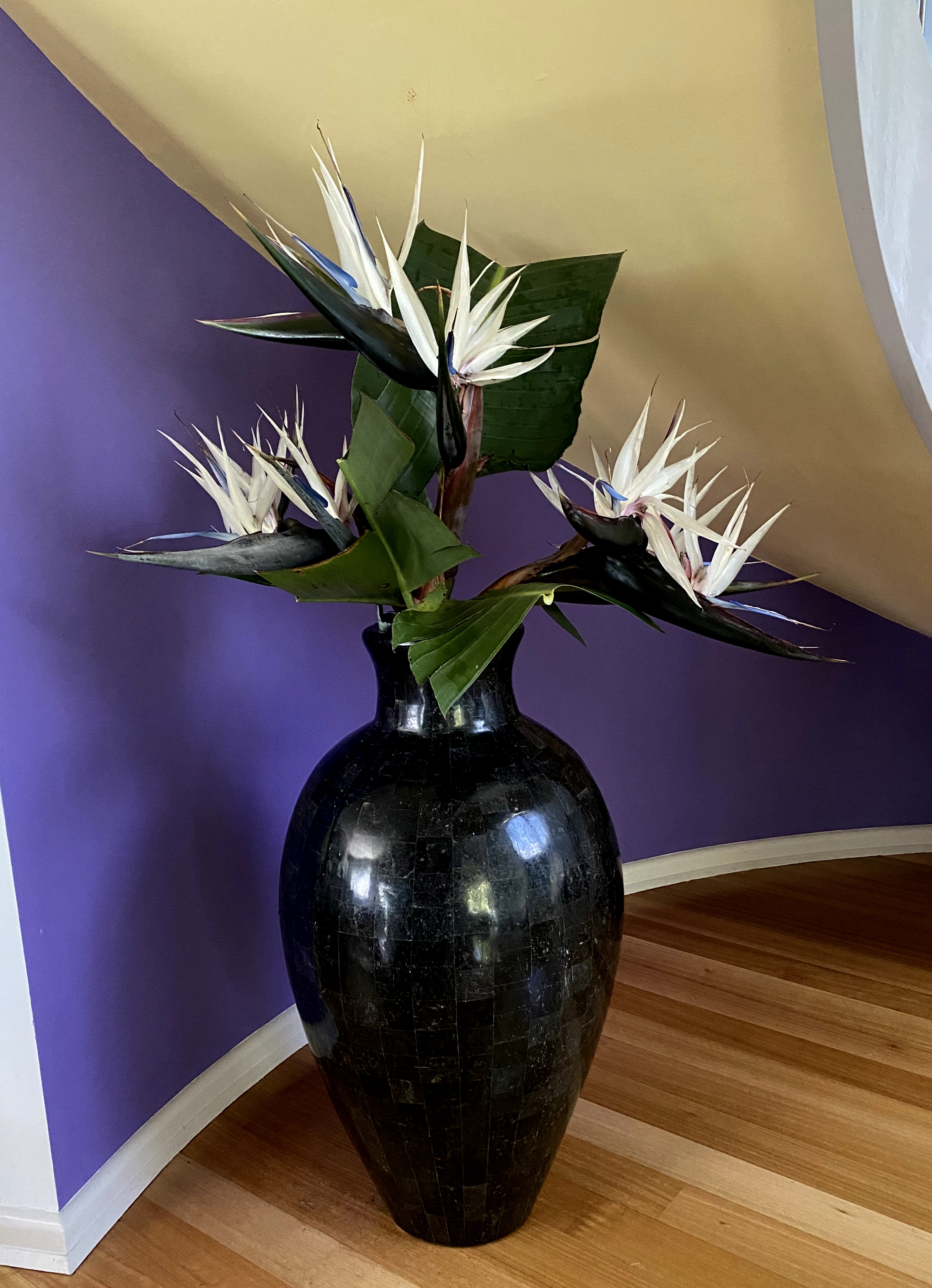
As arrangements go, the one in the photograph, above, is quite large. The urn itself stands a metre tall. I had used it previously for a Christmas arrangement using pine and giant dahlias. 


The arrangement started with Sam, once again, risking life and limb by climbing the ladder to cut the three flowers of the strelitzia nicolai.

Once, safely, on the ground the flowers needed to be prepared by removing dead petals and scraping away the sap that dries on the outside of the 'beak' and looks unsightly. I, then, polished the 'beak' part with an oily cloth to give it a shine but also to bring out its dark green colour.

Before
After


So, having prepared the flowers, I thought I'd give you an explanation of how I managed to use such a big urn. Firstly, I found a plastic bucket that fit snugly in the 'neck' of the urn and cut off the excess, leaving a small piece to act as a handle. I, then, sprayed the edges of the bucket black so as not to show the bright green through the arrangement. I pierced holes and threaded strong wire in a cross pattern just like a cross bar. 


This facilitated the placement of the heavy strelitzia nicolai flowers and stopped them from tipping forward due to the weight.


Once the flowers were in place, I was able to fit in between them the leaves of the same plant. I had, however, cut the leaves down because they are far too big to be used whole. From go to whoa it took me over two hours, not including the work I had done previously on the urn.

The berries in the arrangement, below, are from the plant 'Arum Italicum pictum', the leaves of which have died down and only the stems with the berries remain. I love them at this stage, before all the berries turn red. I wanted to display them the way they grow but I did add some squigly grass as a contrasting element.


A couple of years ago my sister-in-law, Betty gave me a pot of pineapple lilies (Eucomis pallidiflora subs. pole-evansii). This year they produced three flowers, two of which I used in the arrangement, below. I wish I had a way to share their delicious fragrance.The leaves are from the dwarf, variegated iris japonica.


The little container in the photograph, below, looks quite unremarkable, however it has an ingenious feature. In the second photograph you'll notice a protrusion on its underside. This created a hole inside the vase, so that a stem that is inserted there stays perfectly upright. If, like me, you've struggled to keep your material upright in containers that have a small opening, you'll appreciate this little feature. I would like to shake the hand of the person who created it.


Bye for now,

Emily

Monday, 2 January 2023

HAPPY NEW YEAR


Hello and a happy new year to everyone.

The photo, above, is of the 'Vasilopita' we had yesterday. That's a traditional, Greek, New Year's bread, in which is placed a coin. It is, then, divided equally amongst the family members, with everyone hoping that the lucky coin will be in their portion. This year it was in Lucy's piece, the theory being that she will be lucky for the rest of the year.

After the family left, having devoured the 'vasilopita' with copious amounts of iced teaI started thinking about the blog and realised that I had very little material for this week's post. I went into the garden looking for materials and inspiration. Fortunately, there was plenty of both. It is unusual for me to start making ikebana without any theme or idea or, even, a container to start with. I enjoyed this process and quickly had a number of arrangements ready to photograph.

I have eight pots of sansevieria, four that live on the balcony and four in the bathroom. The particularly cold weather we experienced this past winter affected the plants on the balcony. They were looking quite 'ratty', so I removed a number of the affected leaves and, after tidying up the pots, I swapped them with the bathroom ones, which have done so well up there that they are now flowering. The leaves that I had removed were in the bucket and became the start of the arrangement, below. I used with them the creamy-yellow calla lilies and, because this type of arrangement can look a little two dimensional, I added the vine. The stainless steel trough was a gift from my former student, Margaret Wilson.


The clematis had brought out a few more flowers, after its first flush had died, all of them facing the neighbour's garden and, therefore, had to be cut and brought inside. Both arrangements look very simple but, I can assure you, they were not simple to create.


This elegantly shaped, variegated agave leaf was perfect for my creamy-yellow calla lily. Strong mechanics had to be employed to secure the heavy agave vertically in my self made, ceramic container,


The golden elm (Ulmus glabra Lutescens) is always good value. The branches, often, have interesting shapes and their luscious, golden leaves last quite well in an arrangement. I was looking for a way to display my one and only agapanthus 'Black pantha' flower and the space created by the two elm stems seemed ideal.


I was delighted to see the first two gloriosa lilies fully open and ready for ikebana. However, their short stems are somewhat limiting. Growing nearby is the wisteria, which I cut and removed the leaves from the leaf stalks to create a spiky but delicate structure.


To quote the late Peter Cundall, my guru from Gardening Australia, 'That's your lot for the week'.

Bye for now,
Emily


Monday, 26 December 2022

A MERRY CHRISTMAS


Hello all,

I hope all of you who celebrate Christmas had as great a day as we did. We've become quite adept at organising large family gatherings and we're lucky enough to have a house that lends itself well to such events. There were 33 of us in the end, with my daughter's family in Holland and another family of six absent due to covid.

Every family brought a contribution to add to the feast but it was still a huge amount of work for the household. Cleaning up afterwards has its own challenges. In fact, I'm so tired, I debated whether I should write a post this week but, after an afternoon nap, I recovered sufficiently.

You can't have a party without decorating the house with ikebana arrangements. And I made a few.

I made a really big one in a large urn under the curved staircase. Securing the heavy branch of pine to face upwards was a challenge but once that was done, the flowers were relatively easy to place. At the back there are white agapanthus, in the middle alstroemeria psittacina, to the right are nandina domestica inflorescence and showing off at the front are three giant dahlias (for which I paid a small fortune and which died the next day). And lets not forget the giant, gold baubles.


With the offcuts from the pine I made a simple Christmas arrangement for a corner on the buffet table.


This next arrangement is almost as tall as the door and its position is by the front, glass entry. I moved it here to photograph, as it was lost against the glass. I had used this metal structure before at an exhibition at Sofitel some years ago. I added blue and white agapanthus and alstroemeria psittacina leaves.


On the dining table I placed a low arrangement with clematis only. This was done on Christmas eve. By lunch the next day, some of the flowers had wilted and I had to make a mad dash to the garden for replacements. However, cutting clematis is fraught with difficulties. It grows over my kefir lime and olive trees, attaching itself strongly with its leaf stalks and is very hard to find which is the vine you want to cut.


 And a little one for the coffee table, with a Jacobean lily and aspidistra leaf in a glass container.


There were people all over the house and garden making it impossible to take a group photo but I'll share with you this one of some of us girls.


Last Wednesday my class and I went for our breakup lunch at a lovely place called Warran Glen, where we dined al fresco and enjoyed the views of manicured gardens. 
It was a lovely way to end the year.

From left - Wendy Sun, Vicky Kalokathis, Lucy Papas, Shaneen Garbutt, Jenny Loo, Nicole McDonald, Emily
And squatting in front - Lei Wang and Bredenia Raquel.

With Christmas over, we cast our thoughts to the new year with hopes of a great improvement on the recent few.

Bye for now,

Emily


Monday, 19 December 2022

MASTERCLASS #13


Hello all,
The previous Saturday was the last Masterclass for the year. It was a small group of only three students but the class was quite enjoyable. I provided the same materials to each student but allowed them to choose their container. The materials were - a very long flower spike of the New Zealand flax, just under three metres in length, three New Zealand flax leaves, one gymea leaf and a number of dietes leaves. The brief was to create a 'dramatic arrangement'.

The arrangement, above, was done by Chris. She used almost the whole flower stem, bending it downwards and created different angles with the leaves. The arrangement was to be placed on a pedestal or at  the edge of the table with one flax leaf reaching down, beyond the edge. She chose her container for its strength and stability as well as its colour.

Akemi selected a donut shaped container with three openings, of which she used two. She shortened the flower stem to a manageable size but the arrangement was still very tall. Of her materials she used only two New Zealand flax leaves and the gymea leaf. 


Vicky, also kept her materials to a minimum. She used two New Zealand Flax leaves, four dietes leaves and a segment of the flower stem in a ceramic container with only one, small opening.


As for me, I've been enjoying my dogwood, Cornus Norman Hadden. It is an evergreen variety, with the flowers, with their long stalks, looking as though they are floating above the branches. 

But what I like most about this variety is the way the flowers start off cream in colour and, as they age, turn pink, so that, at any one time, there is a mixture of cream and pink flowers. Unfortunately the colour variation is not very noticeable in the photograph.


At our last class Shaneen's lesson was Arrangements for Celebrations. She chose to make a Christmas arrangement but avoided the usual and, perhaps, cliched Christmas colours and chose instead more subtle colours. She used the fluffy smoke bush, Cotinus 'grace', yellow roses, red dogwood stems, Cornus Siberica alba and baubles.


Dianne's class theme was 'Two or More Containers'. She used two, different sized, ceramic containers in which she placed Weigela Florida stems and exquisite, yellow peonies.


Lei's class theme was 'To Be Viewed From Below'. She made an arrangement in a basket designed to hang on the wall. She used hoya vine, dark purple clematis and billy buttons.


As this is my last post before Christmas, I'd like to wish all of you a happy and safe holiday season and, to those celebrating Christmas, may it be as merry as your hearts desire! As for me, I'm getting ready to receive 38 guests on the day, so, if you don't receive a post next Monday, you'll know the reason why.

Bye for now,
Emily


Monday, 12 December 2022

12th December, 2022


Hello all,

Our last class was the final for the year when, usually, we make a Christmas arrangement. This year I set the same theme with a slight variation. A Christmas table arrangement.

The photograph, above is of my arrangement, which I made a few days before class. Unfortunately, the hippeastrums did not last until class, so, I replaced them with the only flowers available in my garden - Queen Elizabeth roses. It makes an interesting colour combination - the pink flowers in a red suiban.

The rest of the materials are pine (pinus radiata), ornithogalum flowers , and palm inflorescence sprayed silver.The strands of silver are mizuhiki.

Jenny used asparagus fern, geranium, lacecap hydrangea, red mizuhiki and Christmas baubles in a twisted, cylindrical container. 


Bredenia used sprayed corky elm branches, altissimo roses and gold and silver mizuhiki.

Nicole used sprayed pear branches, cyprus, roses and Christmas baubles in a ceramic suiban.


Vicky went all modern with umbrella grass, anthuriums, and baubles - shiny and mat black ones and just one white. The container is a glass trough.

Lucy, who is very busy with the building of hers and her partner's new home, came to class without any materials. I told her to go into the garden and help herself but, before she could do that, the other students contributed enough materials for her to create the arrangement, below. The pine was from my 'bucket', the hydrangea quercifolia from Shaneen, the altissimo roses from Vicky and Lucy, herself, provided the sprayed, dried strelitzia leaves.

Mary's class theme was 'Dried, Bleached or Coloured Materials'. She used dried garlic flowers and dried aspidistra leaves in an Ikenobo style container. The fresh material is philadelphus flowers and pinellia tripartita leves.


Before I sign off, I need to make a correction. In my previous post Vicky and I used a material, which was wrongly identified by my Leaf Snap App. It called it Carex acutiformis. However, a much better informed reader of mine, Debra Collett, wrote and told me that it is in fact from the small grass tree,  Xanthorrhoea minor https://inaturalist.ala.org.au/taxa/560378-Xanthorrhoea-minor. Thank you Deb!


Bye for now,
Emily


Enjoyed this post? Never miss out on future posts by following us