Thursday, 26 April 2018

Hello all,

And welcome to my agapanthus issue. Yes, I know they are as common as dirt around here but that doesn't make them any less beautiful or versatile. The name 'agapanthus comes from the Greek and it means 'Love flower'. And I love them!

Some weeks ago I had to remove, literally, hundreds of spent flowers. They were too many for the two large bins we have for garden waste, so the job had to be done over two collection cycles. In the process I kept finding interesting stems that I could not discard and was compelled to keep and then  arrange. It turned into an agapanthus workshop for one. Which, I have to admit, I enjoyed. The photographs, below, are of arrangements using agapanthus in the stages after the blue or white flowers had died.


Dried and sprayed agapanthus with hawthorn berries and roses


With nandina domestica nana


In an asymmetrical Lacquer container

In a glass container


With New Zealand Flax


And now for class.
For last lesson I had set the theme 'Improving Your Technique - In a suibanan Without Kenzan' from Book 5. This is an extension of the Lesson in Book 4 and it includes using flowers and leaves as well as branches and employing a number of fixing methods. I'd like to point out that in all of the arrangements, below, the structure that was created stands without resting against the sides of the suiban, even though it may look like it does in the photos.

Vicky's very tall arrangement using dried strelitzia
leaves, Japanese flowering quince and a very tall
gladiolus, which was a gift to me from Dianne
Longley

Lucy's was also a very tall arrangement. She
used strelitzia leaves and Oriental lilies


Nicole used agapanthus, amaranthus and nandina domestica nana

I used Siberian dogwood branches and chrysanthemums In this more
traditional style arrangement
Here I used a strleitzia flower and leaf with agapanthus

Bye for now,
Emily


Thursday, 12 April 2018


Hello all,
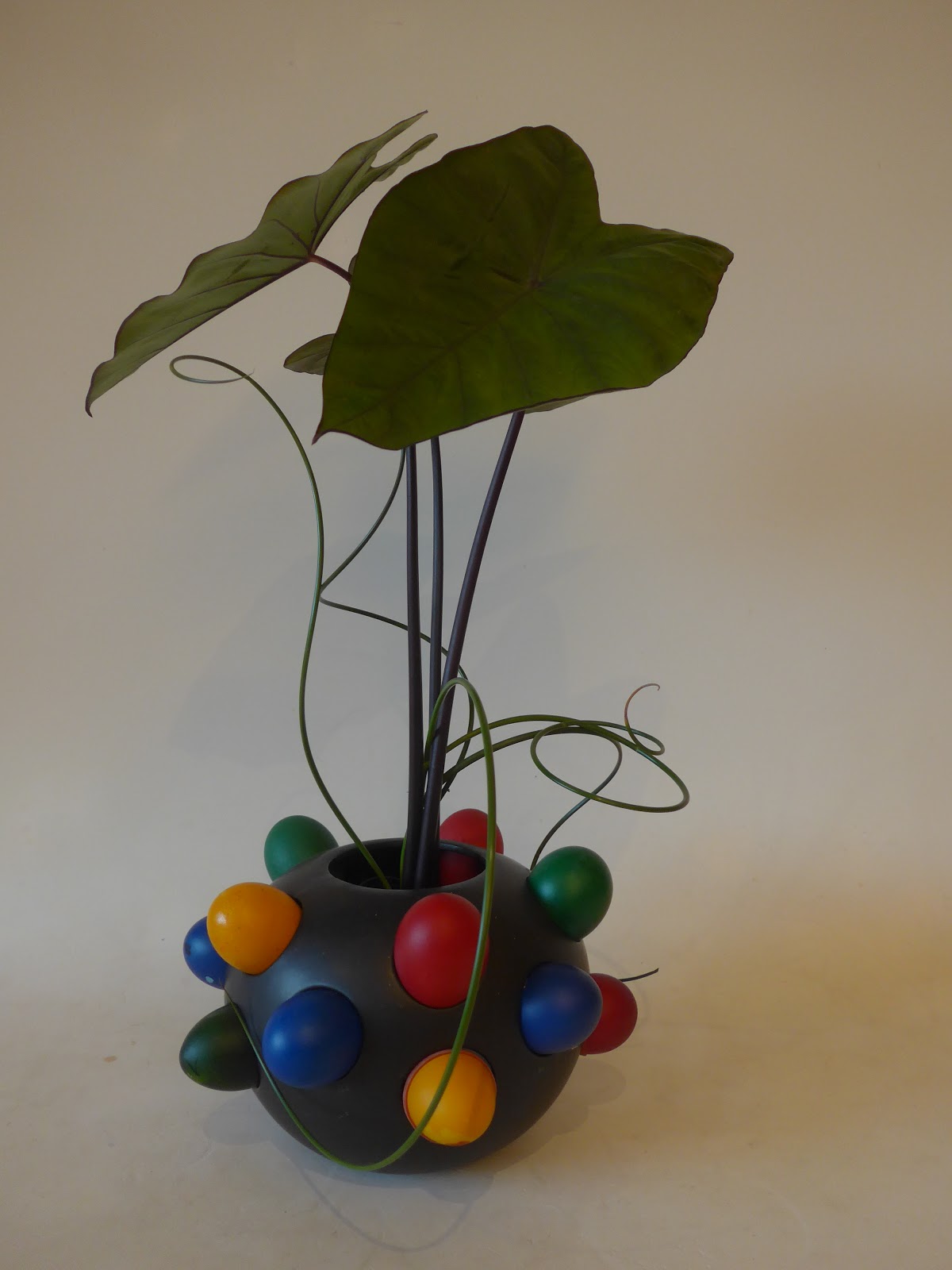
My arrangement, above, addresses the theme in Book 4 -'Specific Scenes, Occasions or Spaces. In my case, my arrangement was to celebrate Easter. I found this container with holes all around it at an opp shop and instantly thought of filling the holes with Easter eggs. I also used taro leaves and squiggly grass.


Aurelia's arrangement, above, was to celebrate her brother's birthday. She used a prostrate banksia and Asiatic lilies. Unfortunately, the photograph doesn't show the beautiful curves of the banksia stems, sweeping from the back to the front.

'Green Plant Materials' is the theme for the two arrangements, below.

I used agapanthus and New Zealand flax. 
Nicole also used agapanthus as well as Setaria Palmifolia and
Green berries, with which I am unfamiliar 


The two arrangements, below, fit the theme in Book 4- 'Vegetables and/or Fruit in an Arrangement'

Judith used a pomegranate, pear, quince and a tulip in this
unusual platter with holes in it.


I used bananas, a plum, a cherry tomato and a button
mushroom


'Seasonal Materials' - Autumn

I used my much prized Haemanthus lilies,nandina domestica
nana, hawthorn berries,amaranthus and a piece of driftwood
that was given to me by my young friend Rita


Nicole used oak branches and nerines ina ceramic vase
I leave you with this arrangement, which I made with the stems of summer flowering calla lilies. I was removing the seed heads before they fell to the ground and self seeded, when I noticed the suppleness of the stems. I took off the gardening gloves and went into my ikebana room to arrange them. The haemanthus lily completed the work.

Bye for now,
Emily


Tuesday, 27 March 2018

MELBOURNE INTERNATIONAL FLOWER AND GARDEN SHOW 2018

This show attracts over 100,000 visitors and is reputed to be the largest of its kind in the southern hemisphere. To quote from their promotional material - "The prestigious Show is well established in the psyche of Australians as a 'must see' event".


Hello all,

The competition that I entered is called the Babtcare Shop Window Competition. The site dimensions are : 2.5 metres wide by 2.00 metres deep by 2.4 metres high. The theme for this year's competition was 'Blossoming with Age' and we were to write something about our interpretation of the theme and how our display related to it. I have to admit that I had some difficulty with this. Conceptual art is not my forte, so I took the following Haiku by Matsuo Basho and referenced it in my display.

This autumn -
why am I growing old?
bird disappearing among clouds

You may remember from my last post, the tragic loss of most of my willow tree. One small, silver lining of that catastrophe, was that I had big branches of willow, from which to choose to use in my display.

I was pleased to receive 'Second' in the competition.

The two photographs, below, were of entries in the same competition and were done by Sogetsu ikebanists.

Akemi Suzuki Fuller, an Ikebana International member


Shoan Lo


The Ikebana International exhibit, representing the five schools of ikebana in Melbourne.
They were awarded the Bronze medal.
On  Sunday, the last day of the show, five Ikebana International members did a demonstration on the main stage. I represented the Sogetsu school.

On the stage in deep concentration


The finished piece after I re-arranged it at home and
photographed it against a blank background

I, also, took photographs of the other four arrangements. However, because of the very busy background, they do not do justice to the lovely work, so I was not able to include them here.

I was very proud of my student Nicole McDonald, who, apart from studying ikebana, is a member of the Vermont Floral Art Society and who, together with Myrna Demetriou, was awarded the Second prize in the Victorian Floral Art Association competition.


Exhibiting in the Melbourne International Flower and Garden Show is quite an undertaking. It takes days of preparations, countless forms , such as Health and Safety to be filled and submitted, loading trailers and cars with materials, tools, ladders etc. As I've been exhibiting for many years and have a great deal of experience, I arrived at the Exhibition Building on Sunday afternoon, quite confident that I was properly prepared. Imagine my surprise when I walked up to my allocated site and found that it was made of completely new  material. Whereas previously, the walls enclosing each site were made of some sort of particle board covered by a black, carpet like fabric, these new walls were made of a stark, white metal. And, whereas I was previously able to hammer nails or put staples into the walls, I was now unable to do anything like that.

I had planned an autumnal scene for my exhibit  with a distinct mood. I had, also, planned a canopy from which I could suspend fishing line, which would hold up the gypsophila creating the 'clouds'. All my plans seemed impossible since I could not attach a single nail to the existing structure.

I bought 9 metres of very wide fabric in pale green, which I intended to attach to the walls to change the colour from what I thought was going to be black. I had cut and stitched the fabric to fit into the space but, then, had to spray the whole thing with a fire retardant spray. Finding the spray and applying it was another story altogether. Unbeknownst to me, the fabric shrank when it got wet and I only discovered it on Sunday when I tried to attach it. So, back home to re-cut and re-sew.

I had two things in my favour, my husband, Sam, who's really good at carrying heavy things and my brother-in-law, Peter, who was only there to provide us with his trailer but who stayed on to help with building a canopy that just sat on top of the walls of the site. Peter is a genius as a handyman.

All of the following day, I had the benefit of help from my sister, Lucy. She and I work very well together because we think alike and are quite good at problem solving. And, I can assure you, we had to use all of our resourcefulness and ingenuity to achieve our goal. Next day was Tuesday and I was on my own but, just when I needed someone to hold a branch for me to screw it onto another,Trish Ward, our president, arrived to see how I was doing and was promptly put to work.

I have always had to rely on help from my family members but never more so than this year. I'm very grateful to all of them, including Vicky, who was not with me but looked after mum leaving Lucy free to help me. I am truly blessed!

So, here it is, Tuesday night and I still have not finished putting away all the paraphernalia I brought back after dismantling my exhibit. Some of the material was still viable, so I made a couple of arrangements, because, God forbid, I should let anything go to waste!


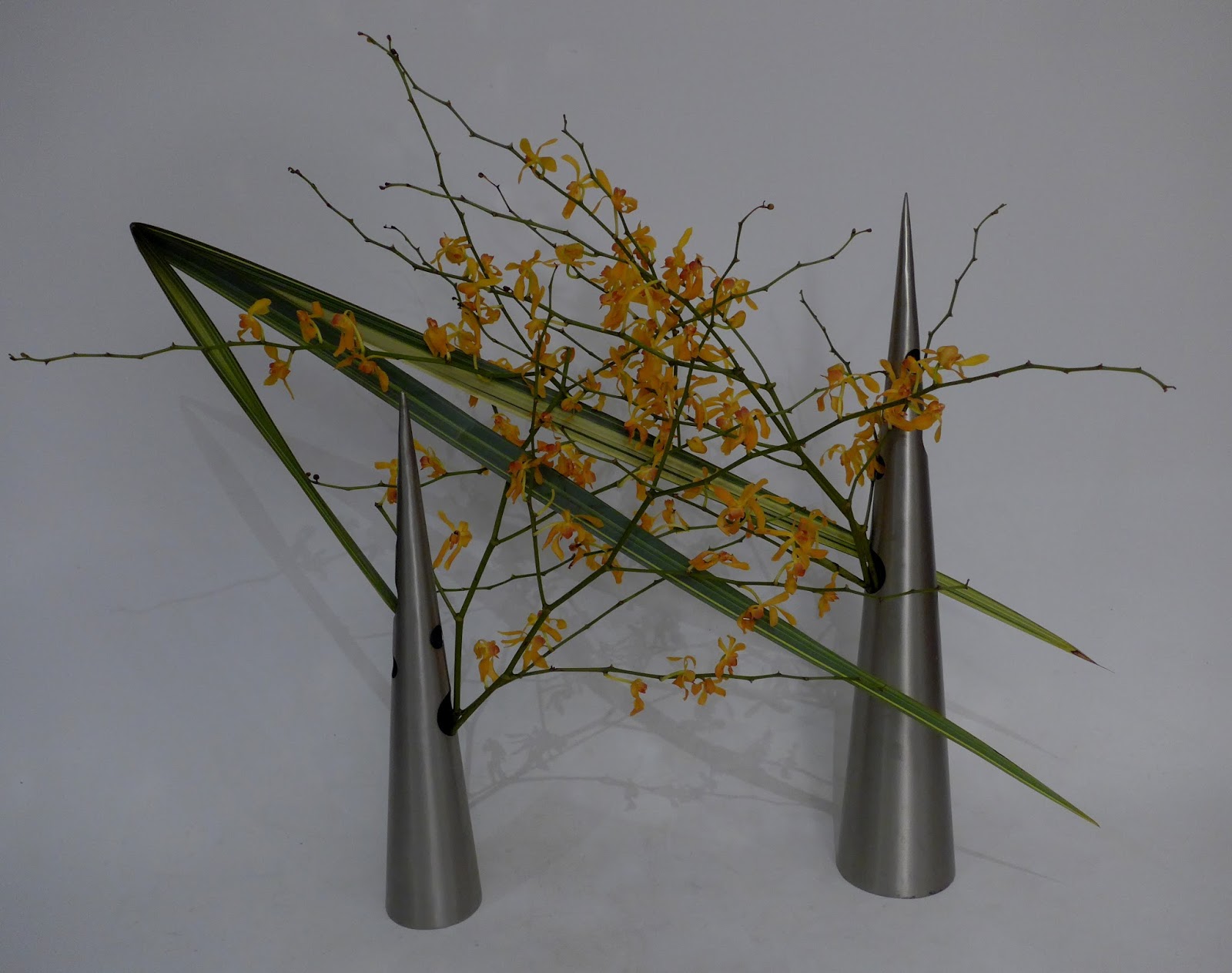
The yellow orchids were from my exhibit and the New Zealand flax was left over
from my demonstration
I reused the amaranthus and nandina domestica nana and
I added the roses to complete this wall arrangement

Thank you for staying to the end of my rant. And now, utterly exhausted, I bid you Good Bye,
Emily


Tuesday, 13 March 2018

Photo courtesy of Christopher James


My poorer quality photo


Hello all,

As I mentioned in my last post, our Ikebana International group held an exhibition in the Bourke Place Foyer last week. The photograph, above, is of my exhibit. I used aluminium louvres, to which I attached 'feet' for stability. I used two large strelitzia nicolai leaves, just as they were changing colour and wisteria vines, that I coloured black. I included the small picture with me in it to indicate scale. For photographs of the rest of the exhibition please go to Ikebana International Melbourne and click on Blog.

Lucy's Exhibit with an Aboriginal flavour
And here she is with her demonstration piece


My garden suffered a major disaster 10 days ago. Our magnificent, mature weeping willow fell. The trunk, which was growing at an angle, started to split after some particularly windy weather two days earlier. On the day in question, I was watching it as it continued to split and fall forward making very scary noises. Three quarters of the tree fell into our driveway, whilst the remainder was still standing. However, we didn't know how safe the standing portion was, so we called SES to come and secure it until we could engage a tree lopper to take care of it.

The heart breaking view of my beloved tree
Initially, we were going to have it removed completely, which would have left a large gap in my garden. But, thanks to an understanding and accommodating tree lopper, we were able to retain quite a lot of it, with thick branches jutting out of the garden like a giant spider. We are hoping that despite the partial split in the trunk, it will continue to grow. The photo, below, shows what it looks like now.


Of course, this was an ikebana opportunity not to be missed. So the senior students were asked to workshop willow.

I trimmed many side stems to reveal this interesting 'elbow' in the
branch and I removed as many leaves as I left on. The container
had to be heavy to hold the weight of the branch. My flowers
were roses and sedum
Nicole stripped the branches of leaves and used belladonna lilies
Vicky also stripped off the leaves, then twisted the stems into circles
and added a brightly coloured bougainvillea 

Lucy managed to balance this heavy branch on the ground and added
a  vase with dahlias
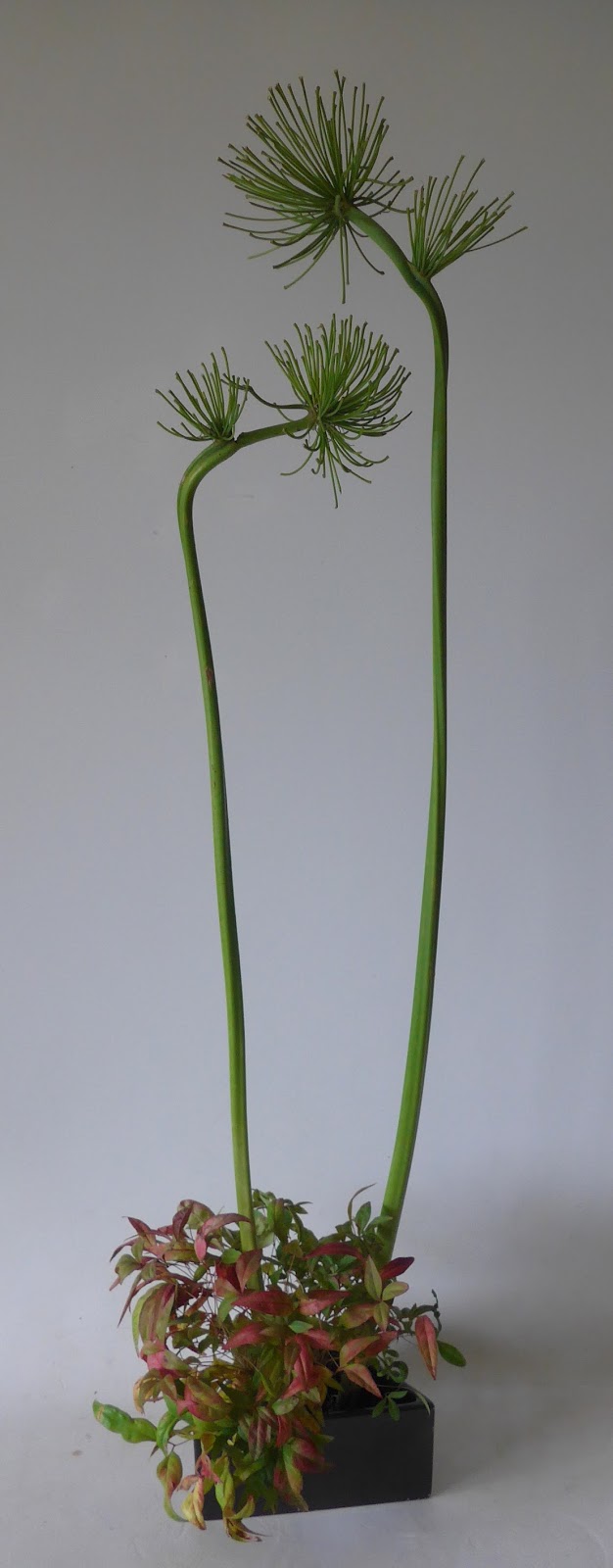
I leave you with this tall arrangement (1.3m), in which I used the left over stem from the strelitzia nicolai, that I used in my exhibition piece. The white belladonna created a natural mass to contrast the lines and added a delightful fragrance.


Bye for now,
Emily


Tuesday, 27 February 2018

This picture was taken through a fly-wire screen, hence its blurry appearance
Hello all,
The juvenile kookaburra in the picture, above, landed on my kitchen window sill and stayed there long enough for me to get the camera and capture it. For some years now, we have had a pair of kookaburras coming to our back yard and been hand fed by Sam. We've watched as they produce two chicks every year. We know when they are nesting because only one comes to feed and when it has had enough it takes food in its beak and flies off, obviously, to feed the one sitting on the eggs.

When the chicks are still fledglings we hear their awkward and quite comical cry. Unlike the majestic call of the adults. When they are able to fly, the adults bring the chicks to our garden but they, themselves, sit up high guarding them while they learn to eat. The young remain with the parents to help with the next generation of chicks and only leave when the new chicks become independent. It's a fascinating family cycle.

We love having them visit and being a part of our lives but we, also, appreciate the services they render. Many times we've seen one of them swoop down and pick up a mouse or other rodent. They, also, keep me company whilst I'm working in the garden.

Perched on the rose arbour


And on the rake handle over the bin


We love these birds that have learnt to trust us but they are not very smart. In marked contrast is the cleverness of the ravens and magpies. They have observed that when we give meat to the kookaburras, they beat it against the tree branch to 'kill' it. This means that bits of the meat drop down and the very opportunistic magpies and ravens are quick to pick them up. They have, also observed and learnt the routine. When the kookaburras appear in our garden, Sam, whose office windows face the garden, usually will go out to feed them. Sometimes, however, he may delay, due to clients, phone calls etc. Then the magpie will come to his window making all kinds of sounds, to alert him that the kookaburras are here and he should come and feed them. Now, that's what I call clever!

And, now, back to ikebana.
Last week we had our first Sogetsu meeting for the year. The workshop was run by Lara Telford, who is the current recipient of the Norman and Mary Sparnon scholarship and, who has recently returned from Japan after three months study at headquarters. Lara's theme was number 48 of 'The Fifty Principles of Ikebana' - 'Remember there are always new,surprising themes and approaches to arranging Ikebana.

Lara requested that we plan and sketch a freestyle arrangement using only botanical materials. Then, at the workshop, she asked us to rethink our original plan and come up  with something new.

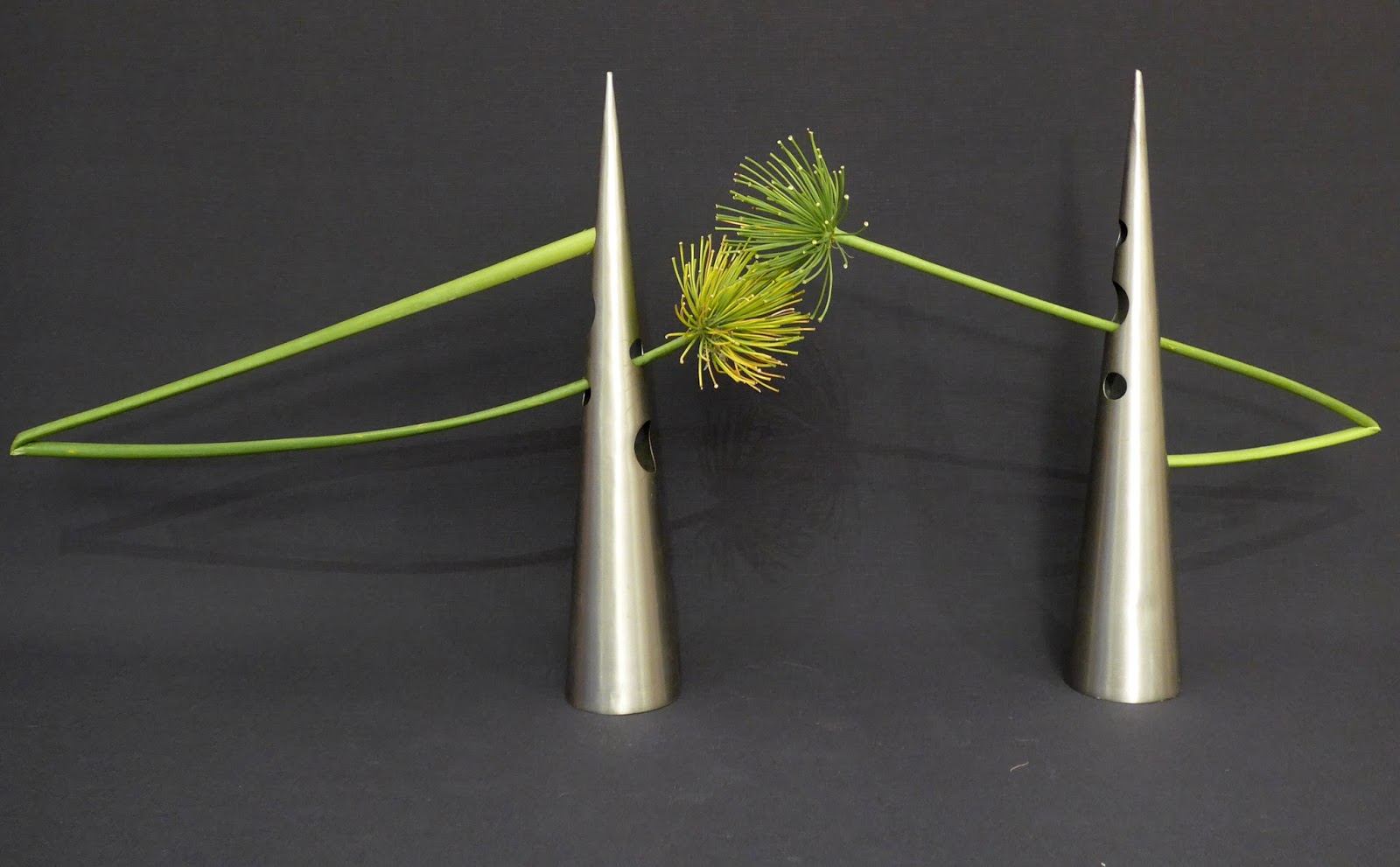
I had planned to use 2 agave leaves and a garlic flower on a glass base that has two small holes. I was going to cut two sticks to about 10 cm and place in each hole, which would then, pierce the agave at the base, thus holding it upright. My very basic sketch is below and next to it is the my final piece.

Original plan
Rethink


Please go to  Sogetsu Ikebana Victorian Branch  for more information and photos.

In my class, last week, the senior students were given the theme from Book 5 - 'Glass Containers'. In this exercise, because the glass is transparent, the inside of the container is just as important as the outside and, sometimes, even more important. We can even create an arrangement only inside the container.

I used agapanthus seed heads and stems, both curved and straight.
Although it looks as though the seed head on the right is touching
the table, in fact, it isn't
Nicole used New Zealand Flax and
Nandina domestica
Vicky's arrangement is a little hard to see - the container is up-side-down, with one
flower head under and two over the container. There is, also, water in the centre


Lucy used straight agapanthus stems
and 2 bougainvillea flowers in a tall vase
Bredenia used a type of Aeonium, featuring the interesting
curves of the stems

Below are two pieces with the theme from Book Four - 'Arrangement with Plants on a Wall'


Aurelia used a prostrate banksia stem and Singapore orchids
I used gymea leaves and ivy


Before I go, I'd like to give you details of our upcoming Ikebana International Exhibition:
Monday 5th – Friday 9th March
9.00 am – 5.00 pm
Bourke Place Foyer
600 Bourke St, Melbourne

Demonstration (Free): By our Lucy Papas
Tuesday 6th March 1.00 pm – 2.00 pm
‘Mistress Café’ Balcony, Bourke Place Foyer

Bye for now,
Emily

Enjoyed this post? Never miss out on future posts by following us