Monday, 12 December 2022

12th December, 2022


Hello all,

Our last class was the final for the year when, usually, we make a Christmas arrangement. This year I set the same theme with a slight variation. A Christmas table arrangement.

The photograph, above is of my arrangement, which I made a few days before class. Unfortunately, the hippeastrums did not last until class, so, I replaced them with the only flowers available in my garden - Queen Elizabeth roses. It makes an interesting colour combination - the pink flowers in a red suiban.

The rest of the materials are pine (pinus radiata), ornithogalum flowers , and palm inflorescence sprayed silver.The strands of silver are mizuhiki.

Jenny used asparagus fern, geranium, lacecap hydrangea, red mizuhiki and Christmas baubles in a twisted, cylindrical container. 


Bredenia used sprayed corky elm branches, altissimo roses and gold and silver mizuhiki.

Nicole used sprayed pear branches, cyprus, roses and Christmas baubles in a ceramic suiban.


Vicky went all modern with umbrella grass, anthuriums, and baubles - shiny and mat black ones and just one white. The container is a glass trough.

Lucy, who is very busy with the building of hers and her partner's new home, came to class without any materials. I told her to go into the garden and help herself but, before she could do that, the other students contributed enough materials for her to create the arrangement, below. The pine was from my 'bucket', the hydrangea quercifolia from Shaneen, the altissimo roses from Vicky and Lucy, herself, provided the sprayed, dried strelitzia leaves.

Mary's class theme was 'Dried, Bleached or Coloured Materials'. She used dried garlic flowers and dried aspidistra leaves in an Ikenobo style container. The fresh material is philadelphus flowers and pinellia tripartita leves.


Before I sign off, I need to make a correction. In my previous post Vicky and I used a material, which was wrongly identified by my Leaf Snap App. It called it Carex acutiformis. However, a much better informed reader of mine, Debra Collett, wrote and told me that it is in fact from the small grass tree,  Xanthorrhoea minor https://inaturalist.ala.org.au/taxa/560378-Xanthorrhoea-minor. Thank you Deb!


Bye for now,
Emily


Monday, 5 December 2022

STRELITZIAS


Hello all,

The strelitzias reginae are looking quite lovely in the garden but even lovelier in my ikebana. In the above arrangement I used two gymea leaves to create the zig-zag design, then added the flowers.

We recently brought an arborist to do some pruning around the garden including removing two of the strelitzia nicolai plants. Once on the ground, I was able to remove the flowers with a longer stem than usual because to do so would damage a number of the leaves. In this case, it didn't matter. 

As always with these flowers, a very heavy container is needed to support the weight of them. The vase, below is very heavy indeed. I certainly can't lift it, so I use it infrequently. It worked well in this arrangement under the stairs.


More strelitzias reginae. I can't resist the unusual shapes these flowers sometimes have. They often exhibit real character in their bird-like appearance.


The material I used in  the arrangement, below is philadelphus coronarius. This plant belonged to my auntie Angela, who passed away many years ago. Her son offered to let me dig it up from her garden before selling the house. It's a poignant reminder of a much loved auntie.


I have another philadelphus in my garden. Below are close-ups of the two. They, also, have a delicate fragrance. Their common name is Mock Orange.


Philadelphus verginalis

Philadelphus coronarias


Sam dropped in to see his brother George, whose wife, Betty, is very successful in growing hippeastrums. George snapped two gorgeous stems and handed them to Sam to give to me. I didn't need to do much to arrange them, except to pick accompanying materials and to place them in my wall container. I did do some judicial pruning of the ferns, although, in the photo, it looks like it needed more.


The previous Sunday Lucy, Vicky and I, together with our respective men, went for lunch at a lovely restaurant down in the Peninsula. On the return trip Vicky collected these interesting, tall stems of flowers. I looked them up and found they are called Carex acutiformis, a type of sedge. She made an arrangement with them and dropped off five of them to me.


Vicky's modern arrangement


My naturalistic arrangement.
Variegated Iris Japonica and hosta leaves


Mary's curriculum lesson was 'Focusing on Water'. She used scrunched up cellophane floating high  in a glass container and added one variegated New Zealand flax leaf and three cumquats.


Bye for now,
Emily


Monday, 28 November 2022

CALLISTEMONS


Hello all,

For last week's class I asked the advanced students to make an arrangement in a basket using callistemons. I had noticed, before we left for our trip, that these brightly coloured, Australian native shrubs were in full bloom and thought they might still be usable for ikebana. Unfortunately, most of the many trees in our area were well past their best but we were able find enough to work with.

For my arrangement, above, I used red bottle brush (callistemon citrinus) and a cream coloured one (Callistemon 'Willow Bottlebrush') in an antique Japanese, bamboo basket.

Jenny used the same materials as I did but her red bottle brush were sitting upright compared to my hanging ones.


Vicky used a basket with lid and, along with her red callistemons, she used a mass of white roses and Limonium meyeri.


Bredenia, also, used red and cream bottle brush stems in a wide basket.


Lucy used a basket she made herself many years ago out of palm inflorescence, during a workshop that I ran for my class. It was good to see it being used again. Together with the red bottle brush, she used strelitzias reginae and dietes flowers.


Shaneen's curriculum theme was a "Table Arrangement'. She used two different coloured roses and spuria iris in an oval, ceramic suiban, keeping the arrangement low, so as not to obstruct guests' view of each other.


Lei's curriculum theme was 'Dried, Bleached or Coloured Materials'. She created a structure from a painted, corky elm branch over a ceramic container and added aspidistra leaves split in half and chrysanthemums.


Dianne did the lesson called 'Free style Ka-bu-wa-ke'. The pink flowering branch is Weigela florida. She, also, used Dutch Iris and gorgeous, purple alliums.


Mary's lesson was ' Using Both Fresh and Unconventional Materials'. She used a rubber sheet with holes punched through it and spuria iris in a white, ceramic trough.


Bye for now, 

Emily


Monday, 21 November 2022

21st November, 2022


Hello all,

Below is the link to the second virtual exhibition, Celebration, of Ikebana International Melbourne chapter. Please click on it to view the exhibition.

https://www.youtube.com/watch?v=bt1eJQsC0wg

My student, Dianne, brought to class a whole bucket of fabulous material, amongst them these stunning peonies, which she gave to me. She lives in Trentham, which is considerably colder than Melbourne and might explain why she has better success with peonies than the rest of us. Or, perhaps she's just a better gardener. Whatever the reason I was very grateful to have the chance to work with these temperamental but gorgeous flowers. I had to include a close up.


With all the rain we had recently some plants have suffered from overwatering but others have thrived. Such a one is my Nandina domestica, which has grown so much that it was encroaching on the foot path and had to be pruned. I cut a large branch and removed three quarters of the leaves before placing it in this tall vase. I love the slanting form and was able to secure it using a horizontal fixture. I, then, looked around for flowers and tried several different ones but none satisfied me, until I noticed this strelitzia with its head looking up. I worked on the stem to create the same curve as the nandina stem.


Vicky recently gave me this quirky container, which I love using.

With rhododendron

With Siberian iris

Last week, as I was preparing for class, my brother-in-law, Peter, walked in and handed me two large stems of kiwi vine in flower. He said they were gift from my sister (Vicky). So I put the branch I was working on into a bucket and proceeded to arrange the kiwi vine. The last of my hippeastrums came in very handy as did the inflorescence of the nandina domestica.


Close up of the flowers which have a 
delicate fragrance


As I was clearing up my studio upon our return from our trip, I was going to throw away these golden ash branches, which I had used previously. But I couldn't. So I played with them and this is what emerged. It was, also, a good way to use my last cymbidium orchid.


Bye for now,

Emily


Monday, 14 November 2022

14th November, 2022


Hello all,

Well, we're home with all that that entails. It was by far the most relaxing holiday we ever had. There are many interesting tours available in Port Douglas but we avoided all of them, having done them before.and chose, instead, to relax at the villa, swim in our private pool and EAT a lot. We will pay the price for that vice later.

In my previous post I lamented the fact that I'm surrounded by some of the best tropical materials but could not use them for ikebana. As luck would have it, on one of our walks around the grounds, we came across prunnings from several palm trees....


The temptation was just too great and I gave into it. Of course, I had my accomplice, my longsuffering, ikebana husband, to help carry some of the cuttings to our villa. Without any tools, except for a kitchen knife, it was challenging to make arrangements but I did my best. Luckily, there was a large white bowl in the kitchen and an empty vase on the bench, both of which came in very handy.

The materials are palm spathes and inflorescence, on the above arrangement the fruit are quite mature, whereas in the photo below, the inflorescence is in what looks like buds. They are both very heavy and tough to penetrate. I tried using one of the needles from the sewing kit provided, but the stem was too woody and the needle broke.

I placed the arrangements in front of the flat screen TV, using it as a backdrop for my photos. Some green leaves would have improved the arrangements but, even as they are, making them satisfied the need I had to get my hands on some tropical material. I was suffering withdrawal symptoms.


Walking down the shopping strip, I noticed this stunning iris-like flower. I looked it up and it is called Travelling Iris (Neomarica) but is not really an iris. The flowers grow at the end of a stalk, which then bends to the ground and sets roots. Hence the name 'Traveling Iris'.

The flowers seem to be growing at
the tips of leaves.


So back to ikebana.

For our last class I had set the theme for the advanced students of 'Both Fresh and Unconventional Materials'. This is always a fun exercise and we all enjoyed it.

Jenny used a whole box of coloured pencils, wired into triangles and, then, joined them into a structure attaching it to a triangular, ceramic container. The arum lilies added height as well as the fresh materials.


Vicky used thick silver wire wound into spiral, spring like structures and placed them in a ceramic container the shape of a cube. She retained the asymmetry by making the 'springs' different size and by placing one green goddess lily in one and two in the other.


The class was the day before we were to leave for our trip, so I was quite time poor. So, for my arrangement, I decided to go into my storeroom and to pick the first unconventional material that I saw and work with that. That turned out to be this bright green, shiny roll of foil with the reverse side in dull yellow.


Then a quick look around for the fresh materials. The loquats picked up the yellow of the foil very well, as did the spuria iris. The mass of white ornithogalums added depth to the back as well as contrast for the other materials. The black vase is glass and has an oval shape.


Shaneen took advantage of the small window of opportunity, whilst iris are available, to do the iris lesson in Book 5. She employed the traditional method of arranging flag iris, with her stunningly beautiful, dark purple blooms and many leaves, as well as a little sprig of Japanese maple.


Wendy's curriculum lesson was 'To be Viewed from all Sides'. The pink flowering branch is called 'buckeye' or 'horse chestnut'. The genus is Aesculus.  She also used Portugal laurel and cottage gladioli in a ceramic, oval shaped vase.


Lei's lesson was 'Focusing on Water'. She used a large suiban and placed a strelitzia reginae flower and leaf diagonally over the top, creating shadows and reflections over the water. The smaller leaves are pinellia tripartita.


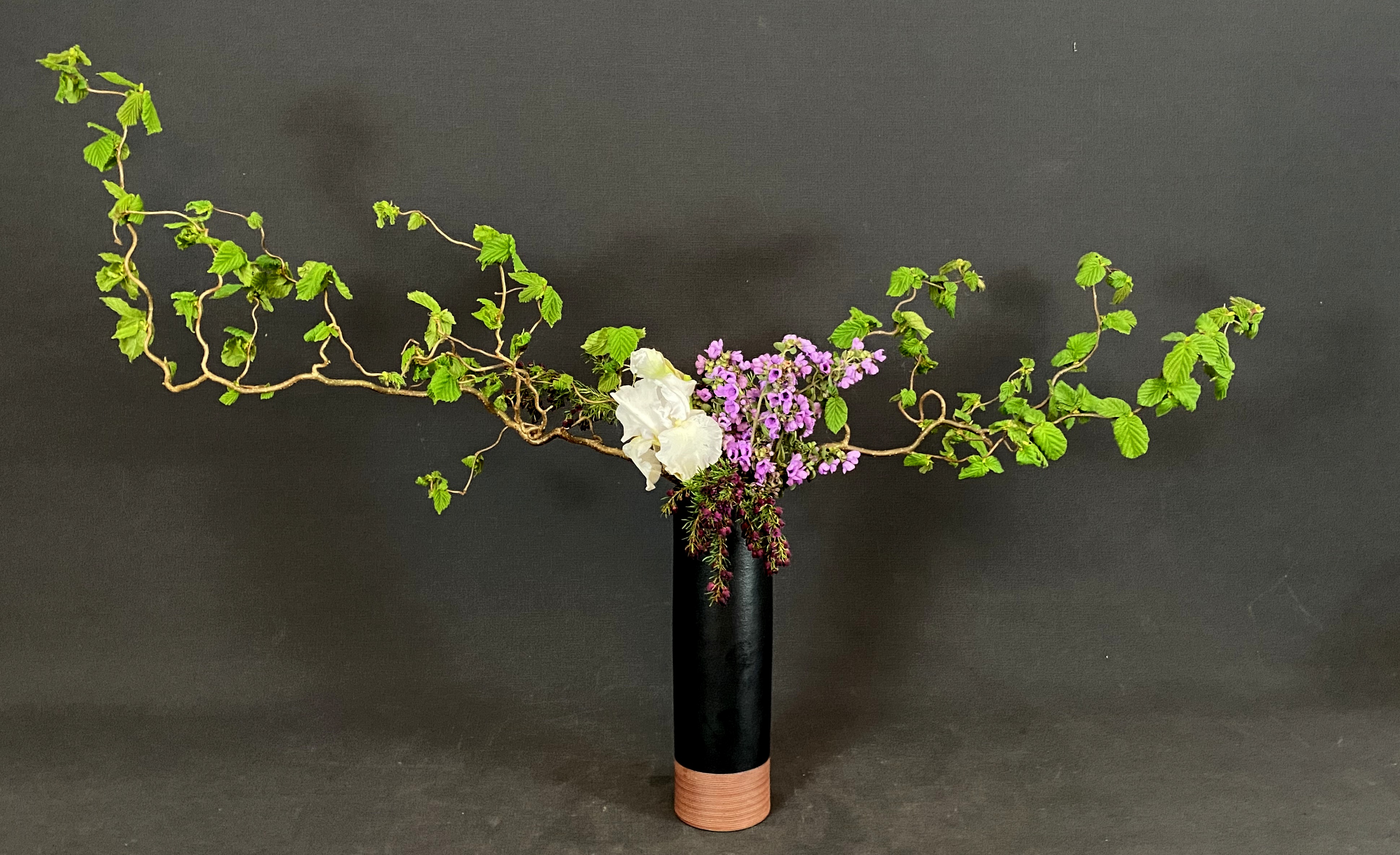
Dianne made a 'Horizontal Arrangement'. She used contorted hazel (Corylus avellana 'Contorta'), white flag iris, native mint bush and boronia.


Dianne also brought along her adorable, brand new puppy, Loulou and Vicky fell instantly in love!


Bye for now,
Emily


Enjoyed this post? Never miss out on future posts by following us