Monday, 26 June 2023

26th Jun, 2023


Hello all,

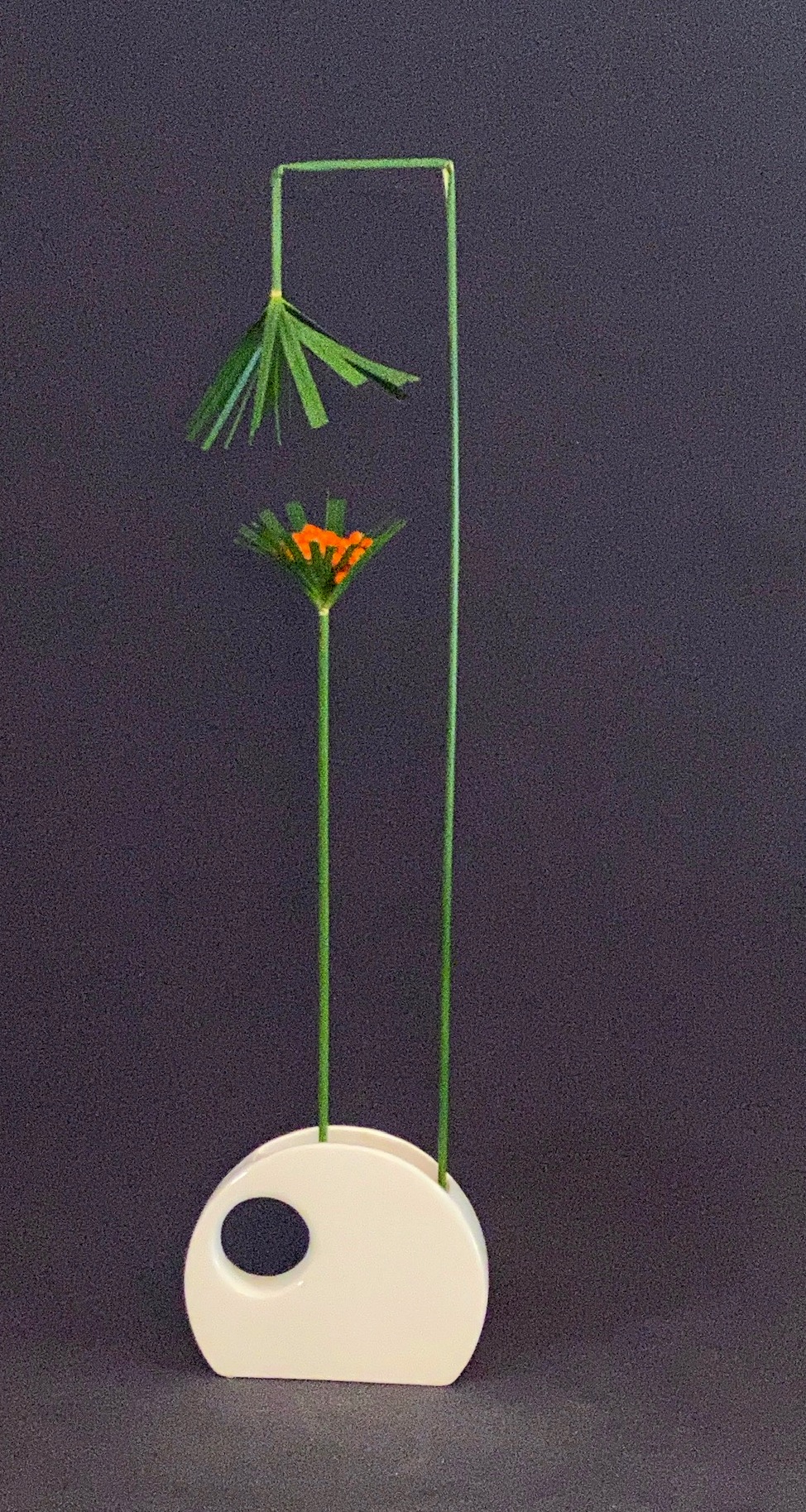
For class last week I had set a particularly challenging, combination theme. I hadn't realised quite how challenging it was until I attempted it myself. We were to make an arrangement 'In a Tsubo Vase' but, also, 'Emphasising Lines at the Base'. Ordinarily, Lines at the base is simple enough when using a kenzan, however, a kenzan is not used in a tsubo vase arrangement. Instead we use a number of different mechanics and we rely on resting one or more stems on the rim of the container. In this situation, we could not use a kenzan and we could not rest the stems on the rim. It made the exercise quite difficult. In fact, I don't think I ever heard as many expletives during class as I did on that day.

In my arrangement, above, I employed two parallel, horizontal fixtures, one higher than the other. I, then, split the lower part of my main stem of Japanese flowering apricot (Prunus mume) and fitted it over the top horizontal fixture and then rested one split half behind the lower fixture, thus holding the branch upright. I was able to work the rest of the materials around the main branch.

Nicole used camellia stems and crucifix orchids in a ceramic vase.


Jenny used bare magnolia branches, arum lilies and Dutch iris in a large ceramic vase.


Lucy's camellia stems had a slanting habit and needed to be arranged that way. She managed to achieve that without resorting to resting on the rim of the container. She followed the same line with the arum lily.


Vicky, after considerable struggle, created an elegant arrangement using Siberian dogwood (cornus Siberica alba) and gladioli in a ceramic vase.


Shaneen had the dubious honour of making the Japanese Narcissus arrangement in Book 5, which requires us to remove a small sheath at the bottom of the stem of jonquils or narcissus, rearranging the leaves and flower and, then, refitting the sheath back. It's a tedious process but Shaneen managed it and then arranged the materials in a vase with many holes. She added a little accent with a sprig of money tree (Crassula ovata).


Wendy's curriculum exercise was 'Simplified Arrangement', where we trim our material down to its very basic elements. She used a single stem of Pincushion Hakea (Hakea Laurina) and removed all but one flower, one leaf and one seed pod.

 
Having finished rather quickly, Wendy made another, smaller arrangement and placed the two together.


Lei's lesson was from Book 5 - Tate-no-soeji-dome - Vertical type fixture. She used holly (Ilex aquifolium) and Chinese lantern plant (Abutilon) in a ceramic container.


Bye for now,
Emily

Monday, 19 June 2023

DEMONSTRATION FOR VERMONT FLORAL ART GROUP


Lucy and I after the demo

Hello all,

Last Wednesday I had the privilege to be the guest demonstrator for the Vermont Floral Art Group at a fundraising event. Proceeds were to go to the Cancer Council.

Lucy, my beautiful assistant, and I arrived bright and early at the venue and unloaded from the car materials and containers for eight arrangements. We were very warmly welcomed by the president, Marion Goldsmith, the committee and members. 

We began our demonstration at the completion of their meeting with the 'Basic Upright' arrangement, being the very first lesson of our curriculum. I haven't included a photograph of that for obvious reasons.

I was not able to take photographs at the venue without intrusive backgrounds so I reset them up at home and photographed them. With the luxury of time I was able to fine tune them before photographing. 

In my arrangement, below, I used a triangular, glass vase with another glass cylinder inside it, filled with cotoneaster berries. When filled with water the berries are reflected on either side. The camellia bud was a necessary element.


Below is a simple arrangement using umbrella grass and orange, cotoneaster berries in a ceramic container.


The arrangement, below, is proof positive of my inability to let go of things, even a broken vase. I tried throwing it in the bin but changed my mind and brought it back inside. I wasn't happy with my first attempt because the space between the two pieces was filled by the dried branch. I was happier when I reduced the branch and just added the crinkly aspidistra.


The next arrangement was a lesson in trimming. The mahonia branch was much bigger and a number of large side branches had to be removed to reveal the lines of the stems and to create space. At the demo I had used the one and only arum lily from my garden however, when I set it up at home I added the sunflowers instead and trimmed a few more leaves.


The next photo is of the lesson 'Fruit and Vegetables'. The glass plate had holes through which I fed skewers attached onto kenzans underneath. I then pushed the vegetables over them. In the interest of full disclosure, it was not as easy as it sounds. The weight of the vegetables was such that it bent the skewers so I had to add supports for them to stay upright.


I wanted to use the basket which I had made using a palm inflorescence but I did not want to crowd it with materials. I wanted the basket to be the main feature. The two branches of Banksia Lemanniana seemed to fit the bill.


Another material that didn't make it to the bin was a bunch of these white, plastic strips. As I was about to put them in the bin an idea came to me on how to use them. So, here's an example of the lesson 'Both Fresh and Unconventional Materials.


For my finale I wanted to use for the first time my brand new container, a birthday gift from my cousin and his wife. I had used a varnish with some colour on the palm pod as its colour was too similar to the container. A vertical fixture held it up and the monstera deliciosa leaf and sunflowers, wedged in tightly, also added stability.


After our demonstration it was time for lunch. I took one look at the sumptuous buffet prepared by the ladies and realised that resistance was futile. So, to my shame, I overindulged.

Bye for now,
Emily


Monday, 12 June 2023

MASTERCLASS #16


Hello all,

At Saturday's Masterclass I had provided the students with a different type of dried material each and one type of fresh material each. So they had only two elements to work with. The dried materials were all quite large and the students could decide whether to keep them large or cut them down.  As always, the selection was by lottery. Each student could choose their own container.

The arrangement, above, was done by Cym, who went through an interesting process. She initially picked her container and placed the large monstera deliciosa leaf at a perfect angle. She then agonised over the fact that it was too easy or too simple, so she tried adding another leaf, then tried pinning the leaves but, in the end, settled for her first attempt because it was the best. She used only a small piece of the large, palm inflorescence, allowing the leaf to be the dominant feature. And for a little bit of whimsy, she added a ceramic mushroom.

Jenny had a very large, dried tumbleweed which had been sprayed black. She cut side shoots and placed them in this large, ceramic container, making sure that movement was created with the branches all facing the same direction. She placed the two stems of amaranthus one in front of the other and hanging straight down.


Bredenia had a number of stems of contorted hazel (Corylus avellana 'Contarta') and aspidistra leaves. She placed the branches over a tall nageire container and bent the aspidistra leaves to give them a horizontal appearance.


Akemi had a very large, palm inflorescence and chose not to cut it down. She did, however, weave the tendrils into submission and then hollowed out the inside creating space. Unfortunately, it's hard to see the space in the photo. She had three, variegated New Zealand flax leaves but needed only one for drama.


Lucy had a tangle of red and black coloured wisteria, which she disentangled and used separately. In her first arrangement she used the red wisteria in a heavy container with splits on either side and placed two strelitzia reginae leaves horizontally.


With her left over material she made another, rather dramatic arrangement.


Vicky felt she had the most boring of materials but she rose to the challenge and created this spiderweb-like structure, keeping it monochromatic, except for the umbrella grass stems.


I must confess that, as a teacher, I'm quite impressed with the quality of the work produced in these classes. We comment on and discuss our work freely and learn from each other. Very satisfying.

Bye for now,
Emily


Monday, 5 June 2023


Hello all,

The mahonia branch in the arrangement, above, was an offcut from an arrangement I did last week in the shape of a pinwheel. I removed all but two, parallel leaves and added a partially open camellia to complete the arrangement.

The arrangement, below, comprises of only one, long stem of chrysanthemums. I wanted to use this curve that was created naturally but it was too weak to hold the cluster of flowers at the tip of the branch. I removed 5 flowers to lighten it and then had to rest the branch on the top of the large conical container.


The photograph, below, is of a floor arrangement. I attached a dowel onto the wooden board and fitted the palm pod over the dowel, making quite a secure structure. I added wisteria vine, chrysanthemums and amaranthus. The fresh materials are in vials inside the palm pod.


The arrangement, below, is a simple but striking one. What makes it work is the combination of container and materials. The curved stem of the crucifix orchid creates the line and the hydrangeas create the mass, both of which relate to the container - colour and shape.


There's something quite charming about a tree that has lost its leaves but is laden with fruit. Such is the case with my pomegranate and fig trees. I cut branches from both to make an arrangement. I needed a very heavy container to hold the very heavy branches, so I settled on the onyx tsubo vase. In my last post I referred to it as travertine, however, Christopher kindly corrected me. I added camellias and cotoneaster branches to complete the arrangement. It can cover a number of themes - Fruiting branches, With branches only, In a tsubo vase and A number of Materials.


Another simple arrangement, below. Wisteria and crucifix orchids in a ceramic vase.


Yesterday Sam and I attended our grandson's Confirmation ceremony which was held at St Patrick's Cathedral. It was quite an experience, as we are not Catholic and have no idea about such matters. The most important thing was being there with our grandson on an important occasion. The second important thing was seeing the inside of the Cathedral. I've been wanting to go and see it for years but never go around to doing so. This was a great opportunity, as it is a truly magnificent structure.

Bye for now,

Emily


Tuesday, 30 May 2023

Supplementary post


Hello all,

When I published my post last night, I forgot to add the information, below. I had added it as an update but, those of you who subscribe to my blog, will not receive it. Hence this supplementary post. My apologies to those who will receive it twice.

I'd like to let you all know that due to unforeseen circumstances, Sam and I have decided to bring forward our plans to downsize. This decision is a particularly difficult one for me as we have loved living in this house that we built ourselves and the garden that I have developed for 32 years. I fear my ikebana will suffer greatly without the resource that is my garden.

So, enough with the sop story. In order to prepare the house for sale, we need to do some decluttering, in particular of our storerooms. To that end, I have notified the ikebana community that I will be selling some of my ikebana 'stuff'. This will include a huge number of dried materials, unconventional materials, ikebana containers and some other odds and ends. In the interest of full disclosure, I will not be selling my best containers, as I will continue to teach and run this blog but there will be quite a few to choose from.

I will also be selling some of my better clothes that, sadly, no longer fit me. They will all be sized 12.

This event will take place on Saturday 3rd and Sunday 4th June from 11.00 am to 4.00 pm. If anyone wishes to attend but does not have my address, you can email me and I will give it to you.

Bye for now,
Emily

Monday, 29 May 2023

PINWHEELS AND MORE


Hello all,

 Nature did all the work in creating the shape of the mahonia in the arrangement, above. All I had to do was trim it right back, removing leaves and leaving only the ones that create the pinwheel effect. The tall, thin, stainless steel vase was perfect to showcase the shape and the hydrangeas add the floral accent.

Inspired by the shape of the mahonia, I reused a piece of dry Japanese maple that came from a large, standard tree, which has died. This time I used it in a wall arrangement and added hydrangeas and cotoneaster berry branches.

Autumn in Melbourne is truly glorious. Below are two views of my persimmon (diospyros kaki 'Fuyu').
This is just a small example of northern hemisphere trees changing colour. My back garden is flanked by a mature golden elm on one side and four, mature English elms on the other. They are all in their autumnal colours and the effect is extraordinary.


Can't get enough of autumnal arrangements. Admittedly the foliage does not last very long in this state, requiring frequent replacements. 

Possums, or maybe rats, have defoliated my entire smoke bush (cotinus 'grace'). A few leaves have survived at the very tips of the bush. If you look closely at the branch in my arrangement, below, you'll see the partially eaten leaves at the top.


My sister-in-law, Toula had given me lots of chrysanthemum seedling a couple of years ago, which I planted and which are going gang busters. They have extremely long but thin stems, which are not able to hold up the heavy clusters of flowers. I staked them in the early stages of growth but, then, forgot about them so they created long curved stems with the heavy flowers resting at the top of the pots. I was determined to find a way to use them in ikebana and, below is the best I could do. I hasten to add that the stems were much longer and had to be trimmed back.


And here's a simplified arrangement using a pomegranate in the same container.


The fruit in the next arrangement is an astringent persimmon. The one and only fruit produced by this tree this season.


Mary's class theme was 'In a suiban without a kenzan'. She used viburnum opulus branches, one strelitzia leaf and Dutch iris in a ceramic suiban.


Before I sign off, I'd like to let you know that due to unforeseen circumstances, Sam and I have decided to bring forward our plans to downsize. This decision is a particularly difficult one for me as we have loved living in this house that we built and the garden that I have developed for 32 years. I fear my ikebana will suffer greatly without the resource that is my garden.

So, enough with the sop story. In order to prepare the house for sale, we need to do some decluttering, in particular of our storerooms. To that end, I have notified the ikebana community that I will be selling some of my ikebana 'stuff'. This will include a huge number of dried materials, unconventional materials, ikebana containers and some other odds and ends. In the interest of full disclosure, I will not be selling my best containers, as I will continue to teach and run this blog but there will be quite a few to choose from.

I will also be selling some of my better clothes that, sadly, no longer fit me. They will all be sized 12.

This event will take place on Saturday 3rd and Sunday 4th June from 11.00 am to 4.00 pm. If anyone wishes to attend but does not have my address, you can email me and I will give it to you.


Bye for now,
Emily


Monday, 22 May 2023

22nd May, 2023


Hello all,

The Sogetsu workshop last week was presented by Lara Telford who set the theme 'Ikebana Incorporating Wood'. We were to avoid using branch material but, rather, driftwood, old, weathered wood etc.

Mine is the arrangement, above. There are two pieces of weathered wood joined together, resting on the ceramic container I found the larger of the two pieces in a ditch, covered with mud in the early days of my ikebana journey. It was at a time when I had little in the way of materials and containers, so, I was ecstatic at finding this piece. I took it home and cleaned it, then, after it dried, I sprayed it with a clear, mat spray to protect it. I used some of my pomegranates, two of which had split open revealing the jewel-like seeds. To the back I added hydrangeas in their autumnal colours. The large board adds a certain formality to the arrangement. 

Lucy's arrangement, below, was made up of a thick stump cut vertically and the two halves placed on a board. She emphasised the 'chasm' between the two pieces by placing a camellia through it, with its stem in a small, round vase at the other end.

For photographs of arrangements by Lara and the other members, please click on Sogetsu Victoria and then on Recent Workshops.


For class last week the senior students were to make an autumnal arrangement in a tsubo vase. I always make an arrangement of the theme I set for the class. I like to show them an example but, also, I need to keep practicing and challenging myself.

In my arrangement, below, the method that I used for fixing the magnolia branches was 'Yoko-ichimonji-dome' (Horizontal single-bar fixture). I used orange and yellow chrysanthemums and a stem of amaranthus'


Nicole used crepe myrtle and viburnum opulus branches, which she split and fitted into each other. She finished the arrangement with hydrangeas.


Cym borrowed my tsubo vase made of stone (I think it's travertine) and used viburnum plicatum tomentosum branches, chrysanthemums and pomegranates.


Lucy used a tsubo vase in a vibrant blue colour, which contrasted well with the warm, autumnal colours of the persimmon branches and the orange chrysanthemums. She added a third element towards the back with the Japanese anemone seed heads.


Mary's lesson was from Book 5 - 'Jumonji-dome' (Cross bar fixture). She used viburnum opulus branches and disbud chrysanthemums in a ceramic vase.


Dianne's lesson was 'Colour of the Container'. She used a ceramic suiban in a bricky-red colour which was picked up by the flower buds of the Laurustinus branches. The pink kaffir lily (Schizostylis Plant) also had a reddish colour in the centre of each flower. Dianne based her arrangement, loosely on Variation No. 4 - slanting style.


Lei's lesson was 'Focusing on the uses of Water' She used fatsia leaves trimmed and three hydrangeas. She kept the arrangement low and hovering over the suiban container, bringing the focus onto the water.


Wendy' lesson was 'A variety of materials'. This is a challenging exercise, often looking crowded or messy. Not so with Wendy's arrangement. She kept to a pastel palette and created both space and movement with curved materials. I don't know the name of the dry material but the others were Dutch iris, snapdragons, chrysanthemums and salvias. She used pebbles to cover the kenzan.


Bye for now,

Emily


Enjoyed this post? Never miss out on future posts by following us