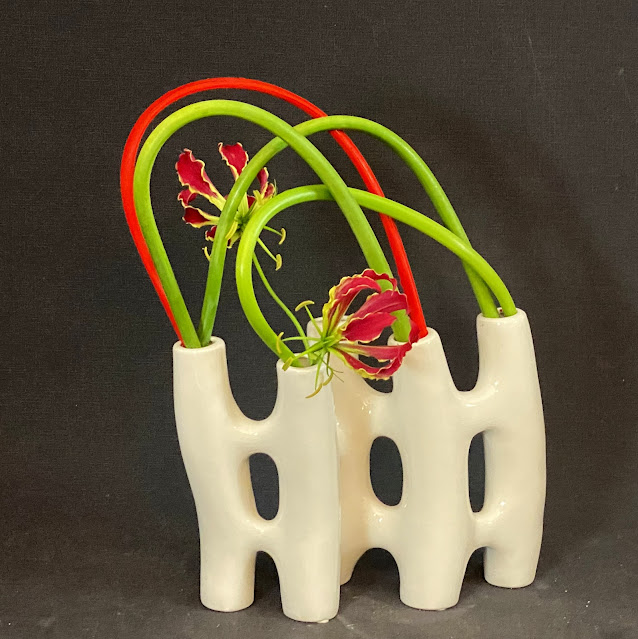
Monday, 14 February 2022

14th Februry, 2022


Hello all,

And Happy Valentine's day to the romantics among you.

The first, regular class for the year had to be postponed due to covid and was held last Wednesday. The theme I set for the advanced students was to make an arrangement using seasonal materials. Seasonal flowers are quite easy to find in Summer but leaves and branches are another matter. Any material that is available for more than one season is disqualified. 

In my arrangement, above, I used crabapple branches with fruit on them, thus ensuring that they were seasonal. And I used the last of my gloriosa lilies to finish the arrangement.

Jenny used pineapple lilies (Eucomis) and one, quite amazing, orange flower called Fireball lily (Scadoxus multiflorus). The flower was so big that it dominated the arrangement, so Jenny partially concealed it with the pineapple lily.


Vicky also had an abundance of pineapple lilies. She teamed them up two of them with stripped agapanthus flower heads and crocosmia stems without flowers in a ceramic container. By keeping the agapanthus low, she emphasised the beautiful colour and curves of the stems of the lilies.


Lucy used kaffir lime branches, hydrangeas, agapanthus and crocosmia in a traditional, ceramic vase.


Bredenia also used crocosmia, agapanthus and hydrangeas in a ceramic container. This arrangement also addresses the theme 'With Flowers Only'.


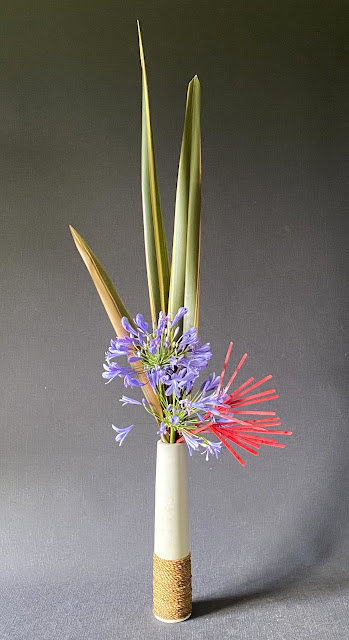
Shaneen's curriculum piece was on the theme 'Using Fresh and Unconventional Materials'. She used New Zealand flax and agapanthus for the fresh materials and put together a couple of fan shaped structures from icy pole sticks, which she then sprayed red for the unconventional materials.


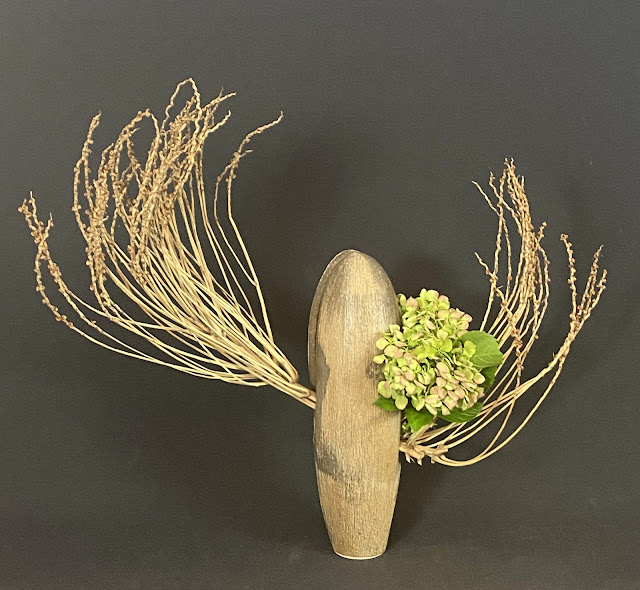
I leave you with this arrangement using a type of date palm inflorescence and hydrangeas in a ceramic container with openings on both sides. I found  the dry material in the storeroom whilst looking for something else and got so  distracted making this arrangement that I forgot what I was looking for originally.


Bye for now,
Emily


Saturday, 12 February 2022

Masterclass No. 8


Hello all,

Today's Masterclass was held on our balcony with the ceiling fan on and social distancing. We have to find ways to stay as safe as we can from Covid, while at the same time continuing with life. We've had to put things on hold for far too long. It was just great to see everyone and to catch up, as well as indulge in one of our favourite activities.

As in previous Masterclasses, I selected the materials for each arrangement and they were given to the students based on a raffle. This time, however, I asked each one to pick a container for their material themselves. Once they did so, I asked them to move one place over, thus having a container and materials they did not choose. I wanted to avoid choosing both the materials and container because, try as I might, I can't help injecting my opinion and taste n the choices.

The arrangement, above, was done by Lucy Papas. The container had been picked by Vicky, when she thought she would be working in it herself. The materials are fern fronds, variegated New Zealand flax and hydrangeas.

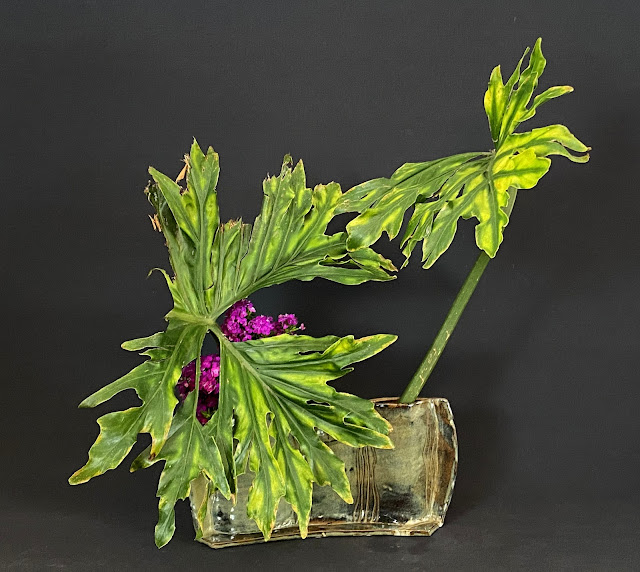
The next, very strong arrangement was made by Bredenia, who found herself out of her comfort zone with this large container and equally large materials. The container was selected by Jenny and was ideal for the tree philodendron (philodendron selloum). The strongly coloured sweet williams were massed behind the leaf on the left.


Jenny's container in the arrangement, below, was chosen by Lucy and worked very well for the hanging branch of viburnum opulus. The roses are 'Queen Elizabeth' and the hydrangea at the back is a white one that has started to change colour.


Christine, also, found herself with a very strong container, selected by Bredenia and strong gymea leaves. She created loosely triangular shapes with the gymeas and repeated the shapes with the finer dietes leaves. In contrast she had very delicate cleome spider flowers.


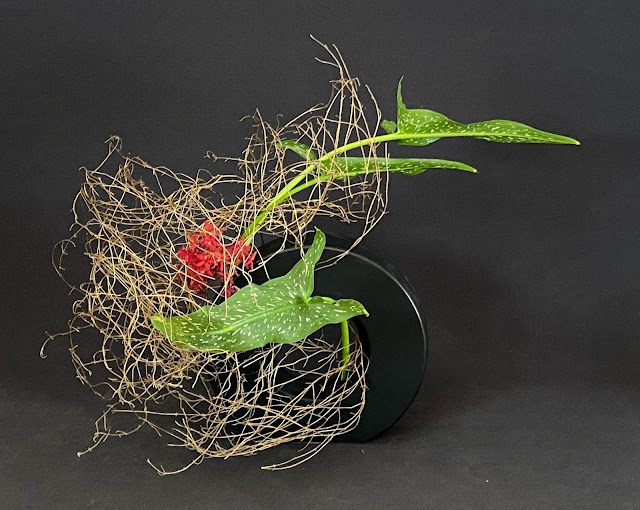
Akemi had some unknown, light, dry material, which I found in the storeroom and a very strong, doughnut shaped container, chosen by Christine. By concealing the greater part of the container with her material, she reduced its strength and created better balance. The placement of the calla lily leaves complemented the curve of the container and the crucifix orchids added just the right accent.


And last but, by no means, least Vicky battled with large golden elm branches to accentuate their curves. She did this by removing the leaves from one side of each stem, creating more space and emphasising the stem. The heavy, ceramic vase, selected by Akemi, doesn't allow for a horizontal fixture due to its slightly conical shape but Vicky managed to balance the stems in the end. The pink cleomes added the floral accent.


I have to admit, I was very pleased with everyone's work today.

Bye for now,

Emily


Tuesday, 8 February 2022

7th February, 2021


Hello all,

The last few weeks, since my son and his family left us and returned to their home I've been addressing certain chores that I've neglected for far too long. One of those chores was to have my studio painted. The painting part was easy enough because we employed a painter to do it but Sam and I had the Herculean task of removing the hundreds of containers, shelves, tables and paraphernalia that I accumulated for decades. And, then, I had to put it all back, after cleaning and culling as much as the horder in me would allow. I, also, had to go through several boxes of paperwork, throwing away the bulk of it but, in the process, rediscovering little treasures.

In order to tidy up my studio, some things had to go to the storeroom, which is in a much worse state than the studio. I'm still in the process of clearing up down there, which is a really horrible task but, here too, I,m discovering treasures I'd completely forgotten about. One of them was the palm inflorescence in the wall arrangement, above. Although it is quite big now, it was even bigger and had to be reduced for balance. The hydrangeas are the only blue ones left and I had to use all 7 flowers because of the size of the arrangement.


I made this arrangement in mid January and, I have to confess, it's the sort of arrangement that appeals to me quite a lot. So I kept the structure and replaced the flowers as they died. Three weeks later, the umbrella grass stems dried and changed colour. It now had a different, more subdued look, so I replaced the gloriosa lilies with white hydrangeas that are starting to turn green. 


In my last post I made an arrangement that I called 'Lazy Ikebana'. The flowers of the Port St John creeper died  quickly and, rather than put away the structure, it was easier to make another arrangement with it. I wanted to use something up high, so it had to light. I have an abundance of dried agapanthus heads, which I sprayed pink. But, then, I remembered that I don't like pink, so I re-sprayed them blue. I'm not entirely sure I like the blue either but it's better than the pink. Now, I had an arrangement of only dried materials, which makes me uncomfortable. I have to have some fresh material, otherwise, I feel the arrangement looks dead. In the first photograph I used two fresh agapanthus heads but I was not happy because there was not enough contrast between the blue and the green. I then replaced them with three, fresh, white agapanthus, the stems of which I put in water vials. 


Amongst the 'junk' in my studio I found a couple of broken picture frames and I debated weather to throw them away or use them. The latter prevailed. I created one rectangular and one triangular shape intertwined. The slate topped container was made by my brother-in-law, Peter who, clever man that he is, weighted it down with lead to give it more stability. The crocosmia are a soft contrast to the sharp lines of the structure.

For Lunar New Year I made three celebratory arrangements for our neighbours, all three families being Chinese. They, in turn, brought us delicious, traditional Chinese goodies. Every year one of them brings us freshly steamed dumplings and always times them to be ready around dinner time.

In the arrangements I used gold and red colours, as they appear to be popular in Chinese culture. Below is one of them.


My student, Mary, is up to the exercise in Book 3 - 'Colours in Contrast'. She used blue agapanthus and orange dahlias and crocosmia, the two colours being on the opposite sides of the colour wheel.

Bye for now,

Emily


Monday, 31 January 2022

CURVED STEMS


Hello all and to those celebrating Lunar New Year, may it be a happy, healthy and prosperous one. 

The photograph of the arrangement, bove, was taken a month ago, when the agapanthus was mainly in bud. I noticed a number of distortions on some of the white flower buds and wanted to use them. I recently bought the glass tubing that's twisted, much like the Gordian Knot, and wanted to use it with the curved agapanthus. After trying a number of other vases to go with it, I settled on this one because the diameter was just right. With the transparency of the glass vase, I had to take care that the part of the stems that were inside the vase were a part of the arrangement. I kept them as straight as I could manage and to the left side of the vase, leaving space on the right side.

And whilst we're on the topic of curves, in the arrangement, below, I used aliams called 'Drumstick', which I manipulated, whilst they were growing, into these curves. I grow almost all my bulbs in pots because I don't have room in the garden for them and I lift them out when they die down and repot them at the right time for the following season. This way I have great success with them. However, the bulbs for these alium are so  small that I missed them and planted other things in the pot they were in. The dear things came up anyway and did very well. 


They are very worth while growing because they last very well as a cut flower. They even dry welI. I made this arrangement 2 weeks ago and, after getting tired of it, I dismantled it and used the same flowers in the next arrangement. An example of the lesson in Book 3- 'Composition of Straight and Curved Lines'.


And just on more with curves. This is a small arrangement for the powder room. I used more of the allium together with squiggly grass in a container that was given to me by my daughter having bought it in The States.


With the current heat and humidity it feels like we're living in the tropics. Both materials I used in the next arrangement are tropical plants. The strelitzia nicolai leaf that has just unfurled has the two tones of green and, of course, the gloriosa lilies are distinctly tropical. My original plan was to have the leaf on the table without a container because it can last for a little while without water. For the lilies I used water vials hidden in the curled up leaf.


Then I thought I'd see what it looked like in a container. I used this large, heavy one made of reconstituted stone, for balance, both visual and actual.


This last one I call 'Lazy Ikebana'. I found the branch structure in the storeroom. It's been there since 2015, when I had originally used it in a demonstration. It needed a touch up of black spray paint but the rest was fine. The flowers are from my next door neighbour's creeper that I have to keep cutting back. It's called Port St John Creeper and it has lovely, long stems, just right for my needs.


Bye for now,
Emily


Monday, 24 January 2022

SWELTERING SUMMER


Hello all,

Well, the heat has been relentless here in Melbourne the last couple of weeks, which affects not only me but also my garden, Unfortunately, our rain water tanks, which have  capacity of 14,500 litres, are both empty and we have to rely on mains water. I have a number of hydrangea shrubs, which require regular watering but, also, protection from the searing sun. Sam and I have been covering them with old sheets, over which I spray water periodically. So far, we've managed to prevent them from cooking. By the way, if you decide to do the same, make sure you use white sheets because the dark ones absorb heat and will do more harm than good.

I've managed to do little gardening jobs in the cooler parts of the day and one of them is the constant battle with the wisteria, which is hell bent on climbing the three trees that grow near it. It had also wound itself very tightly around the cordyline and, in the process of disentangling it, I broke a large piece. Hence the arrangement, above. I removed a great number of the leaves. In fact, if you look closely at the stem, the lighter, upper part was covered with leaves. Having removed the superfluous ones, I was able to create this windswept look. The agapanthus is called Queen Mum and has a tinge of pale blue in the lower part of each individual flower. Sadly, it's not visible in the photo.

Eucalyptus lehmannii, commonly known as bushy yate, is my favourite eucalyptus. There are several, mature trees growing in a rather wide median strip in my area. I just managed to catch them before they were past their best. Of course, any time I try to cut something from along the road (never from people's gardens), some passing motorist feels obliged to toot at me, making me jump out of my skin. 

You can be forgiven for thinking that I just placed the stems in the vase but it's not so. It took some trimming and separating the side stems and repositioning them in a more harmonious design. It's a good example of the lesson 'Paying Attention to the Colour of the Container'.


For the first time in, literally, decades, I planted some Cleome Spider Flower seedlings and am now reaping the rewards. I used the first two flowers in a very simple arrangement together with them a lasoo of the errant wisteria.


My Stefanotis is doing particularly well, climbing on the wall next to the balcony. It has a reputation of being a difficult plant but I must have planted it, by fluke, in just the right spot. Its heavily perfumed, pure white flowers frame one side of our balcony, where we've been having our dinners of late. An added bonus is a little bird (species unknown) with a long beak, which comes for the nectar. The plant is also a memento of my colleague, Joan Norbury, who, having heard me say that I like Stefanotis, arrived at my doorstep with a pot of it. The only down side is that the flowers don't last very long in an arrangement. The one, below, barely lasted two days.


With left over umbrella grass stems, I made the arrangement, below. In order to get the jagged lines, I had to wire the stems, which was quite a struggle because they are not tubular and don't allow the wire to penetrate. I used crucifix orchids in two matching, ceramic vases. 


Like all gardeners, I too, have my failures. Out of a whole packet of sunflower seeds, I only got three flowers. The one, below, was growing close to the strelitzia nicolai, which had a fresh leaf, just starting to unfurl. So I cut them both and married them together in this next arrangement.


Bye for now,
Emily

Monday, 17 January 2022

GLORIOUS GLORIOSA


Hello all,

Recent, consistently warm weather caused my gloriosa lilies to flower prolifically. In fact, they went berserk! The problem is that there are so many, it's hard to use all of them in ikebana but I gave it a darn good try. It's important to cut the flowers, so that more will come later and, because we have no classes, I can't share them with students. I can't share them with family either because we are self isolating, as we are close contacts with someone who tested positive to covid. Fortunately, our first test came back negative but we need to have a second one before we're out of the woods.

In the wall arrangement, above, I used umbrella grass stems to create a structure of surfaces using lines. Because of their short stems, I used the gloriosa lilies as a mass.

The next arrangement is one I made last week in which I featured my dark purple agapanthus. The structure took some time and effort to create and I didn't want to dismantle it after just one week, so I replaced the spent agapanthus with gloriosas.

The next one came about because one of the flowers had broken away without a stem and, not wanting to throw it away, I placed it inside this lopsided, glass container. It looked a bit lonely on its own, so I gave it a companion - the wine decanter and another gloriosa lily.


The flowers on some of my curved agapanthus had died but their stems were still useable and, together with an old, dry, coloured stem, I made the next arrangement. The gloriosas are there as the floral accent.


The down side to these delightful flowers is their short stems. There are ways, however, to overcome this problem in certain situations. In the next arrangement, in order to sit the flowers higher than they would reach, if in water, I adopted a method used by Ikenobo demonstrator from Indonesia, Andy Djati Utomo. He had attached a florists' water vial to a stick so that he could elevate some beautiful orchids with short stems. I did this for one of the flowers and, for the other, I used an old, narrow eye dropper, that I've had lying around for years. Please don't ask me where I got it from, as I don't remember. Of course, we can only use these methods when we can successfully conceal them.


And here's the arrangement using variegated sansevieria with the gloriosas.


I haven't used any of the gloriosa leaves, even though they are quite beautiful in themselves. That's because I would have to cut some side shoots, which would eventually bring buds and I don't want to sacrifice those future flowers. I thought, however, that you would be interested to see the delightful 'hook' that's at the end of each leaf. This is the way this creeper supports itself against whichever host it finds. The leaves, mostly, attach to other leaves using this 'hook', which is remarkably strong for something that looks so delicate.


Bye for now,

Emily


Monday, 10 January 2022

10th January, 2022


Colours in a similar tonal range

Hello all,

The arrangement, above, is very much a summer one. The crocosmia, which are in full bloom at the moment, were very late in flowering compared to others I've seen in gardens quite close to ours. I haven't been able to work out why my plants are always late to flower but it can be quite frustrating. There are also clivias and a fatsia leaf that changed colour out of season. The berries are from  herbaceous plant called Arum Italium - pictum. Below is a photo of an arrangement I made over a year ago using the flowers of this plant.


Someone, who shall remain nameless, broke a very large piece of my aeonium and handed it to me. It's an awkward piece because it is quite heavy and long ( just under a metre) and was growing downwards with the flowers looking up. Placing its stem in water was going to be a challenge.


 I needed a tall and heavy container, so I settled on this stove pipe, ceramic vase with an unusual opening. It had, actually broken and I sanded down the rough edged and painted them the same colour as the vase. It did the trick. It's a big and sturdy vase, so I was able to wedge a horizontal fixture to hold up the curved stem of the aeonium.


Having secured it into the vase with the flowers looking up, as they should, I had to decide what else I could use to finish the piece,


I trimmed some of the more errant flowers, then I tried a number of different materials and found them wanting. In the end I went with canna lily leaves, which have a rich, reddish brown colour to complement the aeonium. But they were not enough. I added some large hydrangeas with a tinge of pink in them but I did not want them to dominate, so I partially concealed them with the leaves. Below is the completed piece, in situ under the stairs.


By anyone's standards, I have an overabundance of the regular, garden variety agapanthus but only two plants of the dark purple ones, that Vicky gave me a couple of years ago. I looked them up and I believe this variety is called Purple Cloud. They are quite lovely and  I wanted to feature them, hence the arrangement, below. I thought that the white would be a great foil for the dark purple and it was but, I felt, it needed a bit more, so a couple clivia flowers peeking from underneath, was just enough.


I've used osage oranges, Maclura pomifera, many times before but this time I wanted to try something different. This is what the fruit looks like in its natural state. 


And this is what they look like after I sprayed them gold.


And here they are in an arrangement with smoke bush and hydrangeas in a metal vase.


Bye for now,
Emily


Enjoyed this post? Never miss out on future posts by following us