Saturday, 11 December 2021

Masterclass no. 7


Hello all,
Today we had the last Masterclass for the year. This time the challenge was using difficult containers. I chose containers that I have found most difficult to use in the past and materials to be used with each, that I would not, ordinarily, have put with the particular container. As always, the selection was by lottery.

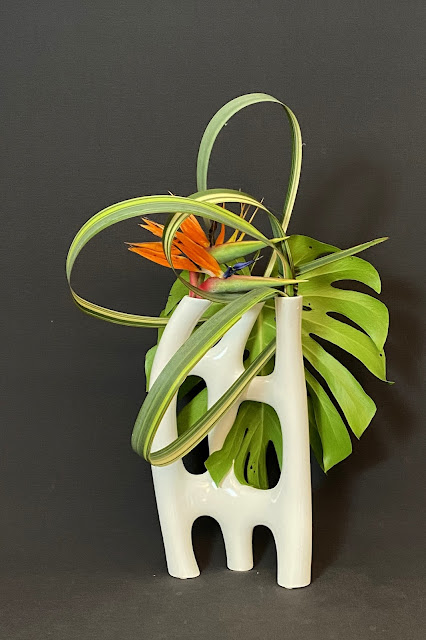
The arrangement, above, was done by Christine Denmead. I particularly liked her use of the monstera deliciosa leaf used behind the container and showing its underside. This added volume to the back whilst allowing the large container (60 cm high) to dominate. The New Zealand flax curved forward, and added volume to the front and created space. The two strelitzias reginae added the accent of colour.

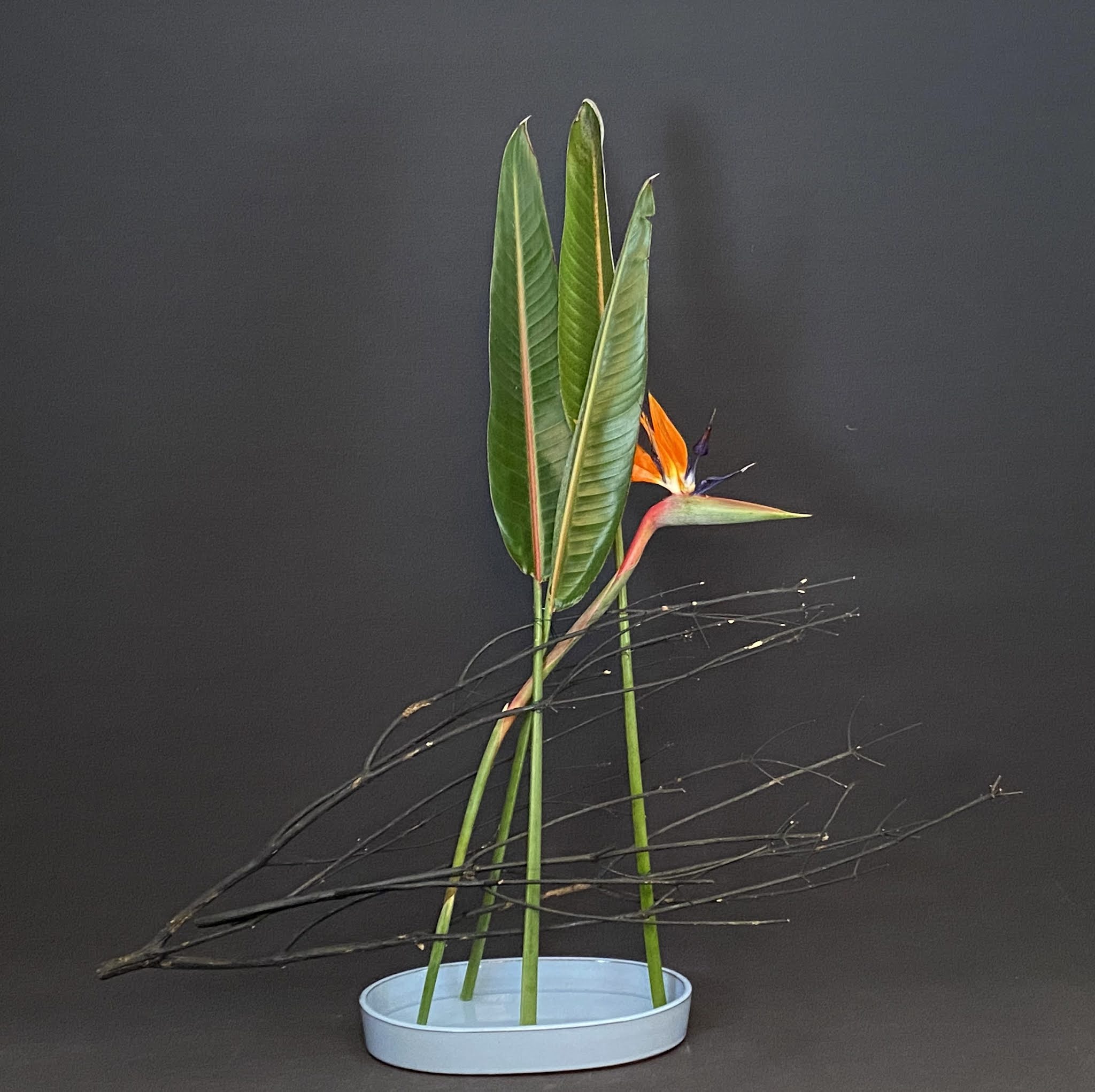
Christopher James was required to use both of these heavy, ceramic containers. The difficulty was with mechanics. Using a kenzan to hold up the heavy, mahonia branch was not an option, so Christopher had to work out another way to achieve that. He managed it very well. Then, having placed a single leaf and a small piece of crocosmia in the hole of the second container, he changed the look of the main branch by catching the leaves together at the top to give a more contemporary look to the whole arrangement.


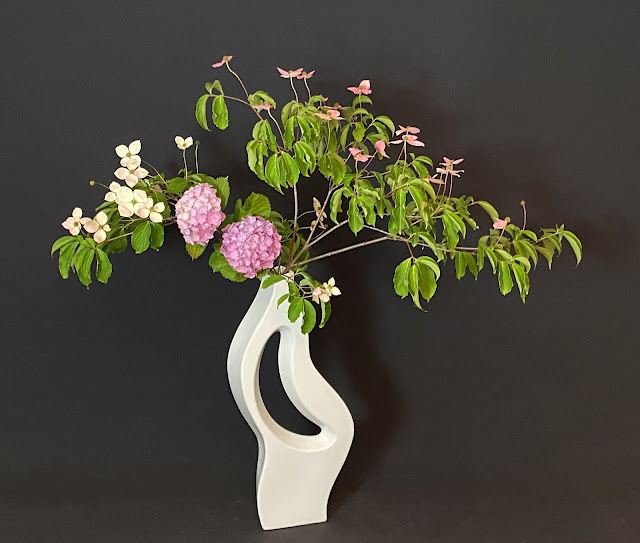
Vicky Kalokathis was delighted with the large branch of evergreen dogwood (Cornus Norman Hadden) but it soon became apparent that it was not as easy as it originally appeared. After trying different ways of using it, Vicky cut branches away and re-arranged them to create some interest. The pink hydrangeas picked up the pink blush on some of the dogwood flowers, which turn this colour as they age.

Jenny's heavy ceramic container by Graeme Wilkie has a very small opening. Because of this, I provided her with materials with thin stems. Jenny struggled quite a bit to place her main stem of Siberian dogwood in just the right position, coming from the back diagonally towards the front. Placing the alstroemeria psittacina flowers high, amongst the leaves of the dogwood, accentuated and strengthened the lines of the stems, creating a more dynamic look.


Akemi Suzuki had one of my favourite containers which, with its multiple holes, could easily be mistaken for an easy one to use. I'm here to tell you it's not! Because there is no access to the inside due to the tiny, bottle opening at the top, I have spent many hours working out ways to secure materials inside. Akemi came up with a method I had not used before. She placed the main branch through one hole into the container, ensuring that it would be in water, then wired from the outside the offcuts from the main branch, securing everything in place and creating a design. She, very wisely, used only one of the hydrangeas that I had provided to finish the arrangement.


Lucy Papas arrived quite late but she had a good excuse. She was awaiting the results of a Covid test before joining us. We were very pleased to see her because we wanted her to join us but most importantly because she got a negative result. She very quickly put together this arrangement, having removed masses of leaves from the wisteria vines and curving them inside this very large, glass container. Because the vines were so thin, leaving the leaves at the top was most important for interest and balance. She placed one agapanthus flower about two thirds of the way up the container and intended to fill it with water up to the level of the flower. We never got around to doing that.


I have tried a little experiment in this blog. Very often students, who would have seen some arrangement of mine on the blog and then see it in real life, have been surprised at how different they look. They always find the photographs wanting. Today Lucy suggested I make the photos much larger. I've done this but I'm concerned at how readers will be able to view them in small devices. So, here's where you come in. I would really appreciate it if you could let me know, preferably via email (emilykara@optusnet.com.au), if you have difficulty fitting the photos in your screens.

Bye for now,
Emily


Monday, 6 December 2021

6th December, 2021


Hello all,

My smoke bush is positively SMOKEN! I wrote about it three posts ago when it was a bit too fragile to use. Now it is more robust, so I'm enjoying using it. I recently bought the container in the above arrangement with the smoke bush in mind. The colour really appealed to me but the small bottle neck is a bit of a problem. Fortunately, the stems of the smoke bush are quite thin and each stem can have several flowers, therefore I could easily fit the rather voluminous branch in the narrow opening. The crucifix orchids, also have thin stems and, together with their vibrant colour, made them ideal for my arrangement.

And, while I'm at it, here's another arrangement. This is one of Lucy's containers. It is made of resin and it, too, has the ideal colour for smoke bush. Interestingly, the flower on the right side is more green in colour compared to the one on the left, which is more mature, thus deeper in colour.


Last Wednesday was our final lesson for the year and, as is our tradition, the theme was a 'Celebratory Arrangement'. We were a small group and we all went with Christmas.

Vicky went with an all white theme, using glass bottles, gypsophila, disbud chrysanthemums, sprayed, dried branch and large tinsel. I feel I have to explain that this was quite a large and spectacular arrangement but the photograph does not do it justice.


Dianne had the most amazing waratah stem with the flowers growing along it like a totem. It was challenging to find an appropriate container for it. She settled on one of mine, which, because of its curved shape gave more stability for the weight of the flower stem.She also used a sprayed corky elm branch and some beads for a bit of Christmas bling.


Nicole used wisteria vine and roses with multi-coloured Christmas baubles in a ceramic, nageire container.


Shaneen started with a dull silver container and added sprayed magnolia branches, red and white roses and beads that were the exact same colour as her roses, which are called 'Hot Chocolate'.


As for me, I re-worked a previous Christmas arrangement. You may remember it from three posts ago. The mahonia was still looking very fresh and I was loathe to discard it. So, I sprayed it silver and replaced the dead flowers with oriental lilies, baubles and a battery operated light (which was very difficult to photograph), which the kids just loved.

Before


After


My student Dianne Longley is an accomplished print artist and Master Printmaker at Agave Print Studio in Trentham. She was recently awarded The Australian Bookplate Design Award - 2021 ($10,000 and medallion).

Dianne with her printing press

Te award winning bookplate

Needless to say, we are very proud of our Dianne and wish her even greater success in the future.

Whilst we're on the subject of Dianne, she, very kindly brought me two stunningly beautiful peonies. Living in Trentham, with its cooler climate, she has much greater success with peonies than me. One of the flowers did not survive the night but I was able to make a very simple arrangement with the other. 


I kid you not, it was the size of a plate


Two days later, the petals had fallen but I still couldn't throw it away. I put what was left - the centre of the flower - into a small vase and added a piece of smoke bush that was left over from other arrangements.


I leave you with these photos, which warm my heart. My husband, Sam, with our three granddaughters foraging  through the raspberry canes looking for raspberries. They each carried a little bowl of them when they came in.


Bye for now,
Emily


Monday, 29 November 2021

29th November, 2021


Hello all,

I made the arrangement, above to showcase the large, softly coloured, oriental lilies, which were a gift from my two beautiful nieces, Angie and Joanna when they came to dinner last week.

I used the agave because I had it in abundance, having just trimmed it back, away from  my lawn-mower man with his whipper snipper.

Looking around the garden, I noticed some pink and mauve flowers and was inspired to use them together. This was not easy because the agapanthus and clematis are both very dominant and hard to use together. Hence the two tall vases. I put each material in a vase - the agapanthus going upwards and the clematis hanging down, as this was the way it grew. The dark purple material was Siberian Iris. 

When I placed the two vases next to each other, the arrangement did not jel and seemed quite disparate. The one on the left looked contemporary where as the one on the right looked naturalistic. I overcame that problem by placing a sprig of clematis leaves in with the agapanthus, thus changing the look to a more naturalistic one. My teacher, Carlyne would have said that now they 'married'.

Before

After

Continuing with the mauve theme, I used the clematis with its long vine in a wall arrangement. This time I used iris ensata to complete the arrangement.


As you know, I have an abundance of materials in my garden but I still get very exited when I get the opportunity to use something I don't have. The Grevillea Robusta in my next arrangement came from my neighbour's tree. I noticed it every time I drove past but then forgot about it when I got home. Today I remembered. The frustrating characteristic of this tree is that it flowers up high, requiring my extendable cutter and the flowering branches hang downwards, making them difficult to be put in water and have them look right. I managed to find a couple of stems that were usable.


Last week I wrote about our workshop with the combined theme of 'Arrangement in Glass Vessel' and 'With Leaves only'. Christopher has uploaded the photographs from the workshop. Please go to  Sogetsu Victoria to view them.

Continuing with the glass container theme and, as I mentioned before, with an abundance of agaves, I made the arrangement, below.


My student, Mary did the next arrangement from Book 3 - 'Composition of Straight Lines'. She used umbrella grass stems (Cyperus alternifolius) and Strelitzia reginae in a ceramic suiban.


On Saturday I had a rare day alone with my 9 year old, grandson, Xavier. He was nursing an injured ankle and couldn't play his scheduled basketball and, with his parents out, he spent the day with me. Typical boy, he can't sit still for a second but, with a sore ankle, he was forced to. Amongst other activities we engaged in was ikebana and it was at his request. Imagine my delight when he was able to understand my explanations of angles and proportions involved in the first lesson in the book. And, he was wearing the Jacket I made him during the lockdown. He also wore it to school on Friday as they had a free dress day. Apparently, his friends liked it and said that I was talented. But the biggest complement was when one of them referred to me as 'Bad ass'. For an old granny, that's pretty cool!

My very special boy with his 'Basic Upright' arrangement.

Bye for now,
Emily


Monday, 22 November 2021

22nd November, 2021


Hello all.

The wisteria constantly needs cutting back because it grows very quickly, especially this time of year, and attaches itself to the trees growing near it. After a recent prune I found this beautifully curved piece. As you can imagine, I had to remove quite a number of side shoots to reveal this shape. The vase was ideal at it allowed me to feature the lines and it supported the vine, which would, otherwise, be floppy. The arum lilies and smoke bush stem completed the arrangement.

Today we had the pleasure of meeting face to face with our Sogetsu colleagues at our scheduled workshop after a number of previous, such workshops held on line. This time  Angeline Lo led the workshop with the themes of using "Leaves only" and in a "Clear Glass Vessel". She demonstrated three arrangements and emphasised the refraction and reflection that can occur in water through differently shaped glass. I found it a very interesting workshop and enjoyed seeing the different works and containers of our members. Christopher would not have had time to post the photographs onto our blog yet but I'm sure he will in time.

For my arrangement, I had prepared a piece initially, with which I was quite happy. I used a  small, square, crystal vase with facets which reflected onto the oddly shaped vase on top. I worked two variegated, New Zealand flax leaves in and out of the containers.


However, this was not the one I took to the workshop. Going over Angeline's notes again, I remembered a tall, triangular shaped vase that I've used before and know that it reflects very well. I used a mauve coloured glass cylinder inside the vase, around which I twisted a single, variegated, New Zealand flax. I had intended to use a second flax but the reflections filled the glass to the point that it looked almost crowded.

 Another, very interesting aspect of glass arrangements is that the view changes based on one's viewing position. I have taken photographs from three different aspects to demonstrate this.


Front view

Three weeks ago we had my son and his family move in with us, quite unexpectedly, after a kitchen fire which rendered their home uninhabitable. My little granddaughter, Althea was sent home with a sore throat on Tuesday and had to go through the precautions of testing and awaiting results. Fortunately, they came back negative. However, as my regular class was scheduled for the next day, it had to be cancelled. The exercise I had set for the advanced students was to bring along their most difficult container so we could workshop it in class. Before the need to cancel the class, I had prepared my example with a container that I designed and made in 2016 at the Sogetsu kiln. The difficulty with using this container is that the receptacle for water is small and set high, which means I can't use any heavy materials as it will topple over.


So, I opted for, primarily, light materials, such as the horse tail (equisetum) and smoke bush (Cotinus coggygria - Grace). The heaviest was the strelitzia reginae but it was placed low and close to the centre of gravity.


When there's a flower on my strelitzia nicolai, which I can reach with a reasonable ladder, I have to cut it come hell or high water. In order to get the longest possible stem, I had to sacrifice two, very large leaves. But it was worth it.as I used parts of those leaves in the arrangement.


Bye for now,
Emily


Monday, 15 November 2021

15th November, 2021


Hello all,

For our November Ikebana International meeting, Chieko Yazaki, head of Shogetsudo Koryu School, lead a workshop on Christmas Ikebana via zoom. Chieko demonstrated three Christmas themed arrangements and we, the members, were asked to make our own arrangement and send a photograph of it to the committee to be included in our Instagram and Facebook accounts. If you would like to see all the arrangements by Chieko and the members, go to our instagram account 'ikebanainternationalmelbourne' but give it a few days for them to be uploaded as the due date for submitting the photos was today.

The arrangement, above was my contribution. I used a mahonia stem with berries, my first white hydrangea, iris ensata and mizouhiki in a glass container.

I made a second Christmas arrangement because I had materials that were crying out to be used. This time it was a wall arrangement using hippeastrums, rhododendron leaves and, behind the flowers and seen only from  side, a spray of white, miniature roses. The silver material is sprayed, dried, spear grass. I debated about which arrangement I should submit. The wall one is simpler but more striking, where as the table arrangement is more subtle as well as more complex. I went with that.


My smoke bush, Cotinus coggygria 'Grace' has gone berserk! It grows on the southern side of the willow and, in an effort to reach the sun, it has grown really long stems, all of them with flowers at their end. I've been impatient to use this wonderful material but, if cut too young, it wilts immediately. Today I gave in to temptation.


Smoke bush in the garden
Apologies for the poor photography but it's very hard
to photograph against the sky

And in the vase with nandina domestica and 
arum lily

My evergreen dogwood, Cornus Capitata is also doing very well and I cut the first stem and used it with the first of my pink hydrangeas.


The 'container' in the next arrangement is made up of a curved container at the bottom. The top is a tile, into which I cut a hole and which I use as a wall container. The two had been sitting on a table in my studio, waiting to be put away, when the idea came to me to combine them. I chose the Siberian iris for its elegant, long stems as well as for its vibrant blue colour. The squiggly grass added some interest with its curves lines.


The ornithogalum that I have featured a few posts ago was 'Ornithogalum arabicum'. In the next arrangement I used Ornithogalum thyrsoides, which flowers a little later. Very convenient for us, ikebanists.

Bye for now,
Emily


Saturday, 13 November 2021

MASTERCLASS NO. 6


Hello all,

Well, it's been a long time coming but we've finally been able to have another Masterclass. As always, I tried to challenge these advanced students. I set them the theme 'In a Suiban Without a Kenzan' but I added a degree of difficulty to this, already challenging theme, by providing quite disparate materials. They each had some sort of dry branches as well as fresh ones with leaves, which would require water. Also, they were given large containers and materials to encourage them to make large arrangements. I'm very pleased to say that they all rose to the challenge and did it justice. Very satisfying for a teacher.

The arrangement, above, was done by Akemi Suzuki. The unusual, dry material is the flower of the agave plant. It is very woody and heavy. The green material is a cordalline, whose leaves were cut sharply and the flower, of course, is an arum lily. Initially, I had given Akemi a much larger suiban but, when the arrangement was finished, it was obvious that the container was inappropriate. So we changed it for a much smaller one and everyone was happy.

Nicole had tea tree branches in two different stages - flowering stage and seeding stage. Also, walnut branches and, for the accent, a stem of oriental lilies in a ceramic suiban. Nicole is not used to making such large arrangements and her comment before she left was that she would have to move house in order to fit this arrangement in it.


Christopher had some unknown dry branches, as well as coastal banksia. I was particularly taken by the white colour on the underside of the leaves of this material. So, Christopher, in deference to me, chose to make a feature of this and he positioned the large oriental lilies behind the branch structure, allowing the banksia to dominate. The container he used was a glass suiban with an uneven base, making this exercise just a bit more difficult.


Vicky had three stelitzia reginae leaves and one flower as well as some unknown dry material. Her container was a large, oval, ceramic suiban.


Jenny had some browallia orange branches, which I cut from my son's garden, a double headed strelitzia reginae and a couple of walnut branches. The container was a rectangular, ceramic suiban.


Christine had  couple of pieces of kangaroo apple (solanum aviculare), some dry bamboo and a stem of oriental lilies. The interest in this arrangement is the creation of triangles with the bamboo which was both in and out of the rectangular, ceramic suiban.


Lucy had large stems of dried magnolia branches, red callistemons and flowers of an unnamed grass. Her container was a very big, stainless steel bowl. 


Just as an explanation, especially for the non-ikebanists amongst my readers, all the arrangements were big and challenging. All the participants struggled to produce the work they did but it was worth it in the end. I, too, had some difficulties and that was with photographing them. They were so big that they barely fit within the area of my photographing screen.

Bye for now,

Emily

Enjoyed this post? Never miss out on future posts by following us