Monday, 3 May 2021

3rd May, 2021


New Zealand flax, crucifix orchid and dyed egg

New Zealand flax and dyed eggs. Glass is
always difficult to photograph


Hello all,

It was Orthodox Easter yesterday and, unlike last year, we were able to celebrate with the whole extended family. We were truly grateful to see each other after more than 18 months of separation. Not surprising, the most notable  change was with the youngest members of the family, who seem to have grown several inches. Maybe that's an exaggeration but that's how it seemed to me.

My sister-in-law, Toula, prepared the traditional 'magiritsa', which we have after midnight mass on the Saturday. It is made with sheeps' or goats' offal and plenty of herbs. Toula has mastered this thick soup from years of making it for us. And it was delicious!

The next day was Betty's turn to shine. She and her husband, George, hosted Easter sunday celebrations with about 40 people in their large home and one acre property. Luckily, the weather was most accommodating, so a very pleasant time was had by all. As for the food, there was enough to feed an army, which is just as it should be, according to my mother. I have to confess that I disgraced myself by overeating, yet once again.

So, back to ikebana. Last month's Sogetsu meeting and workshop was led by Emerald Leung and Angeline Lo. The theme was 'Renka' and I direct you to our website https://sogetsuikebanavic.weebly.com/ for a full explanation of the theme and photographs and video of members' arrangements. My two arrangements are below.

Equisetum, cosmos and yellow dahlias in ceramic
suiban
Marigolds, amaranthus and equisetum in
ceramic container

Here's something interesting. In my first arrangement I used black food dye in the water to conceal a number of kenzans. The next day I got a delightful surprise when I noticed that the dye had been absorbed by the cosmos flowers, creating a lacey effect on the edge of the petals.


I had a pot with four nerine flowers, which I avoided using for a couple of weeks, saving them for something special. Today I noticed that they were aging, so I went out into the garden looking for material to use with them. The magnolia soulangiana is looking wonderful right now. It has shed its leaves and has produced buds on its very distinctive, skeletal branches. I cut a horizontal piece and proceeded to arrange it in this large suiban without a kenzan. After finishing it I was not happy. 


I felt that the nerines interfered with the gorgeous line of the magnolia stem, so I removed them and used two floating camelias insead, leaving the line of the branch uninterrupted.


A brief sojourn just outside Melbourne provided me with some hawthorn and cotoneaster berries. The hawthorn berries are much darker than they had been earlier in their season and provided an interesting contrast with the smaller, paler cotoneasters. The chrysanthemums were generously donated by Toula.


I leave you with this little arrangement using agave and Queen's Tears bromeliad (Billbergia nutans).

Bye for now,
Emily


Monday, 26 April 2021

26th April, 2021


Hello all,

Last week's class theme was and arrangement in a basket using five or more materials. In my example, above, I used six materials. The most important element in this type of arrangement is lightness. This can be achieved by choosing predominantly materials with small leaves or flowers and one or two larger materials as focal points. It's quite challenging to make an arrangement with so many materials that does not end up looking western.

Maren's basket, an anniversary present from Graham, is quite exquisite and the material's she used complemented it beautifully.


Nicole declared that this is her favourite type of arrangement and she, certainly, did it justice,


Vicky, as she often does, went for height, using the nandina domestica to create a type of umbrella over the rest of the materials.


Shaneen, who is still following the curriculum, coincidentally, also had as a theme 'A Variety of materials'. She made a delicate arrangement in a rather rustic, metal container.


Lei has finished Book 3 and is doing revision. Her lesson was ka-bu-wa-ke (moribana). In this arrangement two kenzans are used in one container, paying particular attention to the space between the two groups (kabu).


I've been cutting back my wisteria quite hard, giving me plenty of material to play with. I've used this vine in so many different ways over the years but I never tire of it.

The first arrangement is in a very large and heavy vase. I photographed it without water because I would not have been able to lift it to place on its pedestal if I had filled it first. I did that in situ. It took nearly two watering cans full of water.

The arrangement lasted several weeks, though I did have to replace the water. And I did that by syphoning it into a large bucket. When I got tired of it, I removed the wisteria and re-used it in this op shop bought container.


And just one more.


I leave you with my first camelia arrangement of the season. My much prized kamo-hon-ami.


Bye for now,
Emily


Monday, 19 April 2021

19th April, 2021


Hello all,

For last class I set a double theme for the advanced students - 'The Shape of the Container' and 'The Colour of the Container'. It is quite challenging to keep in mind both those elements, whilst trying to make a good ikebana arrangement. I explained that we do not have to complement the container's shape or colour but can, also, choose to contrast either one or both. 

My arrangement, above, is an example of this contrast of both the shape and the colour. I used Siberian dogwood which I shaped into triangles to contrast the circle of the container and brightly coloured cosmos to contrast the black and grey colour. To finish the arrangement I used cathedral begonia leaves.

I, also, made an arrangement to complement the container's colour and shape. I used hydrangeas, which have changed colour from their original blue to this nondescript, autumn colour and dried, strelitzia reginae leaves in a ceramic container by Graeme Wilkie.

Bredenia used one large gymea leaf which repeated the shape of her container and three flowers and a bud of these large proteas.


Nicole used cotoneaster branches, heavily laden with berries and lightened the whole effect with the use of the delicate Japanese anemones in this interesting, ceramic container. She chose to complement the shape of the container but contrast the colour.


Jenny went with complementing both the shape and the colour of her strong, ceramic container. She used grape vive and New Zealand flax. There was some debate about adding flowers but she chose to leave them out.


Vicky wanted to emphasize the verticality of her tall, glass vase by massing bright red dahlias vertically. The colour, of course, was a contrast.


Shaneen's curriculum theme was 'Using only one kind of material'. She used salvias in this quirky, curved vase, continuing the curve of the vase with the curve of the flowers.


Lei's curriculum theme was an arrangement 'Using two containers'. She used a dried piece of corky elm, brightly coloured dianthus and alstroemeria psittacina leaves in two glass containers.

For last week's Masterclass I had cut quite a number of agave pieces. I found out later that I had forgotten two pieces out in the garden. I brought them in and, after some effort, managed to arrange them. They really can be difficult. Apart from being the floral accent, the dahlias, also, helped to conceal the mechanics necessary to hold the agaves in place.


Bye for now,

Emily


Sunday, 11 April 2021

Masterclass No. 3


Hello all, 

This past week was a particularly busy one, ikebana wise, I had my regular classes on the first Wednesday of the month as well as the private lesson I teach on Friday and the Masterclass, which falls on the second Saturday of the month. By coincidence, all these classes fell in the one week, leaving me somewhat short of time. So I was unable to make an arrangement using agave, which was the exercise for the Masterclass. I looked into my archives and came across the arrangement, above, which I made in 2017. 

A number of the attendees of the class had not used agave before and were pleased to get the opportunity to workshop this rather challenging material. We explored the difficulties in using agave, such as the fact that they are thorny, which can be overcome with sturdy gloves and very heavy, which requires strong mechanics to balance. I, also, demonstrated how to use a kenzan with them. 

I had cut the agaves two days earlier and left them out of water to make them a little bit more malleable. I also provided a number of different accompanying materials to each participant to complete his or her arrangement.

Vicky used umbrella grass stems and seed
heads from Japanese anemones in ceramic
container which has a wooden piece fitting 
over the top

Christopher used smaller pieces of agave
and Japanese anemones in ceramic container


Akemi cut her agave and fitted it in pieces in this heavy, split 
container. She also used Siberian dogwood and hydrangeas

Christine managed to balance the agave without resting on the 
container. She used only three sunflowers with it in a very heavy
stone container

Susan used two stems of agave and just some persimmons 
on the branch in my self made ceramic container


Jenny worked hard to balance the two agaves in this slanting position, then
used wisteria, whose leaves she had stripped, leaving just the stalks, creating softer 
lines which contrasted with the strong lines of the variegated agave. The sunflowers
completed the piece.
 
Bye for now,
Emily

Monday, 5 April 2021

5th April, 2021


Hello all,

I had used the tips of the a number of monstera deliciosa leaves for the funeral flowers last week, so, I wanted to use a couple of what was left of the leaves. I cut them to a sharp point and placed them in a self-made, triangular container, then added one hydrangea to complete the arrangement.

I've been working on two new metal sculptures along the same lines as the one I did a couple of years ago and I went to pick them up from the fabricator. Around the edge of the car park were a number of shrubs that I don't have in my garden and, with Robert's permission, I helped myself to some branches. Here's what I did with them -

In the first, I used two different, orange coloured grevilleas. I think one of them is Grevillea superb and I don't know the other. The two ceramic containers are self made and I added dietes leaves for line.


In the second arrangement, I used only one kind of material - callistemon but I couldn't work out which particular one. I tried to emphasise the lines at the base, making sure that the stems, which I kept clean, do not touch the rims of the double container.


In the third arrangement, I used the pink berries from the peppercorn tree, which Robert hates and encouraged me to cut as much as I wanted. Apparently, it drops rubbish onto his ute. With the berries I used these spectacularly coloured hydrangeas in a tall, silver coloured, ceramic container.


My smoke bush has very long stems, which are mostly bare except for the leaves at the tips. The weight of the tips makes them bend, creating lovely curves. I used two stems in this tall, metal container with a stem of Oriental lilies.


On a personal note, last week I invited the four grandchildren to high tea at yiayia's. We all dressed up and used the good china and silverware and made quite an occasion of it. There were lots of yummy cakes and fruit as well as a number of different herbal teas to sample.


Their attention span being limited, we quickly moved to the next phase of our afternoon entertainment - watching a movie together. And, when that was over, all hell broke loose. They, obviously, needed to expand some energy after sitting quiet for so long. They ran up and down the stairs squealing and screaming so much so that I closed myself in my sewing room and Sam in his office. As much as we love them, we were not sorry to say goodbye to them at the end of the day.

Yesterday was Easter for most of the Christians churches around the world, except for the Orthodox. We will be celebrating Easter on 2nd May but I wanted to make a little arrangement to mark the day anyway. I used an agapanthus stem with two flower heads, from which I stripped the seedpods. I placed two eggs, which I had coloured a couple of years ago and, which are now quite light since the inside has dried. The leaf is aspidistra.


Bye for now,
Emily


Monday, 29 March 2021

29th March, 2021


Philip and Shirley Keon
Hello all,

This past week has been a sad one with the passing of two members of our kebana community, Cherie Glaser and Philip Tobin Keon. 

Cherie was one of the earliest members of both our Sogetsu group and Ikebana International. She began her studies with Norman Sparnon. I did not know Cherie very well, as she was a little before my time but I'm grateful to have had the opportunity to see her at our last Sogetsu meeting, when she came, despite ill health, with the help of her daughter. I enjoyed speaking with her and was most impressed by her positivity.

Philip and I were taught by the same teacher, Carlyne Patterson, albeit not at the same time, so we knew each other fairly well. He had a very unique, creative style both in the work that he did and his sartorial sense. He was always immaculately attired and was never afraid of colour. If I had to find one word to describe Philip, it would be 'dapper'. 

When I was asked to make the coffin arrangement for Philip's funeral, I consulted Shirley as to what she wanted from me. She said she wanted it to be flamboyant and spectacular and to forget the 'less is more' policy. I remembered that Philip liked to use a particularly bright, almost electric blue colour in his work and decided to use the same colour.

I had four dried, strelitzia nicolai leaves which I sprayed gold on the outside and painted blue on the inside as the basic structure. I then added two bunches of white Oriental lilies and two bunches of yellow dahlias. I also used monstera deliciosa leaves cut sharply and placed as a kind of skirt around the oasis holders. To top it all off, I used dried and sprayed gold agapanthus stems to simulate fireworks. I would like to think that Philip would have approved.


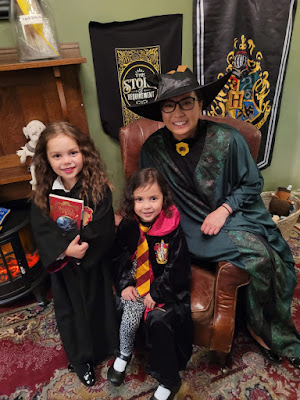
On a happier note, my granddaughter Hermione had a birthday and celebrated it at a venue which specialises in Harry Potter themed parties. As you can probably guess, Hermione was named after Hermione Granger of Harry Potter fame. 

The naming of this child is interesting. Her mother, Jeannine, loved the Harry Potter books as a child and wanted to name her first daughter Hermione. As it turns out, my Greek name is 'Ermioni', the female version of 'Ermis', the messenger God of Olympus. The English name Hermione is derived from 'Ermioni'. This was a lucky coincidence for Jeannine because her husband, Dennis, would not have agreed to the name had it not been, also, his mother's name. You may well ask why I am now called Emily. It's because the teacher, who enrolled me into the primary school I went to straight off the boat, could not pronounce 'Ermioni' and announced that I would be called 'Emily'.

The birthday girl as Hermione Granger

Three more witches - Aria, Althea and mum Jeannine
as Professor McGonagall

And now for some ikebana.

My smoke bush has brought out a flower, completely out of season, much to my delight. I arranged it together with one of the three pomegranates that my little tree produced.


Very large glass vase with agapanthus
heads inside and outside the vase.
The line is New Zealand flax

Bird's eye view


Half of monstera deliciosa leaf, Japanese
anemones and amaranthus
Bye for now,
Emily


Enjoyed this post? Never miss out on future posts by following us