Monday, 19 April 2021

19th April, 2021


Hello all,

For last class I set a double theme for the advanced students - 'The Shape of the Container' and 'The Colour of the Container'. It is quite challenging to keep in mind both those elements, whilst trying to make a good ikebana arrangement. I explained that we do not have to complement the container's shape or colour but can, also, choose to contrast either one or both. 

My arrangement, above, is an example of this contrast of both the shape and the colour. I used Siberian dogwood which I shaped into triangles to contrast the circle of the container and brightly coloured cosmos to contrast the black and grey colour. To finish the arrangement I used cathedral begonia leaves.

I, also, made an arrangement to complement the container's colour and shape. I used hydrangeas, which have changed colour from their original blue to this nondescript, autumn colour and dried, strelitzia reginae leaves in a ceramic container by Graeme Wilkie.

Bredenia used one large gymea leaf which repeated the shape of her container and three flowers and a bud of these large proteas.


Nicole used cotoneaster branches, heavily laden with berries and lightened the whole effect with the use of the delicate Japanese anemones in this interesting, ceramic container. She chose to complement the shape of the container but contrast the colour.


Jenny went with complementing both the shape and the colour of her strong, ceramic container. She used grape vive and New Zealand flax. There was some debate about adding flowers but she chose to leave them out.


Vicky wanted to emphasize the verticality of her tall, glass vase by massing bright red dahlias vertically. The colour, of course, was a contrast.


Shaneen's curriculum theme was 'Using only one kind of material'. She used salvias in this quirky, curved vase, continuing the curve of the vase with the curve of the flowers.


Lei's curriculum theme was an arrangement 'Using two containers'. She used a dried piece of corky elm, brightly coloured dianthus and alstroemeria psittacina leaves in two glass containers.

For last week's Masterclass I had cut quite a number of agave pieces. I found out later that I had forgotten two pieces out in the garden. I brought them in and, after some effort, managed to arrange them. They really can be difficult. Apart from being the floral accent, the dahlias, also, helped to conceal the mechanics necessary to hold the agaves in place.


Bye for now,

Emily


Sunday, 11 April 2021

Masterclass No. 3


Hello all, 

This past week was a particularly busy one, ikebana wise, I had my regular classes on the first Wednesday of the month as well as the private lesson I teach on Friday and the Masterclass, which falls on the second Saturday of the month. By coincidence, all these classes fell in the one week, leaving me somewhat short of time. So I was unable to make an arrangement using agave, which was the exercise for the Masterclass. I looked into my archives and came across the arrangement, above, which I made in 2017. 

A number of the attendees of the class had not used agave before and were pleased to get the opportunity to workshop this rather challenging material. We explored the difficulties in using agave, such as the fact that they are thorny, which can be overcome with sturdy gloves and very heavy, which requires strong mechanics to balance. I, also, demonstrated how to use a kenzan with them. 

I had cut the agaves two days earlier and left them out of water to make them a little bit more malleable. I also provided a number of different accompanying materials to each participant to complete his or her arrangement.

Vicky used umbrella grass stems and seed
heads from Japanese anemones in ceramic
container which has a wooden piece fitting 
over the top

Christopher used smaller pieces of agave
and Japanese anemones in ceramic container


Akemi cut her agave and fitted it in pieces in this heavy, split 
container. She also used Siberian dogwood and hydrangeas

Christine managed to balance the agave without resting on the 
container. She used only three sunflowers with it in a very heavy
stone container

Susan used two stems of agave and just some persimmons 
on the branch in my self made ceramic container


Jenny worked hard to balance the two agaves in this slanting position, then
used wisteria, whose leaves she had stripped, leaving just the stalks, creating softer 
lines which contrasted with the strong lines of the variegated agave. The sunflowers
completed the piece.
 
Bye for now,
Emily

Monday, 5 April 2021

5th April, 2021


Hello all,

I had used the tips of the a number of monstera deliciosa leaves for the funeral flowers last week, so, I wanted to use a couple of what was left of the leaves. I cut them to a sharp point and placed them in a self-made, triangular container, then added one hydrangea to complete the arrangement.

I've been working on two new metal sculptures along the same lines as the one I did a couple of years ago and I went to pick them up from the fabricator. Around the edge of the car park were a number of shrubs that I don't have in my garden and, with Robert's permission, I helped myself to some branches. Here's what I did with them -

In the first, I used two different, orange coloured grevilleas. I think one of them is Grevillea superb and I don't know the other. The two ceramic containers are self made and I added dietes leaves for line.


In the second arrangement, I used only one kind of material - callistemon but I couldn't work out which particular one. I tried to emphasise the lines at the base, making sure that the stems, which I kept clean, do not touch the rims of the double container.


In the third arrangement, I used the pink berries from the peppercorn tree, which Robert hates and encouraged me to cut as much as I wanted. Apparently, it drops rubbish onto his ute. With the berries I used these spectacularly coloured hydrangeas in a tall, silver coloured, ceramic container.


My smoke bush has very long stems, which are mostly bare except for the leaves at the tips. The weight of the tips makes them bend, creating lovely curves. I used two stems in this tall, metal container with a stem of Oriental lilies.


On a personal note, last week I invited the four grandchildren to high tea at yiayia's. We all dressed up and used the good china and silverware and made quite an occasion of it. There were lots of yummy cakes and fruit as well as a number of different herbal teas to sample.


Their attention span being limited, we quickly moved to the next phase of our afternoon entertainment - watching a movie together. And, when that was over, all hell broke loose. They, obviously, needed to expand some energy after sitting quiet for so long. They ran up and down the stairs squealing and screaming so much so that I closed myself in my sewing room and Sam in his office. As much as we love them, we were not sorry to say goodbye to them at the end of the day.

Yesterday was Easter for most of the Christians churches around the world, except for the Orthodox. We will be celebrating Easter on 2nd May but I wanted to make a little arrangement to mark the day anyway. I used an agapanthus stem with two flower heads, from which I stripped the seedpods. I placed two eggs, which I had coloured a couple of years ago and, which are now quite light since the inside has dried. The leaf is aspidistra.


Bye for now,
Emily


Monday, 29 March 2021

29th March, 2021


Philip and Shirley Keon
Hello all,

This past week has been a sad one with the passing of two members of our kebana community, Cherie Glaser and Philip Tobin Keon. 

Cherie was one of the earliest members of both our Sogetsu group and Ikebana International. She began her studies with Norman Sparnon. I did not know Cherie very well, as she was a little before my time but I'm grateful to have had the opportunity to see her at our last Sogetsu meeting, when she came, despite ill health, with the help of her daughter. I enjoyed speaking with her and was most impressed by her positivity.

Philip and I were taught by the same teacher, Carlyne Patterson, albeit not at the same time, so we knew each other fairly well. He had a very unique, creative style both in the work that he did and his sartorial sense. He was always immaculately attired and was never afraid of colour. If I had to find one word to describe Philip, it would be 'dapper'. 

When I was asked to make the coffin arrangement for Philip's funeral, I consulted Shirley as to what she wanted from me. She said she wanted it to be flamboyant and spectacular and to forget the 'less is more' policy. I remembered that Philip liked to use a particularly bright, almost electric blue colour in his work and decided to use the same colour.

I had four dried, strelitzia nicolai leaves which I sprayed gold on the outside and painted blue on the inside as the basic structure. I then added two bunches of white Oriental lilies and two bunches of yellow dahlias. I also used monstera deliciosa leaves cut sharply and placed as a kind of skirt around the oasis holders. To top it all off, I used dried and sprayed gold agapanthus stems to simulate fireworks. I would like to think that Philip would have approved.


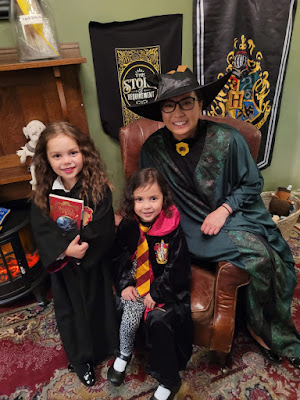
On a happier note, my granddaughter Hermione had a birthday and celebrated it at a venue which specialises in Harry Potter themed parties. As you can probably guess, Hermione was named after Hermione Granger of Harry Potter fame. 

The naming of this child is interesting. Her mother, Jeannine, loved the Harry Potter books as a child and wanted to name her first daughter Hermione. As it turns out, my Greek name is 'Ermioni', the female version of 'Ermis', the messenger God of Olympus. The English name Hermione is derived from 'Ermioni'. This was a lucky coincidence for Jeannine because her husband, Dennis, would not have agreed to the name had it not been, also, his mother's name. You may well ask why I am now called Emily. It's because the teacher, who enrolled me into the primary school I went to straight off the boat, could not pronounce 'Ermioni' and announced that I would be called 'Emily'.

The birthday girl as Hermione Granger

Three more witches - Aria, Althea and mum Jeannine
as Professor McGonagall

And now for some ikebana.

My smoke bush has brought out a flower, completely out of season, much to my delight. I arranged it together with one of the three pomegranates that my little tree produced.


Very large glass vase with agapanthus
heads inside and outside the vase.
The line is New Zealand flax

Bird's eye view


Half of monstera deliciosa leaf, Japanese
anemones and amaranthus
Bye for now,
Emily


Monday, 22 March 2021

22nd March, 2021


Hello all,

The arrangement, above, is an autumn one. The berries (cornus capitata) are popular with birds, so I use them as soon as they change colour from green to orange before they are devoured by our winged friends. The hydrangeas are late flowering ones and the Japanese anemones are at their absolute best.

At our last Ikebana International meeting a number of our Japanese members showed us how to put together an origami box and, then, use it as a  container for ikebana by placing some water holding bowl inside it. They had provided the paper and a variety of fresh material from which we could choose. For my box I used two different coloured pieces of paper and, when I got my arrangement home, I put it in this black wire structure for a bit more interest.


Here's a little heartwarming story of today's technology and social media to counter some of the very bad ones. At my first Masterclass Jenny Loo did the arrangement, below, using heavy pear branches. She, subsequently, posted the photograph on her Instagram account. Someone from somewhere out there was so impressed by it, that she or he was inspired to paint it. Try as I might I could not crop the photo of the painting to exclude the text. My apologies.

The original arrangement

The painting

At the end of the last Masterclass, there was a container and materials left over. They had not been used because of a student's absence. I gave the materials to Lucy, who has a very small garden and relies on mine for most of the materials she uses. The container is a very unusual one and the material was a curved agapanthus. On the spur of the moment I decided to challenge her to make as arrangement where the stem of the heavy agapanthus came out of the narrow opening of the container without resting on either the rim or the loop of the container. I would have accepted resting if anyone had used it in  class because it would have been much too difficult in the two hour session to come up with the necessary mechanics. Lucy, however, relishes a challenge and, having managed to do it myself in the past, I knew it was possible and that she would do it also. She said it took her all afternoon but she managed it. Bravo!

Close up of the opening and loop


I did something very similar in 2015 and had posted it on this blog and, since I don't expect you to remember it, here are the photos again.


The mechanics

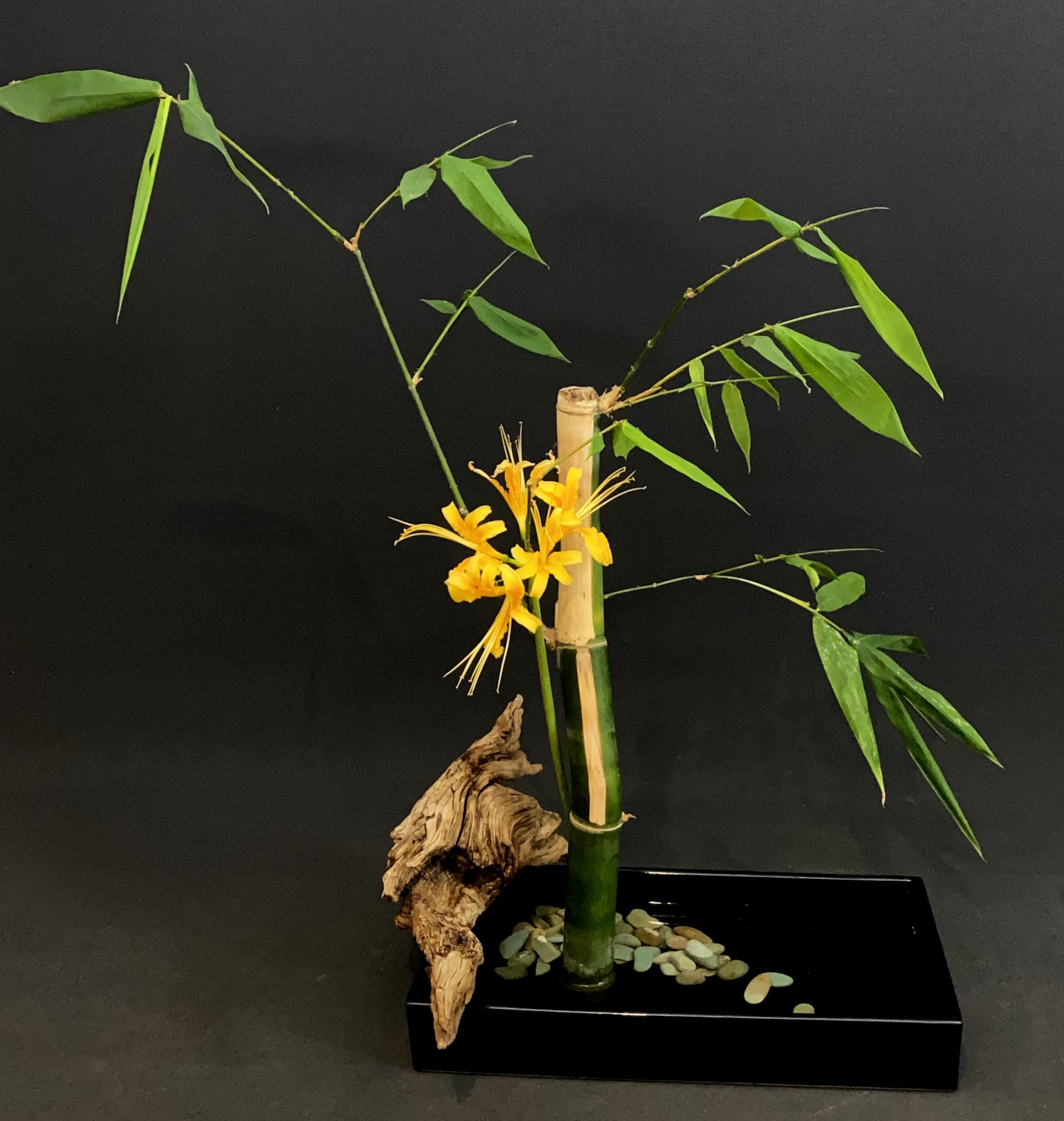
A new and very beautiful, yellow nerine flowered and I was looking for a setting to do it justice.


I have bamboo growing in a very big pot at the front door. A piece had broken some time ago and I've been waiting for the right occasion to use what was left. The nerine and bamboo came together quite satisfactorily. The charming discolouration happened naturally. The difficulty I had was to cut the bamboo very straight so as to balance without the aid of a kenzan. I used a saw to remove it from the root and then very coarse sand paper to level it off. I treated the bamboo by placing it in  cup of boiling, salted water for about 15 minutes. This seems to stop the leaves from curling and drying. It's been six days now and the leaves are still fresh.

I used the offcuts from the bamboo in another arrangement but I treated them also with the salted, boiling water before arranging them.


And I leave you with this little arrangement that I'm particularly fond of. The leaf is bamboo with a delightful stripe 
down the middle and a dark pink nerine.


Bye for now,

Emily


Monday, 15 March 2021

15th March, 2021


Hello all,

At our last class my student Shaneen gave me two very long bird's nest fern leaves and the challenge was on to use their full length. The container I selected made it extremely difficult to secure the heavy leaves so that they did not tip forward or backwards. But I can be very stubborn and, after an inordinate amount of time, I did. The luscious, white, belladonna lily complemented the frilly leaves very well.

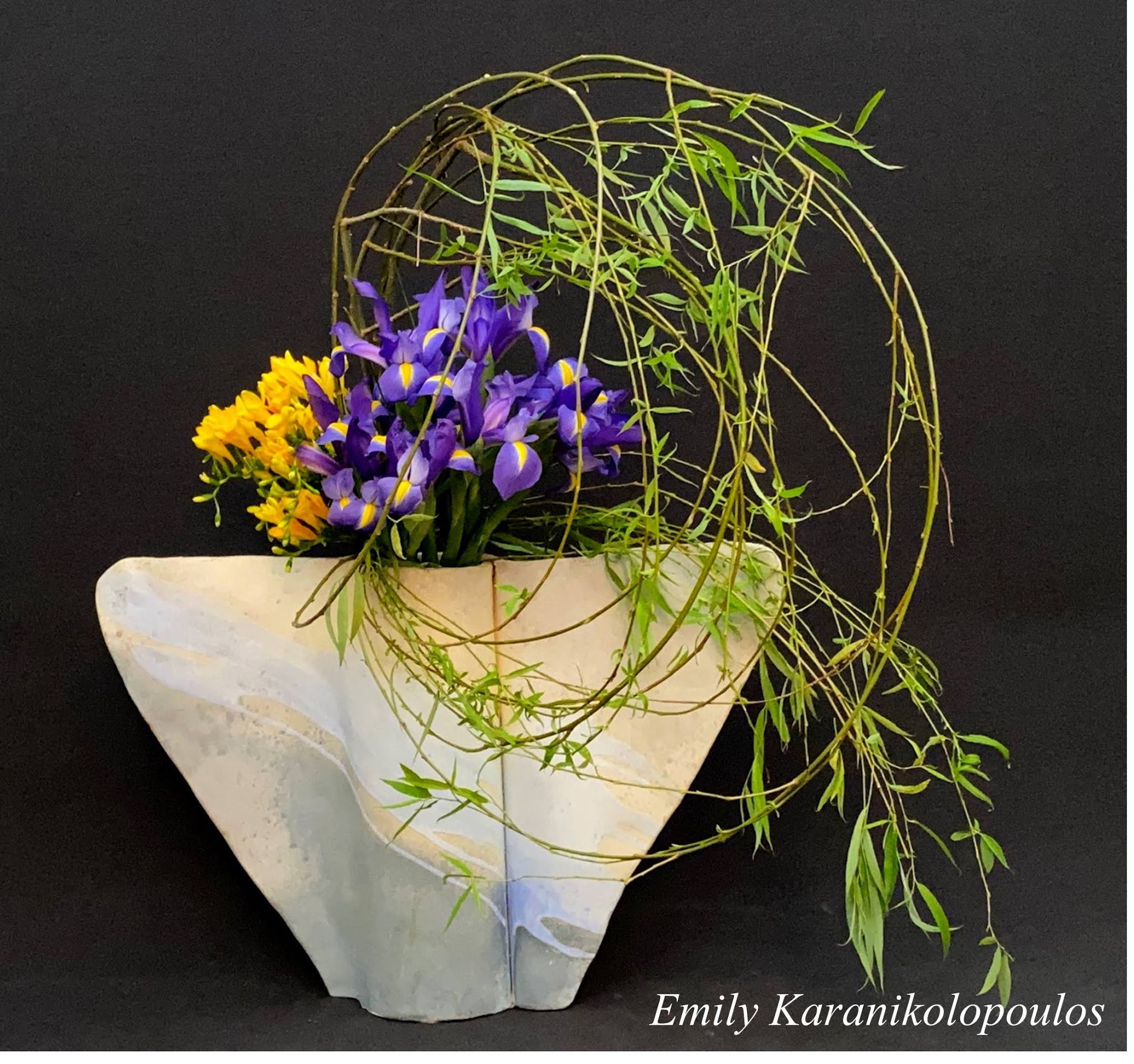
The Ikebana International Mumbai chapter had a virtual exhibition. There were two themes, the first was Spring or holi, Festival of Colours. And the arrangement, below, was my contribution. It was not easy to find spring materials at the end of summer but I managed to get some freesias and we can always get Dutch Iris. Also, my Viburnum tomentosum shrub had a few white blossoms, completely out of season, which helped. One large branch of the willow had lost most of its leaves during a particularly hot day and, subsequently, brought out new ones. It looked just the way it does in spring.


I had done a second spring arrangement to give Mrs. Agarwal a choice. This was the one not used. I used more of the willow with Iris and freesias in a self made container.


The second theme was to use Mitsumata or any other painted material. This was much easier. I used a painted palm inflorescence, cosmos and amaranthus.


If you would like to see the exhibition go to https://youtu.be/ZLy5en5Dc3E


With an abundance of agapanthus, I can't help trying new ways to arrange them. Here's another one.


For the wall arrangement this week, I used mahonia, pink roses, pink sedum and red crucifix orchids.


I have to share with you a minor success. You will remember my covering some of our fruit with net bags that I made. Well, our small apple tree was laden with fruit but I was not able to cover all of them. As a consequence, all the uncovered ones disappeared long before they ripened. The ones in the bags, however, grew so big that I had difficulty peeling the net bag away from them so that I could harvest them. 

There is an interesting story to this apple tree. Many years ago, Vicky and I were travelling in the country when we came across a very small apple tree growing on the edge of a precipice, barely holding on and laden with ripe apples. Of course, we collected some of this unusual variety and brought them home and we all loved them. We went back in winter, when the tree was dormant and collected some branches, which we had grafted onto a strong rootstock. We, thus, managed to propagate the tree that did't look like it would survive and now we, each, have a lovely tree in our garden.

Our harvest!

Bye for now,
Emily


Saturday, 13 March 2021

Special edition - Masterclass No. 2


Hello all,
The bamboo container in the above arrangement was originally owned by Norman Sparnon. The NSW Sogetsu chapter recently had a sale of a number of Mr Sparnon's containers and I was delighted to have been able to purchase this, very unusual container. I'm grateful to the NSW members for their efforts in organising and, subsequently, packaging and sending the containers. My materials are a single knifophia and pinellia Pedatisecta leaf.

And now for the second Masterclass. Each participant was given a container and materials she had not previously seen and was asked to, as quickly as possible, sketch the very first idea that came to her for arranging said material. Once that was done, I asked them to create something completely different. I instructed them that they could use as much of the materials provided as they chose. This was quite a challenge but they all rose to it and below are the photographs of the end results.

Vicky used two large strelitzia reginae leaves, three sunflowers and dietes leaves in a heavy stone container.


Susan used canna lily leaves and umbrella grass, flowers and stems separated and flowers cought to create a rough balloon shape. The ceramic container has a partial split to one side. She, also, had some leucodendron flowers, which she chose not to use.


Christine use red dogwood stems, leaves removed, leucodendrons and amaranthus in ceramic container.


Bredenia used a number of aspidistra leaves, curved and cought, crocosmia seed heads and crucifix orchids, creating a rough mass and line arrangement.


Akemi had cornus capitata berries, which by the way, are edible, and hydrangeas in a metal container. The simple arrangement belies the difficulty in balancing the branches, both physically and aesthetically.


Jenny had a large mahonia branch, which reduced in size and placed facing on rather than the way it grew, creating a type of pin wheel effect. She used the dahlias I provided but chose not to use the amaranthus stem.


Lucy's arrangement was difficult to photograph because of its length. She had a heavy ceramic container, a dried gum branch with seed pods, New Zealand flax leaves and aeoniums.


Bye for now,
Emily
Enjoyed this post? Never miss out on future posts by following us