Wednesday, 11 September 2019


The original arrangement


Hello all,

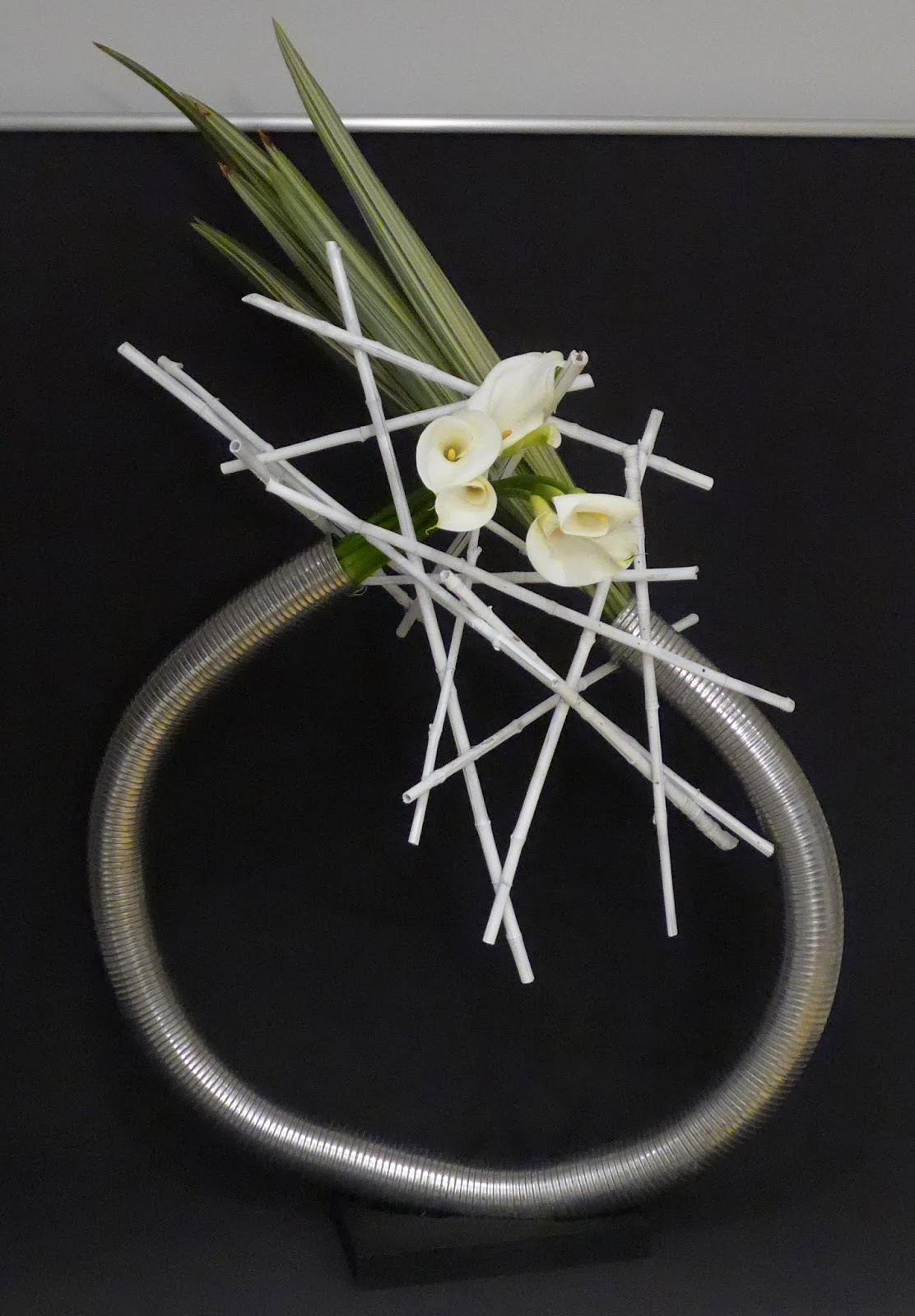
I made the above arrangement after disassembling the piece I had done for St Paul's Cathedral a few weeks ago and the thought of finding a place in my storeroom for the bamboo structure was  too much for me. It was easier and more fun to make another arrangement instead. Its simplicity belies the difficulty in arranging the camellias to look natural and facing up. The large glass vase has areas that are opaque and others that are clear, requiring care in cutting the stems of the camellias short enough so that they are not visible through the glass.

Last Saturday I ran a workshop for eleven members of our Sogetsu group here at my home studio. I've done such a workshop once before, the idea for which originated with Testunori Kawana's classes I attended in Tokyo.

I provided for each participant a small bunch of three different types of materials and made my containers available to them. I also provided, tools, wire etc. Each participant chose a container and made an arrangement, which I critiqued when finished and then photographed. The arrangement was then disassembled, the container returned and a new container chosen to go through the same process again and again using the same bunch of materials.

The workshop ran from 10.00 am to 3.00 pm with a break for lunch and in that time 66 arrangements were completed. A number of people told me that they could, easily, have done many more arrangements, had time not run out. I had advised the participants not to view the exercise as some sort of competition to see who could make the most arrangements. It would be preferable to make fewer good arrangements rather than many not so good. I believe it is necessary for all of us in ikebana to be challenged once in a while and this type of work can be quite challenging because of the restrictions that it poses. I was very pleased with the quality of work that was produced and the feedback I received was positive.

As a teacher this was very challenging for me, as I had to be available to assist whoever needed help as well as critiquing the completed work and photographing it. It certainly kept me on my toes. One unexpected bonus for me was to see some of my containers used in ways I hadn't thought to use them.

Rather than bombard you with photographs of 66 arrangements, I chose to include one per participant. And, I can tell you, this was not easy!

Sue Healey used a large phylodendron leaf, which she thinned out
and weeping willow stems, which she stripped of their leaves
Jennie Stewart used broom that's just starting to flower, with a strelitzia
reginae in a resin vase


Margaret Wilson used two aspidistra leaves with an arum lily in a ceramic vase
Marilyn Woodland used Siberian dogwood,a strelitzia  leaf,
which she cut into a circular shape and an Asiatic lily bud
in a ceramic container


Vicky Kalokathis used a cordyline stem, whose leaves
she curled and an Asiatic lily in a tall glass vase


Christopher James used my self made ceramic container on its side, in a way I'd
never used it myself. I will from now on. He used two gymea leaves and a stem of
Asiatic lilies
Sandra Gawthorp used a monstera deliciosa
leaf, which she trimmed and a single arum lily
in a ceramic container.

Nicole McDonald used nandina domestica and green
Goddess lilies in a ceramic container


Jenny Loo used a strelitzia nicolai leaf, umbrella grass and arum lilies in a
heavy, ceramic vase

Aileen used a branch of prunus elvins in bloom and a green Goddess lily.
The white container is ceramic. The black part is wooden
Lucy Papas used two gymea leaves and a strelitzia reginae in a square suiban without
using a kenzan
Bye for now,
Emily


Monday, 2 September 2019


My magnolia soulangiana in all her glory!
Hello all,
The photo of my magnolia, above, was taken from our balcony. In fact we enjoy the view of this magnificent tree from the family room, the ikebana room and the kitchen. That's exactly what I had in mind when I planted it there about 25 years ago. I guess the old saying of 'All things come to those who wait' is quite true.

And, of course, I made a number of arrangements using only magnolia, for it really needs no other material to complete an arrangement. Two examples are below.


Last week Sam and I felled one of the trunks of my very tall strelitzia nicolai because it was growing right up against the dining room window. When we were cutting it up I removed the dead flowers and discovered something quite beautiful. I'd never noticed the seed heads before because they are covered by masses of dead petals. Once I removed some of that dead material the woody seed pods were open into a three-petaled flower shape and revealed the bright orange and black seeds.

Close up of the seeds.

This is what the dead flower looked like when I had only partially removed the dead petals
And this is what it looked like after being cleaned and arranged.


I must confess that I have an aversion to arrangements made with only dry materials and, generally, avoid making them. However, in both of the above arrangements I tried to use some other fresh material but it simply did not work. Anything I used seemed superfluous. I contented myself with the thought that the vivid orange of the seeds, which is not visible in the photos, gives some life to the rest of the dry material.

At our last Sogetsu meeting the workshop was run by Emerald Leung, who set us the task of making an arrangement using only two types of materials, with leaves but not flowers, either branches with leaves and/or individual leaves. The aim was to accentuate the elements of line, mass and colour. Please go to Sogetsu Victorian Branch for photographs of Emerald's arrangements as well as those of other members.
I used large gymea leaves for line, a loquat branch, whose leaves created the mass
and for colour, the contrast of the dark green of the loquat leaves and the
lighter green of the gymea.
Jenny used stripped aspidistra leaves and spider plant (Chlorophytum Comosum)
I leave you with this picture of my gymea lily, which has two giant flower 'buds' (should I call them buds? It seems wrong when they are so big). Anyway, they are currently about 2 metres in height. I will keep you posted of their progress. Needless to say, I am seriously chuffed to have two such flowers growing in my garden.


Bye for now,
Emily


Monday, 26 August 2019


Hello all,

There has been a flurry of ikebana activity of late. There were my two classes as well as the Ikebana International AGM and the Sogetsu workshop, all within three weeks.

At the Ikebana International AGM four out of the five heads of schools did a demonstration showcasing the styles of their individual schools. As always, members were encouraged to set up their own arrangements. For my arrangement, above, I used arum lilies and clivia nobolis flowers in a ceramic container that I bought at headquarters some years ago. Please go to the Ikebana International Melbourne for photos of the demonstration arrangements as well as those of the members.

For the class before last we workshoped kiwi vine, which was generously provided by my student Vicky. She had to have the top down on her sports car to fit the long vines to bring to class. Unless one is growing it, kiwi vine can be difficult to come by. I don't remember ever coming across it in a florist shop. We all enjoyed the chance to play with it and the added bonus is that it dries well, so  is very long lasting.

Nicole used a locquat branch and an aeonium zwartkop
flower
Bredenia used an aspidistra leaf and a stelitzia
flower


Jenny used mauve and yellow chrysanthemums 
Janette used sunflowers in this tall metal
container


Vicky used white chrysanthemums, whose stems were hidden
behind a chunky piece of the vine.


Lucy used camellias in this very stable ceramic vase, which
she recently purchased  from an op shop.
For our most recent class we went back to book 5 and did the lesson on jonquils or narcissus. The next two arrangements are mine. When I was preparing the first arrangement, considering what other material to use with the jonquils, the kiwi vine practically jumped up and said 'Pick me! Pick me!' So I did.


I wired the leaves for this modern arrangement.
Janette used this very smart container and just one variegated aspidistra
leaf with the jonquils
   
Nicole made this naturalistic arrangement with spring blossom
branches and loropetalum along with the jonquils


Bredenia's 'Pond' arrangement. She used weeping willow and oliander sprigs
with the jonquils and their leaves


Vicky used Siberian dogwood and
aelstromeria psitaccina leaves


Jenny created a mass by curling the leaves. She
also massed the jonquils in this modern
arrangement in a half moon suiban


Lucy used one split aspidistra leaf
with the jonquils in her self-made
basket


Bye for now,
Emily


Monday, 12 August 2019

Hello all,

You may recognize the arrangement, above, as the one I included in my last post and which was placed in front of the speaker's lectern at St Paul's Cathedral last week. My original photograph was taken in situ, where the background was so busy that it was hard to see the arrangement clearly. We had a large family luncheon here yesterday and a number of people, who had seen my blog and then saw the arrangement at home, commented on how different it looked, prompting me to photograph it again against a blank background.

As is always the case when I'm entertaining, I fill the house with ikebana arrangements. Yesterday's lunch was no exception. Below are some of them.


The branch in the above arrangement came from an indoor ficus plant (I think microcarpa), which had become too big and I had planted into a large pot and kept outside. It wan't a particularly good plant and I wanted the ceramic pot in which it was planted, so I decided to get rid of it. But, not before I cut its beautifully curving branch (about 1 metre long) and made this arrangement. I struggled with appropriate accompanying material and settled on the oranges because none of the available flowers worked. The less visible material is a variegated euphorbia.


My magnolia soulangiana is at her absolute best at the moment - just before the flowers are fully open. The simplicity of the arrangement is deceptive because the branch had to be secured in the vase diagonally to maximize the feeling of movement. I attached a stick to the bottom of the magnolia stem using two screws because, if I had used only one would, it would swivel. The appendage was attached in such a way as to wedge against the vase at its widest point, making it very secure.


For the tables where guests would be eating I made a number of glass arrangements using kiwi vine, courtesy of Vicky. This was left over from a large number of kiwi vines that she had brought for the class to workshop. More on that later. I chose to make low, glass arrangements so that they may not obstruct the guests' view of each other.
Glass container, kiwi vine and bromeliad flowers
With lisianthus


This was my arrangement for the class workshop of kiwi vine
Bye for now,
Emily


Monday, 5 August 2019


Hello all,

I have mentioned before that my ikebana is mostly opportunistic. I come across materials which have potential and I go from there. Case in point is the arrangement, above. I was looking through my monstera deliciosa patch for just the right shaped leaf, when I came across this flower, which, of course, had to be cut and arranged. It's a very thick and heavy flower with a short stem presenting some limitations. The container I used is semicircular with an opening of about 2 cm, making it ideal for wedging the stem tightly. I then had to consider which accompanying material to use. After discounting other possibilities, I settled on the agave. Its strength balanced with the strength of the flower and its sculptural shape added depth and interest.


And here's another such arrangement, above. These dear little white flowers (Leucojum) are a delightful surprise because, when I planted them, I thought they were something else entirely. They are just the right size for this much prized container, which was given to me by my daughter and son-in-law.

During our recent exhibition, of which I have spoken before, my sister-in-law Toula gave the demonstration, assisted by our other sister-in-law Betty. Toula made a number of interesting and varied arrangements, three of which I have included here. The rest can be found on our blog at Sogetsu Ikebana Victoria. You will also be able to see the arrangements of the second part of the exhibition.

Toula (left) and Betty 

New Zealand flax and jonquils. Toula used two
containers intertwined


Dried Strelitzia nicolai leaf and stelitzia reginae flower


A service was held yesterday for Hiroshima Peace day at St Paul's Cathedral in Melbourne. It is a tradition now for members of Ikebana International to create arrangements for this service. I volunteered to do the Sogetsu arrangement and Chieko Yazaki head of the Shogetsudokoryu school assisted by students made a much larger arrangement.

Below is my arrangement in front of the speaker's lecturn. I used a large, flexible pipe, which I have attached to a board, as my container and created contrast by using bamboo triangles sprayed white. I finished it off with New Zealand flax and a mass of arum lilies. Unfortunately it is very difficult to photograph the arrangements with such a busy background.


Chieko created a large, naturalistic arrangement with a gorgeous black pine branch, Japanese quince and assorted flowers. This was placed in front of the pulpit.


I leave you with this rather cheeky arrangement. I made it using the loquat branch that was in my exhibition piece but, which was still quite fresh and I added the crucifix orchids. There is no kenzan in the container. The branch and flowers are wedged into the bottom, which comes to a sharp point.

Bye for now,
Emily

Enjoyed this post? Never miss out on future posts by following us