Thursday, 16 February 2017


Good morning everyone,
I say "good morning" because I'm writing this at some ungodly hour, unable to sleep due to a pesky mosquito in my bedroom! So, if you find mistakes, please forgive me, It's due to sleep deprivation.

Those of you who follow Christopher James' blog would have seen recently a tree that he featured from the Botanical gardens called Castanospermum australe ,also known as Moreton Bay chestnut, Australian chestnut, Black bean or Lucky bean. At about the same time my cousin Nick dropped in carrying a potted plant of the same tree saying he thought it was unusual and that I would like it, so he bought it for me.

The fully grown tree from Christopher's blog. It
produces bicoloured red and yellow flowers. The fruit
is a cylindrical pod with chestnut-like seeds.

My potted plant. Notice the chestnut-like seeds
from which it was grown


Now, back to ikebana. My student, Aurelia is a scientist working in a research lab where they use a casing made of grey sponge to secure various vials. At her suggestion, we decided to use these casings in ikebana following the theme 'Fresh and Unconventional materials'. The photos below show what they look like in the lab.


And here's what we did with them.

The two photographs, below, are of Vicky's arrangements where she used only some of the removable parts of the casing. She used with them Bougainvillea and umbrella grass stems.


In the next two arrangements Lucy Papas used both the large pieces of spongy casings as well as some removable pieces.

Umbrella grass stems and roses


Umbrella grass stems


The arrangement below was made by Aurelia Dong and I debated whether to include it here because the photograph doesn't do it justice. Because the aspedistra leaf extends forward, it tends to look bigger that it is and obscures the container. But, I can assure you, it is a good arrangement.


The next two are mine. We really enjoyed this exercise with the only problem being where to stop. We had so many ideas but not enough time.

New Zealand flax and bull
rushes


I used bull rushes on a glass base that has two holes, through which I
put the stems. Under the glass base is a container with water.


My arrangement of 'Disassembling and Rearranging the Materials'.

Aurelia's arrangement of 'With Branches Only'. She used
smoke bush and walnut branches

My freestyle arrangement using bull rushes, dietes and crucifix
orchid. I was given plants of the orchid by Helen Novic and
also by Shaneen Garbutt
Bye for now,
Emily


Thursday, 2 February 2017


Hello all,


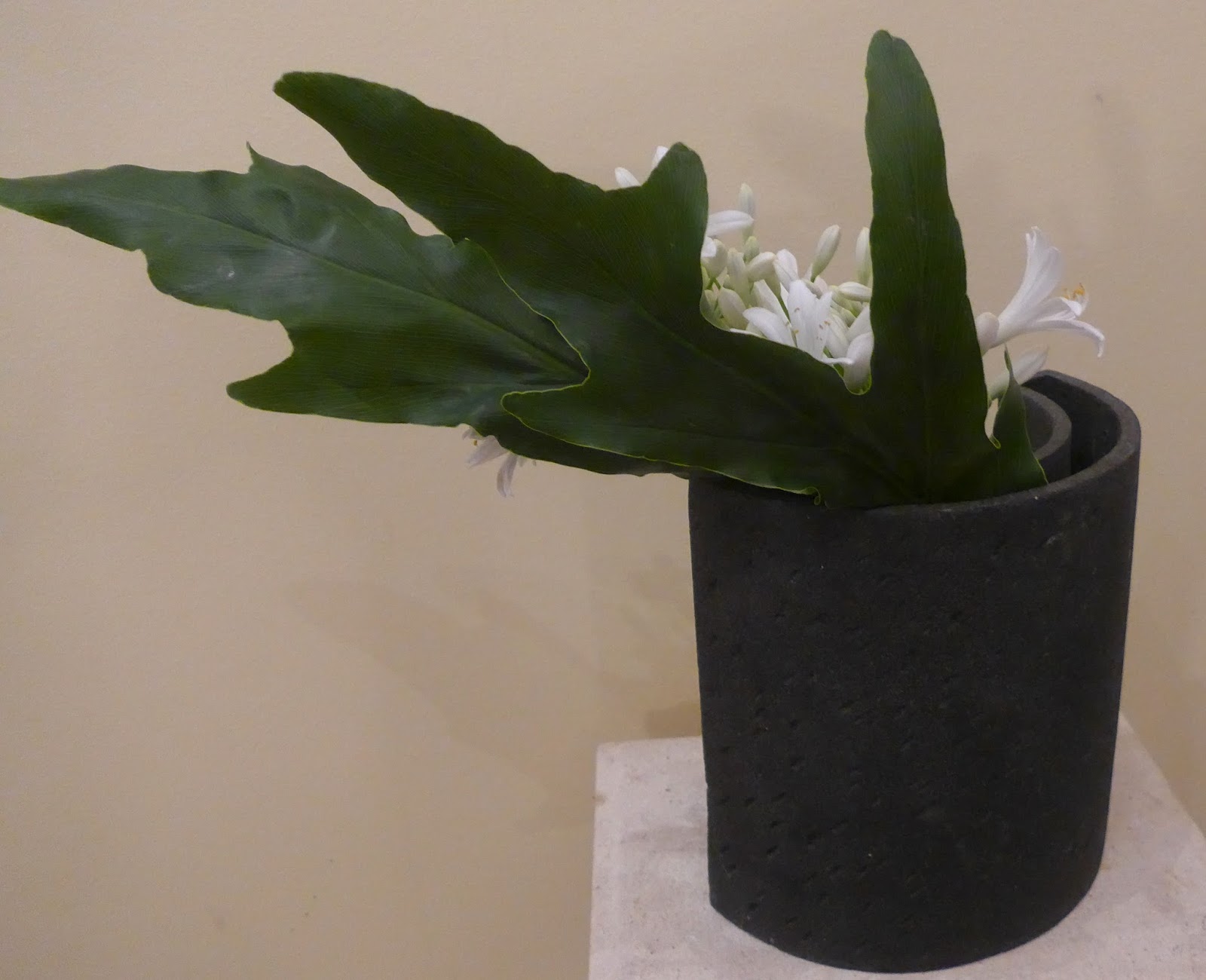
Well, classes resumed yesterday with renewed enthusiasm after the holiday break. For each of the senior students I provided one very big philodendron leaf on a long stem and asked them to make an arrangement in a container of their choice, with or without other material. Below are my three examples:

This simple looking arrangement took me over an hour to work out
mechanics that would prevent the leaf, which is separated from
the stalk, from falling backwards.

Balance was also an issue with this
heavy lleaf
I partially stripped the leaf and used crocosmia and
agapanthus though it


The two arrangements, below, are by Bredenia Raquel.


This next one is by Vicky Kalokathis.

It's hard to see against the white background but there is a large, round,
white container, around which the stripped leaf is draped
The next two are by Lucy Papas

A small part of the large leaf with Crocosmia


This large, heavy leaf is perfectly balanced in this
ceramic container. It looks to me like it's wearing
a stiletto!
Nicole MacDonald's two 'Simplified arrangements' are next. The containers were each a gift from classmates for Christmas.
Flax and green goddess lily


Stripped agapanthus and Crocosmia


This is my example of the same theme

Aurelia Dong's class theme was 'With Leaves Only' and she made the two arrangements below.


This is my example

You would be justified if this next arrangement caused  you confusion. You don't, normally, see wisteria flowering this time of year but these stems were brought to class last night by my new student, Guy Pascoe. I had to arrange them despite the fact that there is absolutely no place in the house to put another arrangement.


Bye for now,
Emily


Sunday, 15 January 2017


Agapanthus in abundance!

Hello everyone,
The photograph above is of my agapanthus bed, which covers approximately 20 sq. metres and is at its absolute best at the moment. Ok, I admit, this borders on 'showing off', but look at it - there are hundreds of flower heads and they're all mine! 'Agapanthus' comes from the Greek and it means 'Love flower'. And I absolutely love them.

Agapanthus praecox is a very common sight in Melbourne and a tough and versatile plant, often planted on roadsides and hostile environments, where other plants would not survive. The reason I had originally planted them in that position was because there were two large pine trees growing there and, after trying, unsuccessfully, to grow all sorts of plants under them, I gave up. Then my sister-in-law, Toula gave me some agapantthus plants, which survived and I kept planting more and more. About three years ago the pine trees died and had to be removed. Since then the agapanthus have been growing as if on steroids. Some of the flower heads are 25 cm in diameter and the stems are thick and strong.


In ikebana they are useful in all their different stages. I've used the leaves, which are lush and green all year round, the buds on their long and straight stems, the flowers, of course, and then, what I call 'the toilet brush' stage. And after they dry, I have sprayed them many different colours and used them with other fresh materials. They, also, allow me to manipulate them by bending the young flower buds so that their stems grow into delightfully twisted shapes. My friend, Parthena, calls this 'plant molestation' but she's a bit of a smarty pants.

Agapanthus buds with Alstroemeria in a large, Graham Wilke
container


Two arrangements featuring the twisted stems


They are perfect when massed
This is an old photograph of a Christmas arrangement featuring the dried and sprayed white
agapanthus.
Below are a couple of examples of re-using materials.

You may remember the arrangement on the left, which I made using acacia aphylla and two Green Goddess lilies. When the acacia aphylla dried I sprayed it white and used it with the twisted agapanthus.


The Gymea leaves can last for many weeks and when I took down the Christmas arrangement, below, they were still a healthy green and I was loathe to discard them. I used one of them in the second arrangement, again, with agapanthus.


Bye for now,
Emily


Monday, 2 January 2017


Hello everyone and a very happy new year to you all. I wish you good health, above all else and, then, happy 'Ikebanaring'!


The Christmas arrangement above is the work of my sister-in-law Toula Karanikolopoulos and is in the entry of her home. She and her husband, Con, not only provided a veritable feast for the whole extended family on Christmas day but the house was decorated with a variety of stunning arrangements. I've included two more below but I have to apologize for the poor quality of my photos, as they were taken on my mobile.

You might be interested to know that the solid
white material is wax


Sam and I spent the period between Christmas and New Year in a little-known place called Kims Beachside Retreat, on the central NSW coast. It dates back to 1886 and has undergone a number of transformations since then. It's a place for pure indulgence and perfect for short breaks. The three meals per day are pure decadence and the reason for the considerable weight gain by both of us. This was our fourth visit and, I hope, it won't be the last.

Kims is a cluster of 34 timber bungalows and spa villas on the beach or immersed in rain forest shaded by an avenue of enormous, ancient Norfolk Island pines. Beneath the pines the mostly-foliage vegetation is green and lush. There are palm trees, bamboos, philodendrons, aspidistras, New Zealand flax, hydrangeas and many, many more.

The little skink, below, was often on our doorstep and would scurry away as we approached but I managed to sneak up on him, snapping this photo.


The slow pace and lack of any activity was great for a couple of days but, by the third day, I was getting restless. Finally, I gave in to the temptation that was the vegetation around me and asked the manager if I could make an arrangement for their foyer. She, very kindly, indulged me and handed me a vase, a pair of scissors and a stapler. I had to use some ingenuity with regards to mechanics but I managed to get my materials to sit where I wanted them to. As there are not many flowers in the gardens, I had intended to make an arrangement 'With leaves only' but, then, I found the berries and they fitted in very well with the colour of the flax.  


The arrangement was much admired by the staff, who had never heard the word 'ikebana'. So, all in all, a worthwhile exercise. And, I got my fix!


Back home and the holiday is quickly forgotten as the garden beckons. The warm weather, then torrential rain caused all sorts of problems. I did so much pruning today that I filled my wheelbarrow to overflowing but I find gardening therapeutic and never a chore. My only problem is finding enough time for a high maintenance garden.

My strelitzia Nicolai is in full flower. Only trouble is, the flowers are too high. For the arrangement, below I'm indebted to my window cleaner, Luke, who, whilst on his ladder cleaning the windows, cut the two flowers for me. I used a large gymea leaf, which was given to me by my friend Olga. The container is one I made many years ago.


Below is an arrangement I made to showcase my dogwood 'Cornus Norman Haddon', which is now large enough to cut. The basket-like, much prized, ceramic container is one I brought back from Japan in 2014.


I had a lot of fun with the leek flowers, below, both in training them to shape and in arranging them.


Bye for now,
Emily


Wednesday, 14 December 2016

Hello everyone,

Lets start with iris -

My ensata iris (also known as Hanashobu or iris kaempferi) which
I grow in pots placed in a bucket of water since I don't have a
pond.I arranged it in the traditional way but the leaves are from 
Spuria iris, as i don't have enough of the ensata to sacrifice for 
one arrangement.
The glorious, vivid blue of these Siberian
iris makes up for the fact that they are
short lived. I used with them curculigo
leaves, a plant of which was given to me
by my colleague, Pat Hetrel


Here I used the ensata iris with begonia flowers and wisteria vine


I find myself apologizing, again, for my long absence but it's been an even busier time than normally, even for me. It's also been a particularly difficult year in terms of my health and I will be very happy to see the back of 2016.

Anyway, on to ikebana. I ran a three-hour demonstration and workshop at the Park Orchards Community Centre recently, which was attended by some keenly interested ladies. It was a great deal of work for me because, apart from preparing 8 arrangements, I also had to acquire containers, kenzans, branches and flowers for the attendees. Judging from the feedback, it was all worth it.

I'm including only one photo (below) from that workshop, as I was on my own and was unable to also act as photographer. Usually, I reset the arrangements at home and photograph them, however, as I mentioned before, I've been too busy.


A rather modern Christmas arrangement using umbrella grass stems
Nandina domestica flowers deep in the glass container that used to
belong to a beloved aunt.

As always, for our last lesson we made celebratory arrangements. Due to absences, we had fewer students taking part. However some made up for it by making more than one.


Vicky Kalokathis
Lucy Papas


Nicole McDonald 
Also, Nicole McDonald

Shaneen Garbut. I was very impressed by these
Hydrangea quercifolia


Aurelia Dong. These are young Banksia, which, in the photo, look
like they are dried but are, in fact, quite fresh


Aurelia Dong, again.

Aurelia, again
I made this modern wall arrangement using Gymea
leaves and hippeastrums that I grew.
I wish a very happy festive season to all of you, whichever way you are celebrating it and may 2017 bring you everything your hearts desire.

Bye for now,
Emily


Enjoyed this post? Never miss out on future posts by following us