Saturday, 8 October 2016


Hello all,

 Sam and I were at the Gold Coast for a short but much needed break recently. As always, when I'm up north I become envious of all the lush, tropical plants and this time was no exception.


Dotted all around the resort we stayed in were large planters each with a single plant of Agave Desmettiana variegata. These stunning plants are softer than the agaves we have down south and I was itching to get my hands on them for use in ikebana.


I have posted many times arrangements using strelitzia nicolai, which I prize very highly and, for which, Sam has to risk life and limb, climbing a ladder to cut them for me. Up north they grow like weeds and, if you look closely at the photograph below, you will see buds and flowers on this plant,  growing at ground level or close to it.


Yes, I was envious!

We returned home at about 8.00pm, a lot later than we expected, due to a number of delays, including a dead battery at the long term parking at the airport. We came from a 26 degrees day to dark, wet and freezing and in those conditions I had to go into my garden, using a torch, to cut materials to prepare for classes the next day.


Within 10 minutes, in those hostile conditions, I had cut so much material that I could barely carry it all inside. In the five days of my absence, I was surprised to see a number of plants had flowered. I made six arrangements including one themed 'A variety of Materials'. So, right then and there, my envy of the tropics changed to a deep appreciation and gratitude for my wonderful, productive and forgiving of neglect, southern garden!
The first of my favourite rose, the 'Altissimo'
And this


This delghtful phalaenopsis orchid stem was 
given to my by my new student Guy.


I had to include a close up.
'Using only one kind of material'

As I had many aspidistra leaves left over after the Ikebana International exhibition, for class I decided to run a workshop on aspidistras for the senior students.

This material is also called Cast Iron Plant for a very good reason. It is practically indestructible. It grows in shady spots and thrives on neglect. But, for us ikebanists, it has the great advantage and flexibility of surviving without the need for water.

I have already featured my three pieces on a previous post but, just as a reminder, here they are again.


Add caption

The aspidistra here is rather insignificant but, I felt, it was
a neat way to cover an awkward spot


There were a number of absenteeisms recently, for various reasons but the students that attended the class were quite enthusiastic and produced a number of arrangements.

Lucy Papas
Vicky Kalokathis
And again


Vicky again


Helen Novic


Helen again

Robyn Unglik


Robyn again
Bye for now,
Emily


Sunday, 18 September 2016


Calla lilies, green goddess lilies and clivia berries


Hello all,

Ikebana International was approached recently by a rather exclusive club in the city requesting someone to make ikebana table arrangements for a Japanese dinner they were planning. Lucy and I volunteered to do 18 table arrangements and one larger one for the entry to the dining room.

We had a number of challenges to overcome, such as to make all the arrangements low, so that they did not obstruct the guests' view. They also had to be quite narrow to fit in between the table settings. But the biggest challenge of all was how to fit all our materials and containers in one car, because we were allocated only one parking spot. This was impossible, so my ever-supportive husband loaded up his car and drove down then drove  it back home.

We gave quite a lot of thought as to how to approach this exercise and decided to use this opportunity to show people, who would otherwise not know about ikebana, the scope of our work. So we planned to make completely different arrangements on each table. We used all kinds of containers ie: ceramic, glass, basket and metal. We even made miniature arrangements on two tables. We placed 5 miniatures on a black board on each table. These elicited an unexpected amount of interest. People kept stopping and peering at them intently.


This was at the entry of the dining room


We were overwhelmed by the interest that was created even whilst we were setting up. Apart from the staff who were clearly delighted with our work, guests of the establishment kept drifting into the dining room saying they had been told to come and see what we were doing and as they left, they too were very generous with their praise.


All the photographs in this post were very kindly provided by Chieko Yazaki, the president of Ikebana International. As you can see, the tables were set up for dinner with a lot of glassware, which made it difficult to fit the arrangements on the tables and also to photograph them. As some of them did not photograph well, I am not including them here.


Mahonia leaves and red and yellow chrysanthemums 

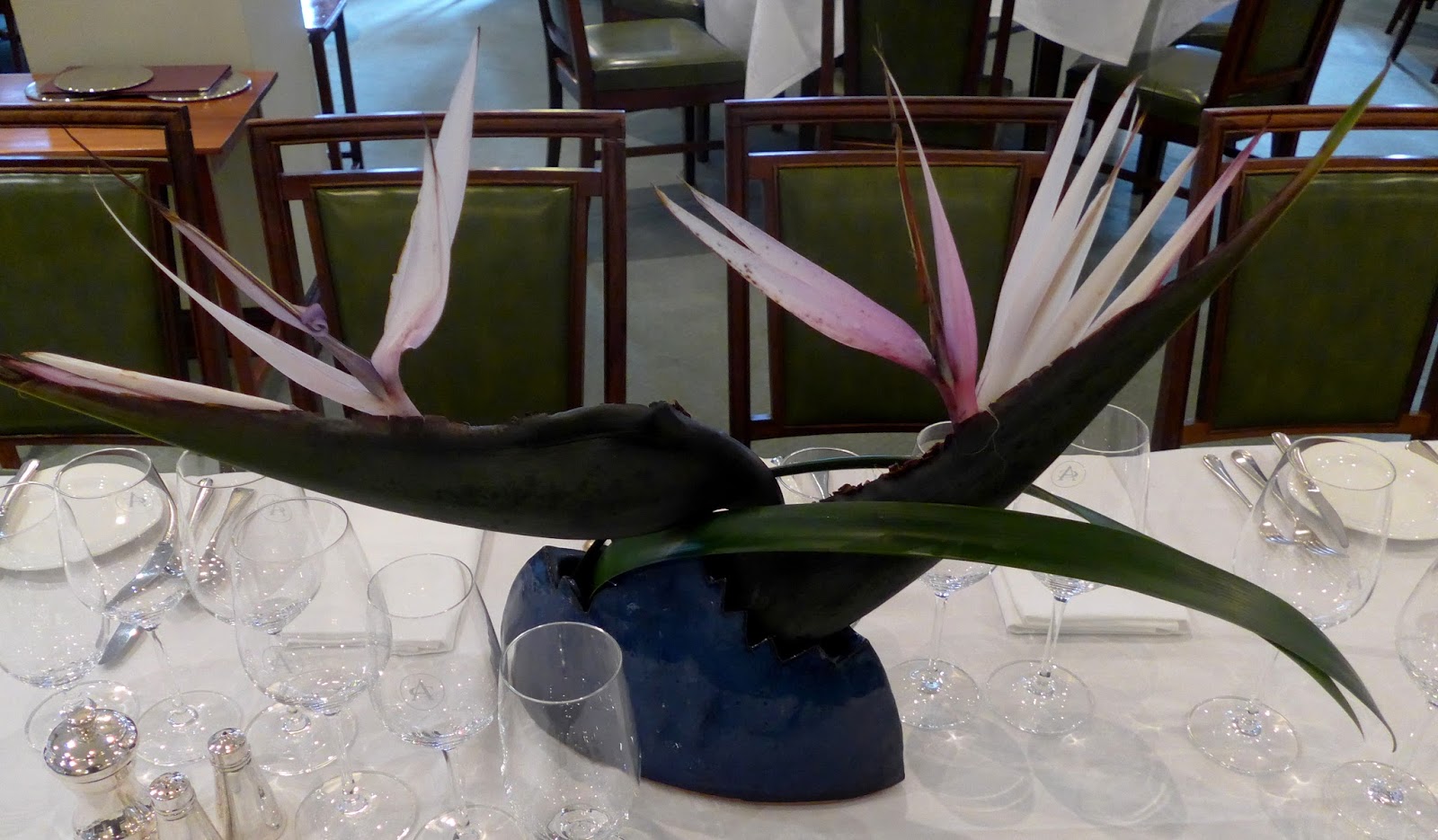
The two arrangements, below, were placed on either end of one long table. They were made using one strelitzia nicolai flower,  which was cut in half.


One strrelitzia nicolai leaf, one monstera deliciosa leaf and three cymbidium orchid
stems
Stachyurus stems, cymbidium orchids and alstroemeria leaves in a basket


Aspidistras and cymbidium orchid


Loquat branch with camellias
Calla lilies in glass decanters
Magnolia soulangeana and magnolia grandiflora leaves


I'm sorry, I don't know the name of this succulent.
Camellias and pine

The following three arrangements were placed on one very long table with seating for 23 people. The two 'pond' arrangements were placed on either end with the round one in the centre.


 We had so much positive feed back that it made all our efforts worth while. We are, also very grateful to the staff of the establishment for their ready help.

Bye for now,
Emily


Sunday, 11 September 2016


Hello All,

The exquisite flower in the above photograph is a tree peony and measures 18 cm in diameter. It was given to me by my student Aurelia Dong. She and her partner recently moved into their new home, in the garden of which was growing a shrub they could not identify. It had a bud that grew and grew until it flowered and revealed itself to be a tree peony. They, of course, are quite delighted, as am I to be given such a treasure.

It has been a busy ikebana week. On Monday, we had the Sogetsu meeting and workshop, which was organised and run by Joan Norbury, Eugenia Chudacek and Margaret Wilson. The theme was 'Random Encounters" and the brief read as follows: 'Unconventional material will be provided to create a moment of confrontation with the unexpected. This is discussed by Sofu Teshigahara in Kadensho p. 23, wherein he claims 'All of ikebana is about random encounters which are given meaning'.

The girls went to a great deal of effort to collect all types of man made materials, then put a selection in a plastic bag for each participant. They were all different and we had no idea what we would be getting. We were instructed to bring along a couple of containers and some fresh material to complete our arrangement.

Knowing my tendency to make large arrangements, the girls gave me a small bag with few and small materials to challenge me. Below is my creation in a container, which coincidentally, was given to me by Margaret Wilson. My fresh material was two calla lilies.


In marked contrast, Lucy was given a large bag with a lot of different types of material, from which she chose only two. And to complete her smart arrangement, she used one aspidistra leaf.


I started my previous post with the flyer for the Ikebana International exhibition, which is running currently and will be until the 16th September. The large, collaborative works are to stay for the duration of the exhibition but the individual pieces will be taken down and replaced by new ones. This will happen twice, giving many people the opportunity to exhibit as well as keeping the exhibition fresh.

Lucy and I put up our arrangements on Monday and took them down on Thursday. Below is Lucy's piece, in which she used Haemanthus coccineus leaves and one calla lily.

You will be able to see photographs of the rest of the pieces on our II website, after the conclusion of the exhibition.


In my piece, below, I used variegated aspidistra leaves and a fine wisteria vine, which I spayed red.


To have enough aspidistra leaves of similar size and direction for the above piece, I had to 'sacrifice' a great number of leaves. However, this embarrassment of riches gave me a rare opportunity to 'play' with the leftovers and, below, are just two arrangements I made.

This container is one of two that I made when I went to the Sogetsu kiln in April.
With the aspidistra leaves, I used several calla lilies and two umbrella grass stems.


I leave you with this class arrangement with the theme 'With Branches Only'

Prunus elvins, stachyurus and Viburnum plicatum f. tomentosum
Bye for now,
Emily


Thursday, 1 September 2016

We'd love to see as many of you as possible at the exhibition.


Hello all,

In the wall arrangement, above, I used a branch of my Prunus Elvins, which is ready to burst into flower. The mauve tulips were given to me by my friend Connie and, I think, they complement the branch very well. And below is the same arrangement once the tulips died and were replaced with cymbidium orchids, which, I'm proud to say, I grew myself.


 For this week's class, one of my students requested we make an arrangement using spring branches and another 'To be viewed from all angles'. So we combined the two and below is my example, photographed from three sides. I used white and red Japanese flowering apricot, camellias, calla lilies and diosma.


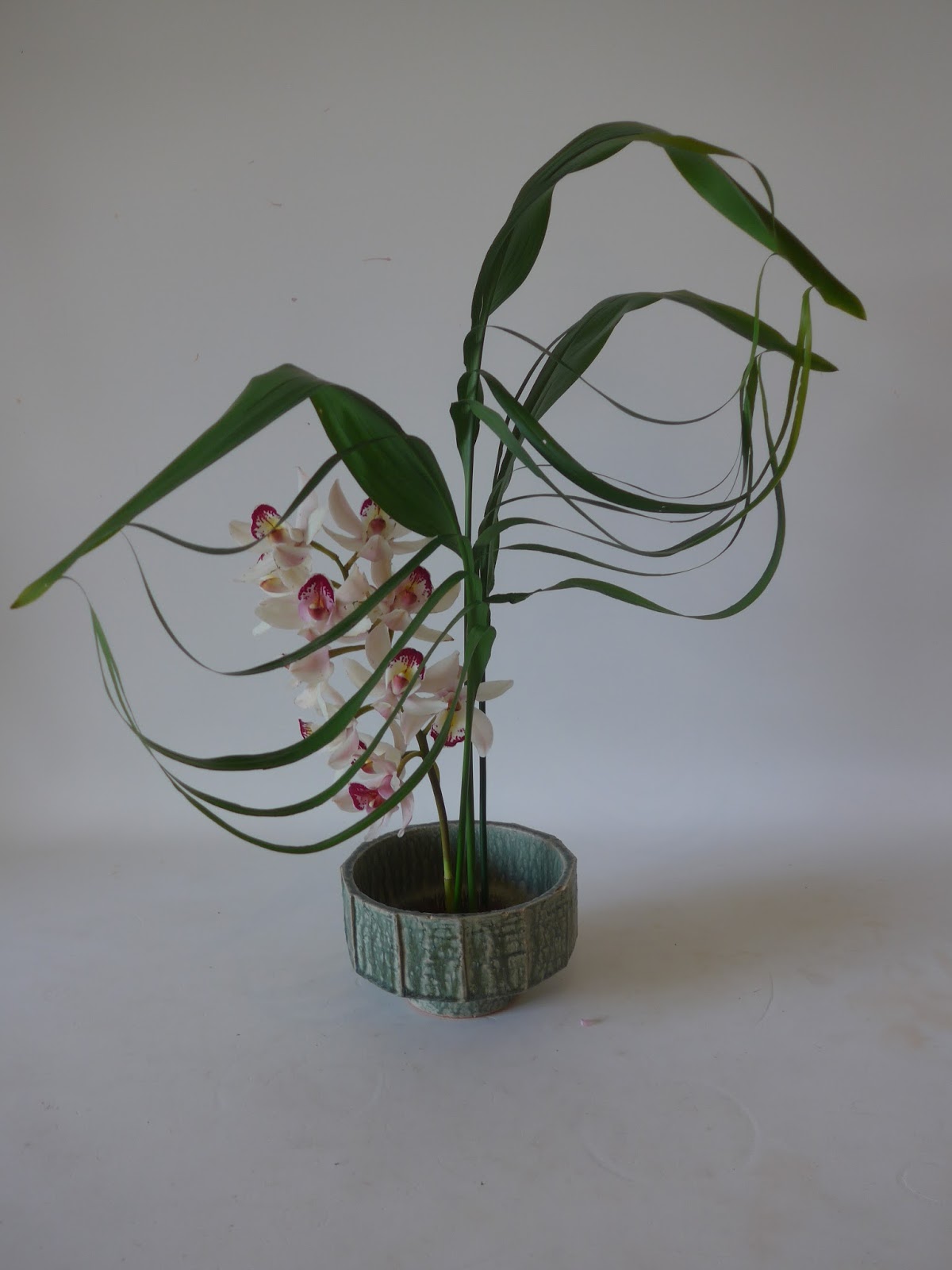
 The stunning orchid in the arrangement, below, came from my Auntie Elizabeth's rather large collection. I had some difficulty arranging it because its natural curve, when the stem is placed in water, makes it turn away from the container. I had to cut the curved stem quite short to achieve the end result.


Arrangement "Repeating similar forms or shapes'. I used cymbidium orchids, weeping
willow and alstroemeria leaves


'With Flowers only'. Calla lilies, clivia and helleborus.


'With leaves only'. One Monstera deliciosa, one strelitzia nicolai
and several calla lily leaves which I folded into this tulip shape. 
Bye for now,
Emily


Friday, 19 August 2016

The weeping willow in our front garden with new leaves. This is my favourite time of
year as it looks as though it's wearing a green veil
Hello all,

I'm sorry it's taken so long between posts but I've had an injury, for which I needed surgery and have not been able to keep up with all of my responsibilities. I'm very grateful for my family, in particular Lucy and Sam, for taking very good care of me. Lucy even took my class last week whilst I was in hospital.


About a month ago I dug up from a construction site some bulbous plants, that, I thought, were jonquils. I planted them in my garden and was delighted to see they turned out to be Summer Snowflakes.


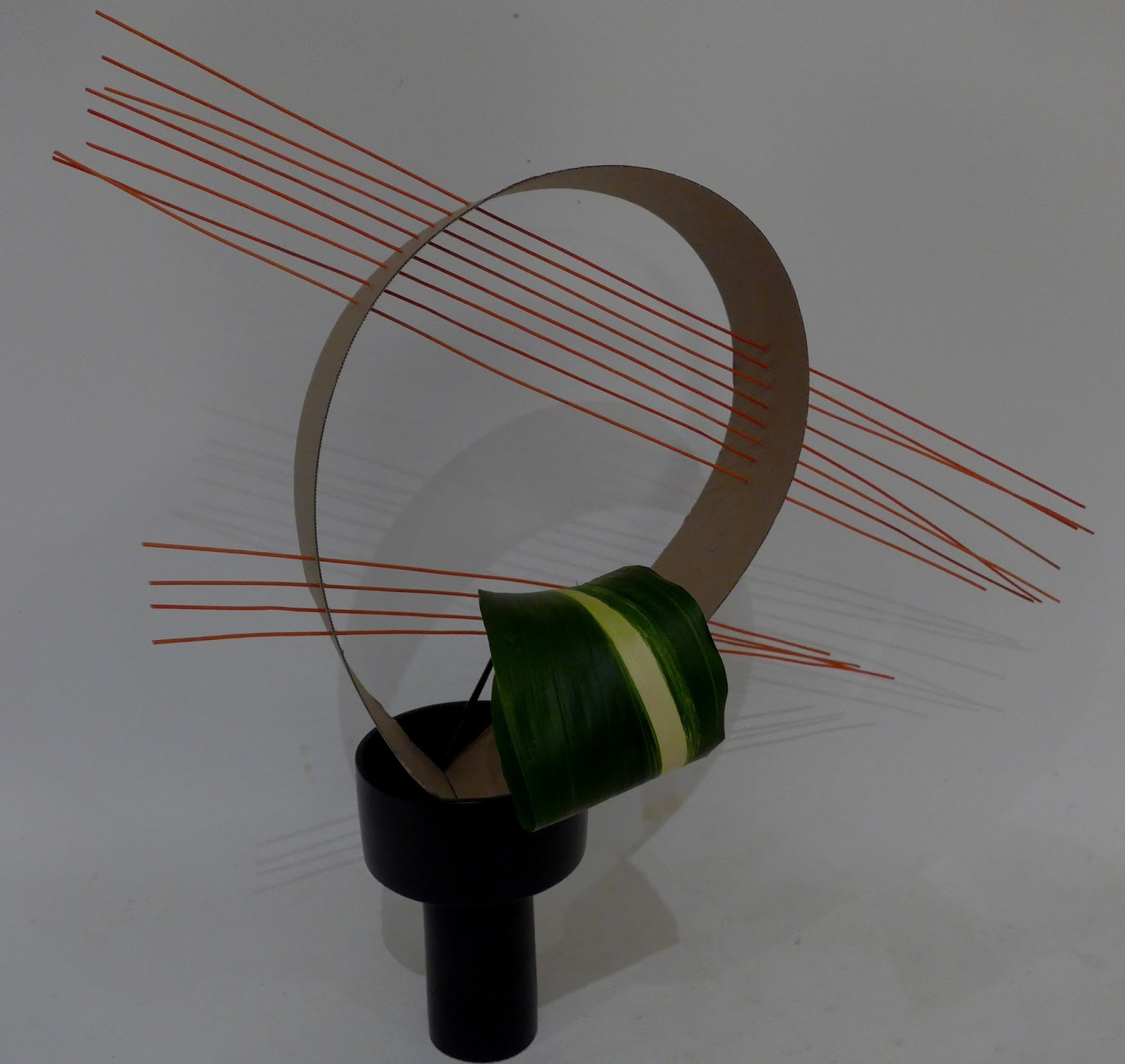
The arrangement below is for the theme 'Composition of Surfaces made by the massing of lines". I used fine dried bamboo to create two surfaces, one curved and one straight and added the curved calla lilies between them. I have included a photo of the side view that shows the space between the two surfaces.


At Lucy's suggestion, we recently had an interesting workshop, where each student arrived with materials and container to make a freestyle arrangement of their choice. I then supplied each of them a piece of material they had not seen before but they were required to include in their arrangement, thus increasing the degree of difficulty.

Lucy Papas used Strelitzia nicolai leaf and oranges. The surprise
material here is the dried root.

Robyn Unglik. The surprise material was a stem of mahonia.
Robyn used a small part of it with celocias and wisteria vine in
yet another container made by her clever husband.

Vicky Kalokathis used Siberian dogwood and green goddess
lilies. The surprise material was a large fern frond, from which
Vicky used a small piece
Bredenia Raquel used dried branches with russet coloured red
hot pokers. The surprise material was a white, knitted fabric in the
shape of a stocking

This was my piece, using garrya eliptica and cymbidium orchids. The surprise material,
supplied by Lucy, was the thick, orange rope.
Bye for now,
Emily
Enjoyed this post? Never miss out on future posts by following us