Friday, 22 January 2016


Hello everyone,
And a very happy 2016 to all

I delayed publishing this post because I had hoped to be announcing the arrival of our granddaughter, who was due last week but who is stubbornly refusing to leave the comfort of the womb. So I decided to go ahead with this post and leave the announcement until the next one.

Most of the ikebana I do, outside of preparations for class, is opportunistic. That is, I work with material that I find at the time.

The next arrangement I made with this lush young pine I found growing by the side of the road on a recent trip to the country. It is quite big and heavy and this container was ideal, firstly because it is big enough and, secondly, because I already had some serious mechanics in it for a previous arrangement. 


You may remember this from my previous
post


This large vine arrangement was another opportunity, which could not be missed. Our new next door neighbour was cutting back the much overgrown wisteria from our common fence. By the time I became aware of it, he had already cut the pieces indiscriminately but I managed to get quite a few good ones that I joined together to create my wall arrangement. With it I have some dietes leaves and hydrangeas.


With this extreme weather we've been experiencing I managed to keep my hydrangeas from burning by covering them with old sheets and watering the whole plant, sheets and all, several times a day. Fortunately, we have large rain water tanks that allow us to do that.

These two palm leaves were also a lucky find and I made this arrangement, fitting the theme 'Only one kind of material'. I gave myself the challenge to use all of the two Palm leaves, so I created another three arrangements from the left overs.


With gloriosa lilies


Again with Gloriosas


With hydrangea

You may have noticed that all the flowers in this post are either hydrangeas or gloriosa lilies. I've already explained the reason for the former and for the latter, it is because they are tropical flowers and less affected by the heat. In contrast, my roses are cooked to a crisp. But then, there are always my trusted agapanthus.


We have several large Elm trees on either side of our back yard, which, unfortunately are infested by Elm Leaf Beetle. We treat the trees periodically but it seems the pests have weakened one of the trees to the point that some large limbs have broken. We called in David, our lawn mower man to cut and take away the branches. He, very kindly, cut some stems with his chain saw for me for ikebana. They have beautiful, almost iridescent lichen growing on them and, when I have some time I want to play with them. This next little piece, however, was just crying to be used. I put it in this container I made many years ago but which I use infrequently because of the narrow neck.


I leave you with another arrangement with 'Only one kind of material', this time with agave in another self made container.


Bye for now,
Emily


Friday, 25 December 2015


Hello all,

Finding time to write this post has been difficult at this crazy time of year but I wanted the opportunity to wish you  all a very happy and safe festive season, in whichever way you're celebrating it.

As for us, our plans were right on track to have nearly fifty people for a buffet lunch featuring a lamb on the spit. However, the total fire ban, which was announced for tomorrow has ruined our plans and we are scrambling around for a plan 'b'. I'm sure we will manage and that no one will go home hungry but this extreme heat will make things much harder. So, I'm writing this post after midnight hoping to publish before Christmas Day.


Some time ago I was about to throw out this unremarkable object, a rack from an old dishwasher, when Lucy came up with an idea for its use. She suggested we each take turns making an arrangement using the rack as unconventional material. So I put it to the girls, some of whom managed to make one.

 
Lucy Papas


Margaret Wilson


Janette Fonda


Helen Novic
Bredenia Raquel

Vicky Kalokathis

Emily Karanikolopoulos

At our last Sogetsu workshop, which was conducted by Lara Telford, we were to do an arrangement along the style of one of the Iemotos. I chose Sofu Teshigahara because I particularly like the way he used 'mass' in  his arrangements.


I leave you with this arrangement that looks like it's about to take flight. The flowers of this strelitzia reginae grow as tall as two metres and the heads are so large and heavy that they bend down creating these interesting shapes.


I wish every one of you a very happy New Year.
Emily

Tuesday, 1 December 2015

It would not be spring without my Japanese iris.Their perfection must be enjoyed in
 an ikebana arrangement.
I made this container many years ago. The surface at the bottom is made from
crushed green and blue glass


Hello all,

My apologies for my lengthy absence from this blog and, I confess, the reason I'm writing now is because we have a power failure and I can't do the things I had planned for tonight. I will spare you the details of my hectic life with one notable exception - the Baptism of my little granddaughter, Althea, which took place yesterday.

I was heavily involved in the preparations of the baptism with the cake, the flowers and making dresses for the girls as well as my own outfit.
Our princess with her very proud papou!
And here she is modeling


The Christening cake
This large arrangement was placed at the entry of the restaurant


So now, back to ikebana.

Two lessons ago I set the theme 'glass containers' and below are three examples I made. It was just coincidence that I have used two containers in each one.

Loquat branches and Siberian iris in large containers


The vases have holes through which the stems of the
osage oranges pass


Squiggly grass and Siberian iris

For the last two classes with Elizabeth, we were to do an arrangement 'with leaves and roses' and an arrangement 'in an ordinary household item', respectively. Below are my two pieces.
Dorianthus palmeri leaf, fish bone fern, spuria iris leaf
and rose (Mr Lincoln)

 
This dogwood was given to me as a seedling by my friend Hazel McNaught, whom we lost
many years ago. Her dogwood is now a small tree and much loved.

And for my last lesson of the year we all did 'a celebratory arrangement'. We had quite a lot of fun with this and I'm including most of the arrangements made.
Helen Novic
Margaret Wilson
Robyn Unglik
Nicole McDonald
Soo Mei Leong (Book 1)
Vicky Kalokathis

Bredenia Raquel

The next three arrangements are by Lucy Papas, who is quite prolific.


And the next five arrangements are by me. OK, so I went a little overboard!


I would like to leave you with a piece I call 'the embarrassment of riches', in which I used three of my giant strelitzia nicolai flowers and monstera leaves.


Bye for now.
Emily


Sunday, 1 November 2015


I have two herbaceous peonies, that have been the source of great frustration for many years by their stubborn refusal to flower. I have tried everything, including freezing water into big blocks of ice and placing them on the ground above the plants to simulate frost. But to no avail. This year, to my great delight, each plant has produced four buds, thus earning a place in my blog. I'm guessing that the unusually cold winter may be the reason for them flowering but I can't be sure. I did not want to make an ikebana arrangement with them, firstly, because the stems are very short and, secondly, because the flowers make such a statement that they don't need anything else.

At the October meeting of Ikebana International Mr Barrie Gallacher, a volunteer from the Australian Native Association spoke to us about Australian natives and more particularly about the Royal Botanic Gardens in Cranbourne. I had not visited those gardens before and was inspired to do so after Mr Gallacher' talk. I highly recommend to anyone, who is able to visit the gardens to do so. I learnt a great deal, most especially about how ignorant I have been about Australian natives. One of the things I learnt is that the plant I have been calling gyamea lily is actually doryanthes palmeri, also knows as giant spear lily. It's the slightly different, doryanthes excelsa that is known as Gyamea lily.

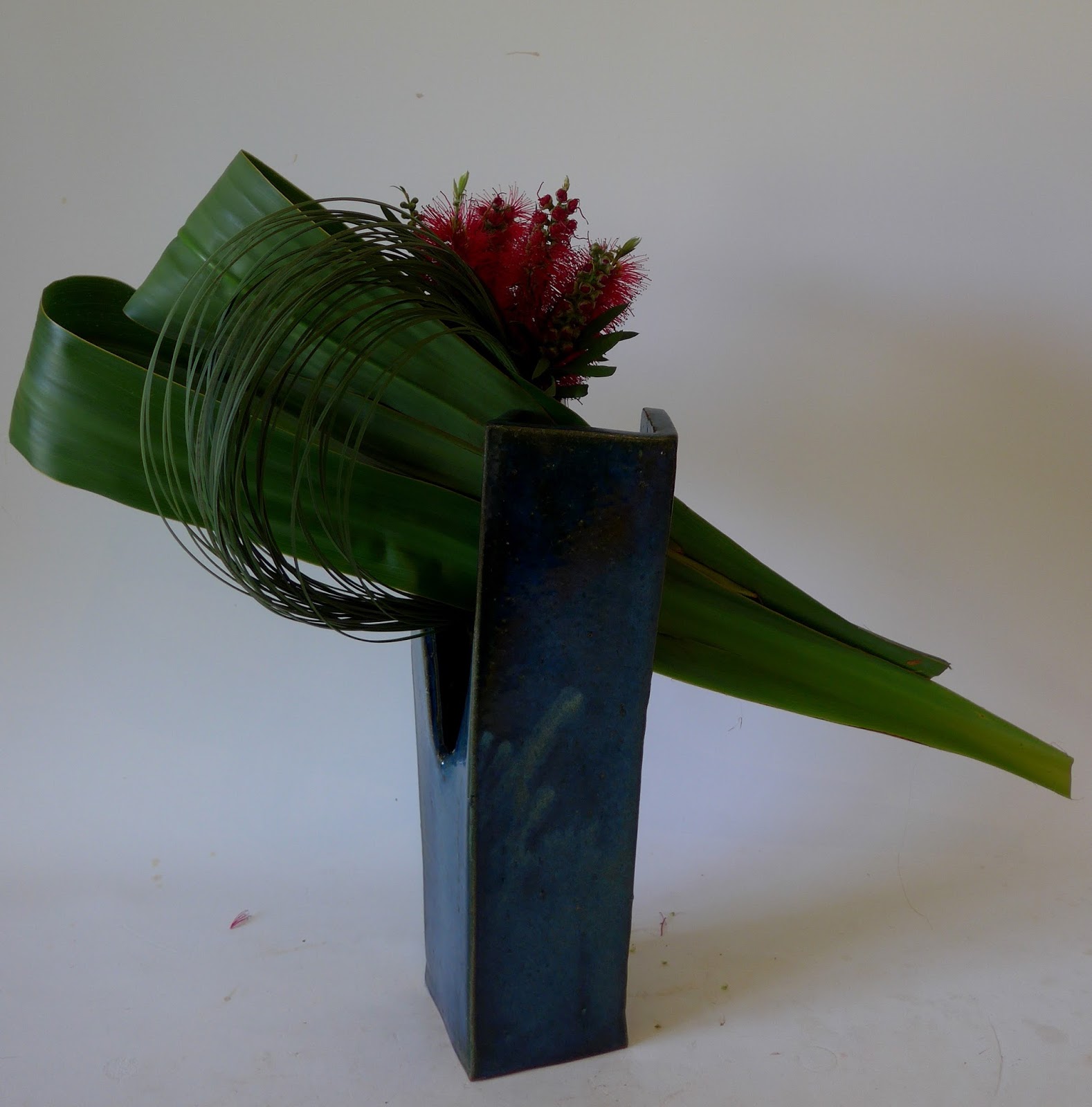
I had been asked to do a demonstration for the group using Australian natives. I have to confess that I don't have many natives in my garden (a situation I'm already rectifying). So the task was made more challenging, firstly, in finding appropriate materials and, secondly, because I prefer modern styles of ikebana and Australian natives tend to lend themselves more to naturalistic work. But I felt I should rise to the challenge. I used Doryanthes palmeri leaves, red calistemon flowers and bought some spear grass. The resulting arrangement is below.


The theme for one of our recent lessons was 'In a suiban without kenzan', for which I prepared the two examples below.

Hawthorn and calistemon


Oak and rhododendron

On the same day we also had students doing and arrangement 'Emphasizing curved lines' and my example for that follows.

Wisteria and Cymbidium orchids

Two weeks later, our theme was 'Seasonal Material', in this case 'Spring' and I instructed the class to make it a 'maze-zashi'(a mixture of a variety of materials and colours). Again my examples are below.


By coincidence, my teacher, Elizabeth had set the same theme for her class and I tried doing something a little different this time.


And then, there's some work I did just for fun:


This wall arrangement of Strelitzia nocolai flower and leaf stands
almost 2 metres in hieght
Until next time,
Emily
Enjoyed this post? Never miss out on future posts by following us